Share this @internewscast.com
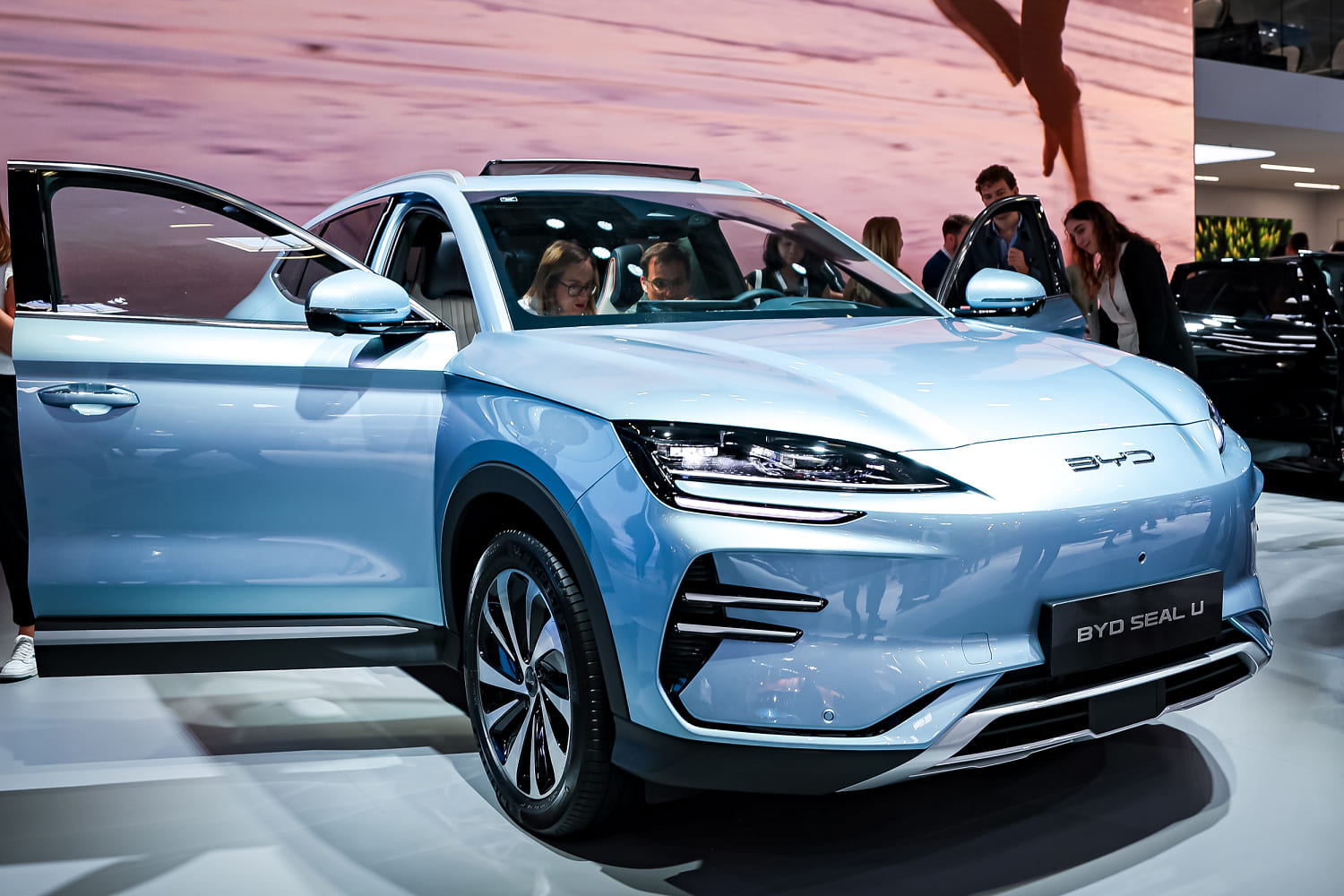
Elon Musk dismissed BYD in 2011 by laughing at their products during a Bloomberg interview.
“Have you seen their car?” Musk quipped. “I don’t think it’s particularly attractive, the technology is not very strong. And BYD as a company has pretty severe problems in their home turf in China. I think their focus is, and rightly should be, on making sure they don’t die in China.”
BYD did not get wiped out. Instead, it dethroned Tesla in the fourth quarter as the top EV maker, selling more battery-powered vehicles than its U.S. rival.
“Their goal was to be China’s largest auto manufacturer and put China manufacturing on the map,” Taylor Ogan, CEO of Snow Bull Capital, said of BYD’s long-standing ambition.
So how did the Chinese company, which began by making phone batteries, become an electric car giant?
BYD’s history
While BYD is now known as an electric car giant, its tentacles stretch into many areas from batteries to mining and semiconductors, which is a large reason behind its success.
Chemist Wang Chuanfu founded BYD in 1995 in the southern Chinese city of Shenzhen, China’s massive tech hub. It was founded with 20 employees and 2.5 million Chinese yuan of capital, or $351,994 at today’s exchange rate.
In 1996, BYD began manufacturing lithium-ion batteries, the type that are in our modern day smartphones. This coincided with the growth of mobile phones. BYD went onto supply its batteries to Motorola and Nokia in 2000 and 2002, respectively, two of the mobile phone industry’s juggernaughts at the time.
In 2002, BYD listed on the Hong Kong Stock Exchange, riding the wave of its success in lithium-ion batteries.
BYD’s pivot to autos
It wasn’t until 2003 that BYD acquired a small automaker called Xi’an Qinchuan Automobile.
Two years later, it launched its first car called the F3, which was a combustion model. And then in 2008, it launched the F3DM, its first foray into electric vehicles. The F3DM was a plug-in hybrid electric vehicle.
That same year Warren Buffett’s Berkshire Hathaway made what was at the time a $230 million investment in BYD.
This gave a boost to BYD’s electric car ambitions.
BYD continued to push into the EV space and this is where its history as a battery maker came into play. In 2020, the company launched the Blade battery, which many argued helped spark BYD’s growth in EVs.
It is an LFP or lithium iron phosphate battery. At the time, according to Ogan, many battery makers were moving away from LFP batteries due to perceptions that they had poor energy density, i.e. they were too heavy for the amount of energy they were able to provide.
But BYD touted the Blade as a breakthrough that provided good energy density and high levels of safety. It committed to putting this in its Han, a sporty sedan which was released in 2020 and seen as a rival to Tesla’s Model S. BYD then put the Blade in subsequent models it released.
“The energy density at the cell level and the pack level were actually higher than what BYD initially unveiled … Everyone was blown away,” Ogan said.
BYD sold 130,970 pure battery electric vehicles in 2020. Last year, the company sold 1.57 million battery EVs.
What has been behind BYD’s success?
The breakthrough with the Blade underlines why BYD has found success in EVs — strategic investments and the fact that it has more businesses than just cars.
“BYD cut their teeth being a supplier in the high tech space, building up resiliency by supplying batteries to hard to please companies like Apple,” Tu Le of Sino Auto Insights, told CNBC.
“Wang Chuanfu then had the wherewithal to acquire a broken down local Chinese automotive brand and was able to focus on innovating on battery tech, enough so that it can sell to other automakers. If that wasn’t enough they were head down grinding, continually improving the design, engineering and quality of it’s own stable of vehicles. We didn’t know this at the time, but everything it’s done over the last 15-20 years set it up to surpass Tesla in Q4 ’23.”
At the start, BYD did not jump straight into pure EVs. The company still sold hybrid cars, which Alvin Liu, analyst at Canalys, said was key to BYD’s initial success.
“In the early stages of the Chinese EV market, BYD chose to simultaneously launch Battery Electric Vehicles (BEV) and Plug-in Hybrid Electric Vehicles (PHEV). This strategy allowed BYD to win the market when charging infrastructure was not well-established, and users were not very clear about the advantages of EVs,” Liu told CNBC.
“PHEV’s characteristics like high economic efficiency and not having range anxiety played a significant role in helping BYD to win the market.”
Liu said BYD postioned itself in the mid-range market where there were fewer competitors in China which helped propel its growth. BYD has done well on branding, according to Liu, creating differetn sub-brands to tackle different price points in the market. One such example is BYD’s mid-to-high-end EV brand Denza.
Beijing backs EVs
As well as BYD’s own tactics, its rise has been helped by the Chinese government’s huge support of the country’s EV sector. Over the past few years, Beijing has offered subsidies to incentivize buyers of electric cars and offered state support to the industry. These measures began around 2009, at the time BYD was looking to ramp up its EV push.
Rhodium Group estimates that BYD received approximately $4.3 billion in state support between 2015 and 2020.
“BYD is a highly innovative and adaptive company, but its rise has been inextricably linked to Beijing’s protection and support,” Gregor Sebastian, senior analyst at Rhodium, told CNBC. “Without Beijing’s backing, BYD wouldn’t be the global powerhouse it is today.”
“Over time, the company has enjoyed below-market equity and debt financing allowing it to scale up production and R&D activities.”
Global ambitions
After dominating China’s EV market, BYD is now epanding aggressively overseas. It sells cars in a number of countries from the United Arab Emirates to Thailand and the U.K.
In southeast Asia, BYD has a 43% market share in electric vehicles. But BYD’s interntional expansion is not just about selling cars, it involves manufacturing and materials too.
BYD said in December it would open its first European manufacturing plant in Hungary. And the company is also looking to buy lithium mining assets in Brazil. Lithium is a key component of BYD’s batteries.
However, with global expansion comes scrutiny from governments who are concerned about the subisides that Chinese carmakers have received.
In September, the European Commission, the executive arm of the European Union, launched an investigation into subsidies given to electric vehicle makers in China.
Meanwhile the U.S. is trying to boost its own domestic EV sector through the Inflation Reduction Act, with an aim of keeping out Chinese competitors.
“Initiatives like the IRA and the EU anti-subsidy probe aim to impede China’s progress in these markets,” Rhodium’s Sebastian said.
“To ensure sustained growth, BYD is proactively addressing these political hurdles, as seen in its recent investment in an EV plant in Hungary, underscoring its commitment to global expansion.”
What next?
The battle between Tesla and BYD — the world’s two biggest EV makers — is set to continue. Sino Auto Insights’ Le said he beleives that BYD still hasn’t “reached max potential.”
“Most automotive companies for the longest time didn’t take them seriously. That’s where part of their journey mirrors Tesla’s because people didn’t take Tesla seriously in the early days either,” Le said.
As for Tesla, the company is facing stiffer competition in 2024 with Chinese competitors launching more models and traditional automakers trying to catch up in the EV race.
Daniel Roeska, senior research analyst at Bernstein Research, told CNBC that there isn’t a big driver of sales volumes in Tesla’s car portfolio in the coming months. BYD on the other hand could see faster growth.
“BYD quite to the contrary is really pushing the pedal to the metal … by accelerating growth in Europe and other overseas markets. And so there is a lot more growth in the BYD story in the next 12 to 24 months for sure,” Roeska said.
Tesla’s Musk has recognized that he shouldn’t have taken BYD lightly. In a comment posted in X in response to a video of his 2011 Bloomberg interview, Musk said: “That was many years ago. Their cars are highly competitive these days.”