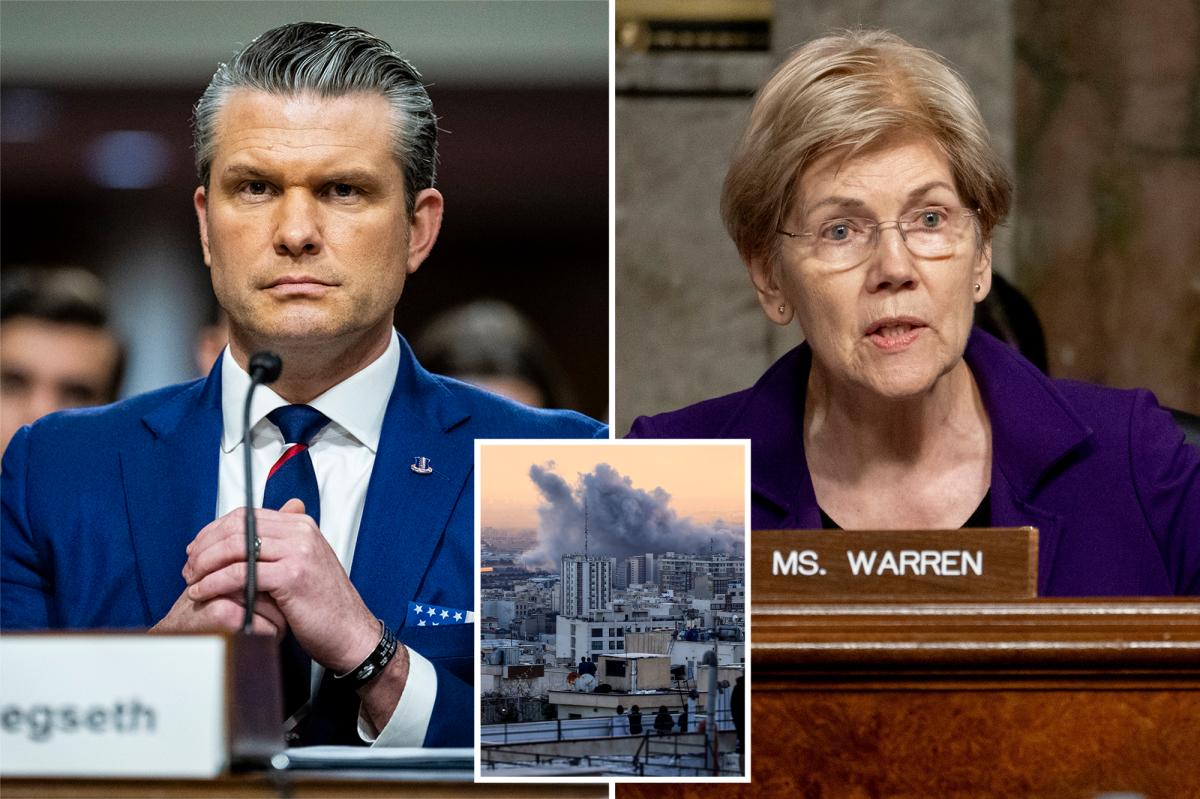


WASHINGTON — In a fiery exchange on Thursday, Secretary of War Pete Hegseth confronted a barrage of questions from Democrats during a tense Senate hearing. The session focused on his controversial military decisions, allegations of insider trading, and the ongoing conflict in Iran.
Joining him was the composed Gen. Dan Caine, chairman of the Joint Chiefs of Staff, as they defended President Trump’s ambitious $1.5 trillion defense budget proposal for the fiscal year 2027. The hearing, held by the Senate Armed Services Committee, quickly became a stage for Democrats to express their growing concerns.
Sen. Jack Reed (D-RI), the committee’s ranking member, was particularly vocal, noting, “Mr. Secretary, it’s been nearly a year since you last testified here. Since then, you and President Trump have led us into a war with Iran without sufficient deliberation.”
Reed continued, “You’ve also sanctioned an attack on Venezuela and initiated an ongoing, unauthorized boat strike campaign. Our military has engaged in operations in Yemen, Somalia, Iraq, Syria, Nigeria, and Ecuador. Domestically, thousands of troops have been deployed to cities like Washington, Los Angeles, Chicago, and Portland.”
He concluded with a warning, “These actions are bound to have far-reaching and lasting repercussions.”
“These actions will have significant and long-term consequences.”
Hegseth remained defiant, at one point sniping that “the biggest adversary we face at this point is the reckless naysayers and defeatist words of congressional Democrats and some Republicans” who “seek to undermine” the war in Iran.
Democrats on the panel prioritize different grievances to whack him with in their limited time.
“In just the space of minutes, it looks like insiders have been making out like bandits, using secret information about the war,” Sen. Elizabeth Warren (D-Mass.) groused.
Warren peppered Hegseth with questions about conspicuously well-timed trades on Polymarket and oil-related purchases, which the war secretary argued wasn’t his lane. She also pressed him about whether his broker was told to purchase defense stocks.
“I’ll give it to you as a big fat negative,” Hegseth shot back.
Of particular concern for many Democrats was Hegseth’s purging of dozens of senior U.S. military officers throughout his tenure as Pentagon honcho.
Reed noted that “60% are black or female” and argued they were “fired for reasons unrelated to performance.” But Hegseth insisted his “only metric is merit” and declined to talk about the nature of why they were asked to step down.
Even one Republican, Sen. Joni Ernst (R-Iowa), raised concerns about the firings, harping on firing former Army Chief of Staff Gen. Randy George and Gen. James “Jim” Mingus as Vice Chief of Staff, in particular. She read through a list of their achievements.
“I was disappointed to see that their retirements were hastened, over what I believed had been set out by you and the administration,” she said.
Hegseth also fielded concerns from Democrats about the Pentagon’s use of artificial intelligence to conduct military operations, given the row between Hegseth and Anthropic.
“AI is not making lethal decisions,” the secretary of war assured senators.
Hegseth was testifying before the panel to make the case for a close to 50% increase in the Pentagon’s budget request, something Trump championed.
The secretary of war underscored how the military industrial base has eroded over time and framed the bigger budget as a generational investment in national security.
“President Trump inherited a defense industrial base that had been hollowed out by years of America’s last policies, resulting in diminished capacity to project strength,” Hegseth said. “We are reversing this systemic decay and putting our defense industrial base back on a war footing.”
The war in Iran was also top of mind for senators, ahead of the supposed Friday deadline for Trump to seek congressional reauthorization in keeping with the War Powers Act of 1973, which requires presidents to get approval after 60 days.
But Hegseth suggested that it won’t be necessary due to the ongoing cease-fire with Iran.
“I would defer to the White House and White House Counsel on that,” Hegseth told Sen. Tim Kaine (D-Va.) when asked if the president would ask Congress for reauthorization.
“However, we are in a ceasefire right now,” he added. “The 60-day clock pauses or stops in a ceasefire…that’s our understanding, just so you know.”