
Share this @internewscast.com

On Wednesday, an ambitious project was unveiled that will pay homage to America’s rich history: a time capsule, scheduled for burial on July 4, is set to mark the 250th anniversary of the nation’s founding. This capsule is not just a nod to the past, but a gift to the future—it will remain sealed until the year 2276.
The capsule itself is a marvel of modern engineering, crafted as a cylindrical pod with three layers. Designed by some of the country’s foremost scientists, it aims to preserve its contents over the next two and a half centuries. It will find its resting place in Philadelphia’s Independence National Historical Park, a site steeped in American history.
“This is truly America’s Time Capsule,” announced Rosie Rios, the chair of America250, the organization spearheading this monumental project alongside various celebratory events for the semiquincentennial. Rios emphasized, “Congress tasked us with creating a lasting tribute to this milestone, and we have collaborated with prominent scientific and preservation experts to ensure it is done with care and consideration.”
When the capsule is eventually opened in 2276, Rios hopes it will offer an “authentic window” into the America of today, revealing our values, accomplishments, and self-perception as a nation at its 250th year. The vision is for future generations to gain a genuine understanding of our society.
What’s inside?
The capsule’s contents already include a coin from an NFL playoff game’s pregame toss, items from the 2026 Rose Parade, and a handheld American flag. However, the full list is still being finalized, with additional items to be revealed in the coming months.
Other contents are still being finalized and will be announced in May or June, according to the organization.
Items representing all 50 states, the District of Columbia and the five major inhabited US territories –Puerto Rico, the US Virgin Islands, Guam, American Samoa and the Northern Mariana Islands — will also be included in the time capsule, with each jurisdiction deciding on their contribution.
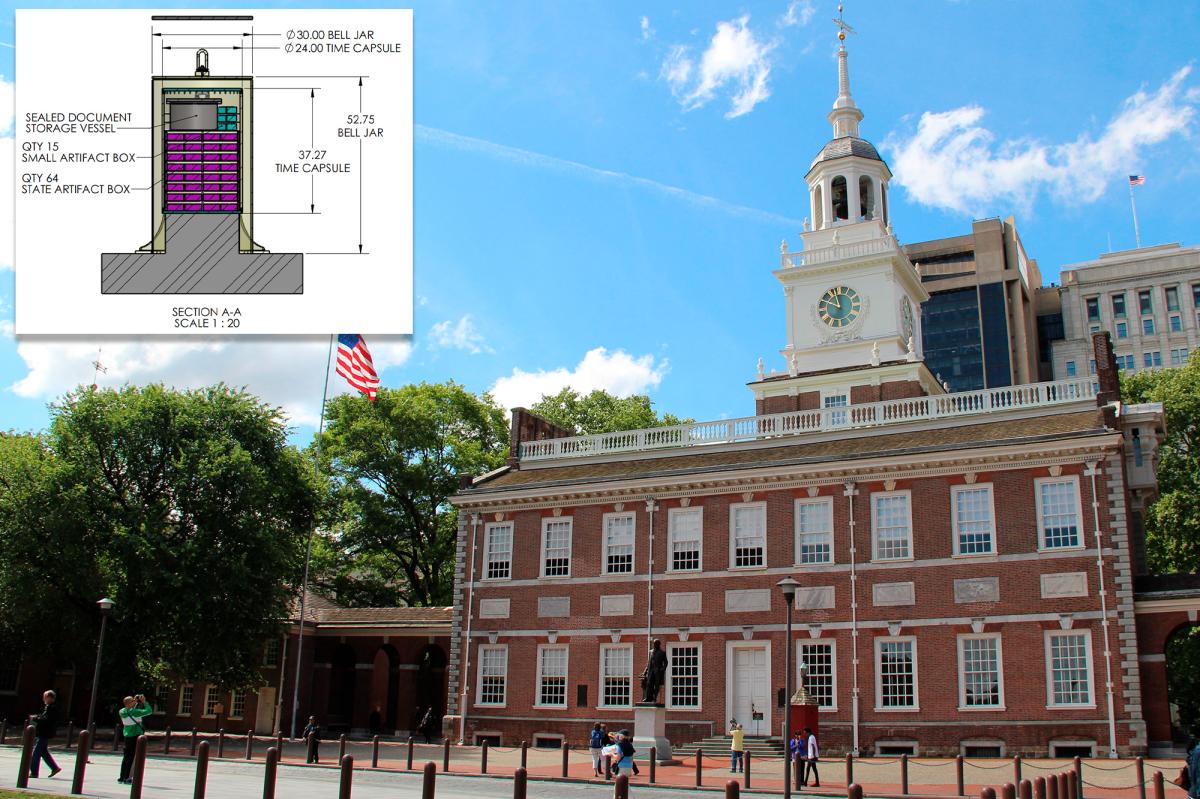
Each state, district and territory will be allotted a box within the 3-foot-by-2-foot vessel suitable for items like poetry, letters or artwork.
Contributions from all three branches of the federal government will also be encased in the vessel.
Organizers explained that only certain kinds of paper, ink and nonreactive material — like stainless steel, glass, or ceramics — will be allowed to ensure the contents survive being underground for 250 years and don’t interact with other material inside the capsule.
‘Water is the enemy’
America250 worked with engineers at the National Institute of Standards and Technology (NIST) in Gaithersburg, Md. to build a precision-milled stainless steel pod capable of withstanding more than two centuries of humid conditions underground.
âOur responsibility is to ensure that what we seal in 2026 remains protected for the people who open it in 2276,â said project manager Tom Medema.
Medema noted that a time capsule assembled for the 1976 bicentennial currently sits on a shelf inside the climate-controlled National Archives and that building one to bury under the earth is a âmuch different task.âÂ
Most time capsules that have been unearthed in recent years have been box-shaped and the âcontents havenât fared very well,â Mederma said.
The US Military Academy at West Point recently discovered a 200-year-old, box-shaped vault that was âlargely filled with silt,â with only a few coins surviving the test of time.
âAnytime you have a corner, thatâs where itâs going to fail,â said NIST engineer Jacob Ricker. âThatâs why we really chose the round design.â
âWater is the enemyâ of time capsules going in the ground, Ricker explained.
America250âs capsule is inside a stainless steel bell jar designed to create an air pocket keeping the contents dry over the long term.
Archival boxes stacked on shelves within the time capsule will hold some of the material for future generations, while the âmost precious itemsâ will be housed in a separate round chamber, according to Ricker.
âBuilding a seal to last decades is one thing, but 250 years is a whole different ballgame,â said NIST mechanical engineer Jay Nanninga. âWe are using the best materials and scientific know-how, so when they open this capsule up in 250 years, the contents will be dry and intact.â
Where will the capsule be buried?
On Independence Day, the time capsule will appropriately be buried on the grounds of Independence Hall in Philadelphia, the site where the Declaration of Independence was signed in 1776.
The capsule will lie adjacent to a new “Join, or Die” snake sculpture, referring to a famous cartoon published in 1754 by Benjamin Franklin that later became a symbol of colonial unity during the Revolutionary War.
Organizers initially investigated the possibility of placing the time capsule inside the sculpture itself, but there were concerns it wouldnât remain intact for 250 years.
A replica of the time capsule will go on display at the White House Visitor Center in Washington on April 1, with visitorsable to write letters to future Americans. A select few messages will be placed inside the actual time capsule.
Beginning in late June, the real time capsule will be put on display in Philadelphia until it is buried.