
Share this @internewscast.com

In a dramatic escalation of cancel culture, Russian President Vladimir Putin has implemented a new legislative ban that came into force on March 1. This move targets films perceived to undermine Russia’s “traditional spiritual and moral values,” as reported by The Moscow Times.
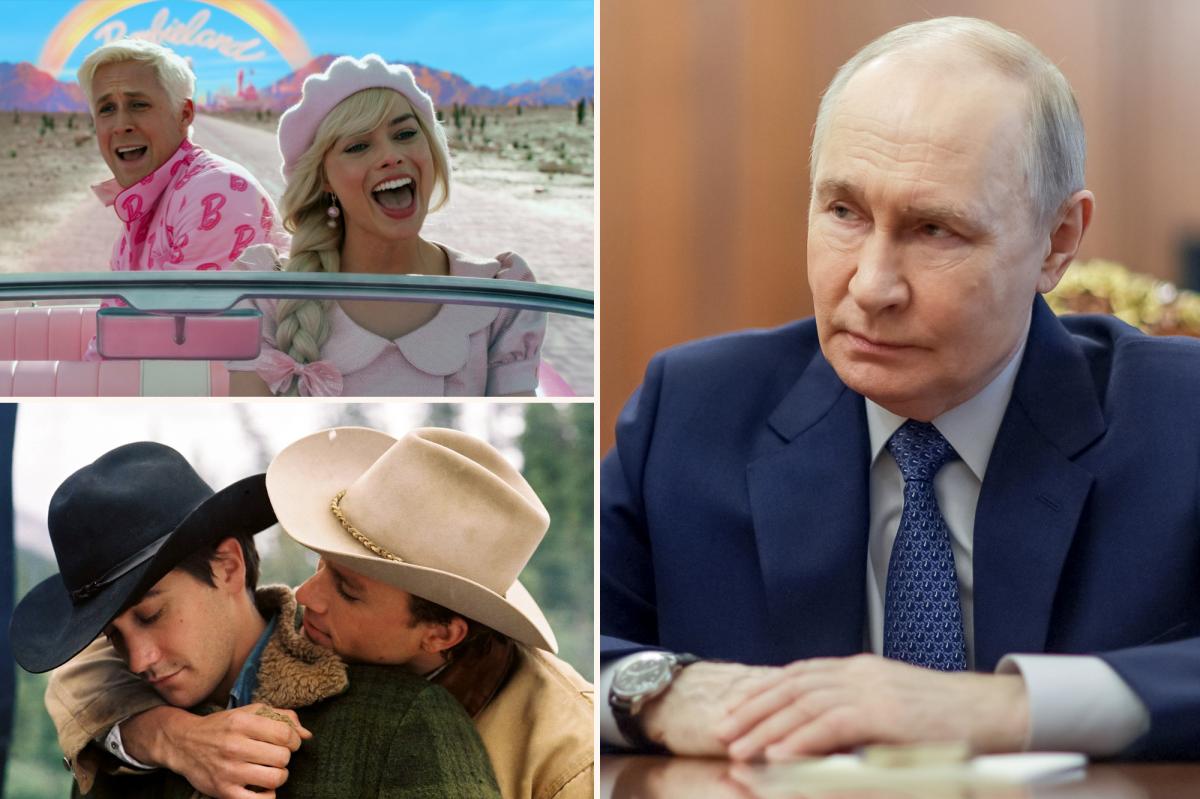
Prior to this law, Russia already had a history of blacklisting several prominent American films. Among the banned titles are “Barbie,” “Oppenheimer,” “Jojo Rabbit,” “The Interview,” and “Borat,” according to Metro, a British news outlet.
The newly enacted legislation grants Russia’s Ministry of Culture extensive authority to suppress films that fail to align with the country’s ideological stance. This means officials can remove such films from theaters, streaming services, and even social media platforms.
The Kremlin has declared films unworthy of Russian screens if they promote LGBTQ+ relationships, endorse a “child-free” lifestyle, or criticize government authorities. This law further intensifies the control the Russian government exercises over cultural content within its borders.
That means Putin’s henchmen can yank such films from cinemas, streaming services, and even social-media platforms.
Films deemed “not worthy” by the Kremlin are those promoting LGBTQ+ relationships, advocating a “child-free” lifestyle, or criticizing government authorities.
And Putin’s wrath can go beyond just canceling films.
Theater owners who dare to screen something officials deem unworthy of Russia’s highest ethics could face hefty fines and other penalties.
Once the state watchdog Roskomnadzor, or Russia’s Federal Service for Supervision of Communications, Information Technology and Mass Media, flags a film — theaters and streaming platforms have 24 hours to pull it or face fines that get progressively worse.
Non-compliance means fines which could reach $200 for individuals, $20,000 for officials, and $10,400 for legal entities. If violations are repeated, the fines get steeper, with individuals facing up to $3,150, officials up to $8,400, and legal entities up to $52,500, according to the new legislation.
Roskomnadzor will handle enforcement if the content is not removed. Cases will be adjudicated by district courts.
The move is part of a broader tightening of state control of culture and media in Russia since Moscow launched its full-scale invasion of Ukraine in 2022.
That same year, Russia passed legislation banning LGBTQ+ “propaganda” both on screen and in public life. “Brokeback Mountain” was banned shortly afterwards.
“LGBT today is an element of hybrid warfare and in this hybrid warfare we must protect our values, our society and our children,” said Alexander Khinshtein, a senior legislator.
State-controlled Gazprom Media Holding has even claimed it spent “several hundred million rubles” developing an automated system to scan video content for anything that might violate the Kremlin’s definition of “traditional values.”
The new ban will significantly expand the list of films which can be barred, reported the Memorial Human Rights Defence Center.
Films portraying a Russian or a person of Russian descent as anything other than the bearer of the highest spirituality and impeccable morality or as an antagonist, a criminal or even a person with bad habits face censorship, according to a 2022 presidential decree.
When TV shows aren’t banned outright, the English-to-Russian dubbing gets rewritten to fit the official narrative, said a New York Times report.
In the CBS comedy series “Ghosts,” for example, references to the marriage between two gay characters were translated as a “friendship alliance.” The episode about their marriage ceremony was cut entirely, according to the report.
Of course, brutal censorship isn’t exactly new in Russia.
“Crime and Punishment” author Fyodor Dostoevsky was arrested in 1849 for participating in a “radical” intellectual group, and after a mock execution, thrown into a brutal Siberian prison camp for four years.
For filmmakers today, the message from Moscow is crystal clear: the script may belong to the artists, but the final cut belongs to the state.
with Post wires