
Share this @internewscast.com

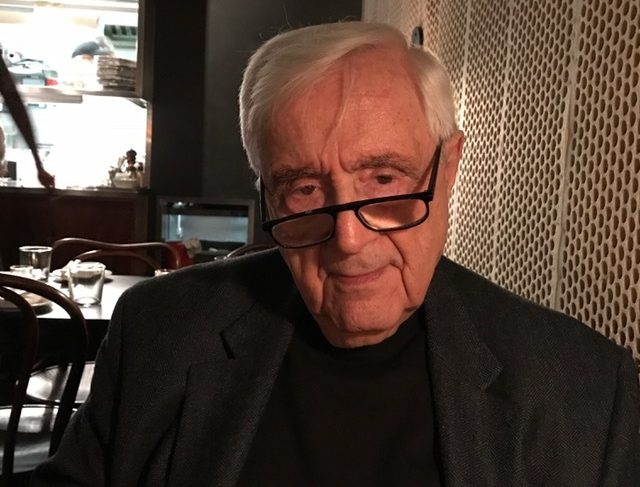
This summer marked the final chapter for Morty Matz, a man who narrowly missed celebrating his 101st birthday. A former editor at the Daily News turned public relations virtuoso, Matz remained sharp-witted until his last days. As the year closes, three of Matz’s close friends share their memories of him.
Reflections by Sam Roberts
When I first ventured into journalism, Morty Matz imparted a crucial lesson: never judge a book by its cover, especially when it comes to professions. Initially introduced to me as a public relations expert, the typical stereotype suggested he might be the sort who masks a scandal for a client or strategically targets a patron’s adversary. However, Morty defied these clichés entirely.
He elevated the standing of public relations with his integrity. From the outset, he gained my confidence with his honesty, reliability, and good humor. Morty was always approachable, sincere, and fiercely loyal—sometimes to a fault. His resourcefulness and commitment to his personal ethics often took precedence over the images he crafted for his clients.
While he occasionally asked us to stretch our imagination slightly—no, there weren’t a million visitors at Coney Island every weekend, and the hot dog eating contest wasn’t as ancient as claimed—Morty never exaggerated a story beyond belief.
As he once candidly shared with the Daily News in 2024, “I cherished my behind-the-scenes role as the go-to guy who knew where the secrets were buried (some of my clients buried them), and I leveraged that insight as a tool to enhance their public image. I persuaded reporters to either give my clients the benefit of the doubt or, when necessary, ignore them entirely.”
The turnout at his memorial service in October — from his pals at the Cigar Inn to the salmon slicers at Sable’s — was a tribute to the diversity of lives he touched and the people whose tangles he would mysteriously unravel.
“He was trusted in a world where there’s very little trust,” author and screenwriter Nick Pileggi said. “The good guys trusted him, but, amazingly, so did the bad.”
Morty was, in a word, a mensch.
George Shea
I began working for Morty in 1988, and one of the first media events I attended was the Nathan’s Famous Fourth of July Hot Dog Eating Contest. Morty and his partner Max had created the contest in 1972, and while it was a small event at the time, the participants were fiercely competitive.
During the contest, Morty believed he saw one of the eaters cheat, and instructed me to ask a nearby policeman to arrest the competitor. I refused, saying that this would ruin the contest. He explained that the contest was run solely for publicity and that an “arrest” would not ruin the event. On the contrary, it would create a much larger story, leading to more exposure. In this case, more is better.
Morty lived and breathed news media and he always knew how to identify, create and place a story. He carried a tote bag filled with newspapers and magazines and read constantly. He knew every reporter, editor and television producer in New York City and used these connections to advance the efforts of his clients, which ranged from unions and elected officials to real estate developers and restaurants. Morty was a master pitchman, and when on the phone with a reporter he often lowered his voice to a near whisper to indicate the special nature of information he was providing. It was irresistible.
To Morty, it was a sin to be boring and it was a sin to bury the lead. If you gave him a news release that failed to grab the reader’s attention right away he would hand it back and say, “Max would cry.” Max, who had died, was an old-school press agent who knew how to hype things up. This was the skill that Morty prized — find the angle and make it interesting.
His endless consumption of news about business, politics, food, lifestyle, real estate, arts, culture, health and finance positioned him to understand almost any issue and to find an angle that would produce a story benefitting his client. He was effectively New York City’s assignment editor-at-large, working across all media, placing stories day-in and day-out and leading the direction of the news.
Morty loved New York City and he loved food. From his arrival in the office (with a cup of black coffee and a bialy) through lunch (“you can always tell if a restaurant is good by their white clam sauce”) to afternoon coffee (“we should have gotten the linzer torte”) — and through all the many client issues that arose between these daily milestones — he delighted in the glory of life and the entertainment that came from engaging in what was to him a fantastic game.
After decades as one of the city’s most celebrated public relations agents, trusted by leading elected officials and top business executives, he was still thrilled when he placed a good story, or created a publicity stunt that drew throngs of reporters.
Morty was an enormously joyful and loving person. His clients relied on his loyalty, experience and deep connections throughout the city, but it was his love of the game that set him apart from everyone else in his field.
Bob Brody
What was it about Morty Matz? What made Morty Morty? All I know is what I know.
So here’s what I know. I worked for Morty from 1991 to 1994, so I know a little. When he hired me, he explained why. He said, “You’re a live wire.” I felt honored. He might as well have given me the Nobel Peace Prize.
My first week there, Morty composed a memo about all our clients. It was his only memo in my entire time there. Morty never believed in memos. Or anything of the sort. He was the opposite of corporate.
One time, Morty convened a staff meeting. His opening line? “Which clients are we failing today?” It made my day. Such a light touch in managing an organization is priceless. Morty was a master of mischief.
Another time, a reporter I trusted sandbagged a client of ours in Vanity Fair. I felt like a fool for getting played. Morty could have come down on me. But no. He shrugged it off. He cited the little good that came of it.
You want to talk endearing? Every once in a while Morty would rest the side of his head against your shoulder, as if seeking comfort. I got a kick out of that. No boss of mine at any of my jobs ever rested his head against my shoulder.
Morty had other winning habits, too. Sometimes, if you got into a disagreement with him, he would just say, “OK.” That was it. OK. Case closed. He knew how to circumvent confrontation.
Here’s an example. I was calling in sick a lot even though I was usually in good health. Morty wanted to address the issue of my absenteeism. So he brought up the topic with our colleague George Shea with me standing there. Morty asked George, “How many days would you say an employee should be entitled to miss in a year? Maybe 10?” George said “yeah, that sounded about right.” End of discussion. I got the message.
Let me cite one more habit here. He would often call out your full name, cheerfully, on encountering you, whether in person or by phone. “Bob Brody!” he would exclaim. You felt as if he’d just dubbed you a knight.
He had a genius for surprises. A year into my tenure with him, I asked for a raise. He took almost two months to answer, but gave me more than I requested.
I left Matz Associates long ago, but for the next 31 years I never lost touch with Morty. My former boss became my friend. Morty complimented me on my writing. He liked my posts on Facebook. He adored the photos of our grandchildren. No other person 100 years old ever liked my posts on Facebook.
Others knew him better than I. But I knew all I needed to know. He showed me the ropes in PR. What he taught me in those 2½ years I still apply today.
I learned that action indeed spoke louder than even the loudest words. I also learned that every once in a while, in the thick of some friction, you should just say OK.
He also demonstrated a talent for friendship that I still aspire to emulate. We came to love each other, Morty and I, and said so in our emails to each other.
I never stopped thanking him for everything he did for me, but I could never thank him enough to satisfy myself.
Morty was a sweetheart, and then some. He was one of a kind. And, for me, larger than life. His legacy, in my life and no doubt many others, will never be matched.
Roberts is a former Daily News reporter and editor, who now writes for the New York Times. Shea is co-founder of Shea Communications, a public relations firm focused on the real estate industry, and of Major League Eating and hosts the Nathan’s Famous July 4 hot dog eating contest. Brody, a consultant and essayist, is author of the memoir “Playing Catch with Strangers: A Family Guy (Reluctantly) Comes of Age.”