

Share this @internewscast.com
The cost for Americans to renounce their U.S. citizenship has been significantly reduced by the State Department, with fees dropping by approximately 80%. The new charge, now $450, is a substantial decrease from the previous $2,350, and this change took effect on Friday.
This fee adjustment, originally announced in 2023 but only recently enacted, brings the cost back to the same level it was in 2010 when the government first introduced a fee for renouncing citizenship.
The State Department explained that the fee reduction is a strategic move to lessen the financial burden on individuals pursuing a Certificate of Loss of Nationality. This certificate is issued after a person formally renounces U.S. citizenship in front of a diplomatic or consular officer abroad.

In 2015, the State Department increased the renunciation fee to $2,350 from $450. This hike was partly to offset administrative costs as more Americans opted to renounce citizenship, prompted by new U.S. tax reporting requirements for expatriates, according to The Associated Press.
The number of Americans seeking to renounce their citizenship saw a notable rise in the early 2010s. In 2010, there were 956 applications, which surged to 3,436 by 2014, as reported by the State Department.
Applications to renounce citizenship rose sharply in the early 2010s, climbing from 956 cases in 2010 to 3,436 in 2014, the State Department said.
The department said the new $450 fee remains well below the government’s actual cost of processing renunciation requests. The State Department estimates roughly 4,661 people apply each year for a Certificate of Loss of Nationality.
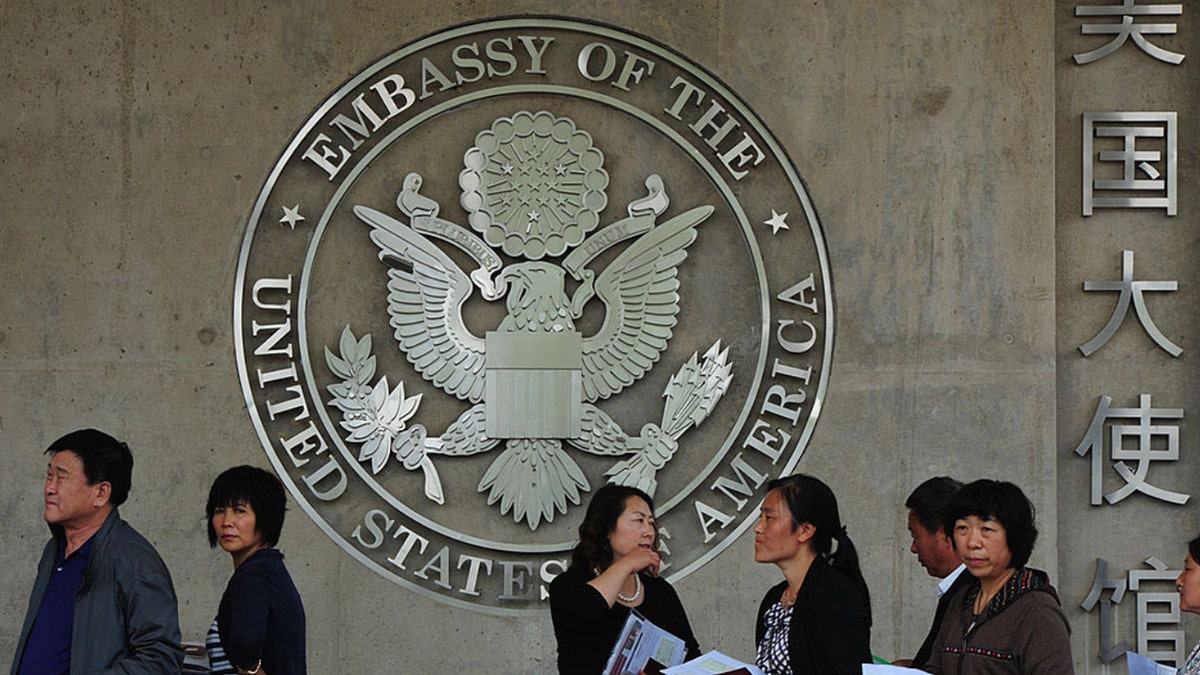
People walk past the seal of the U.S. Embassy in Beijing. Americans must appear at a U.S. embassy or consulate abroad to formally renounce their citizenship. (Mark Ralston/AFP/Getty Images)
Lowering the fee is expected to reduce annual federal collections by about $8.9 million, the State Department said in the rule. The money collected from the fee is deposited into the U.S. Treasury and is not used to fund the State Department’s consular operations.
Renouncing U.S. citizenship involves a multistep process that requires applicants to appear before a U.S. consular officer abroad and confirm in writing and verbally that they understand the consequences before taking a formal oath of renunciation, The Associated Press reported. The State Department must then review and approve the request before issuing a Certificate of Loss of Nationality.
Stricter financial reporting requirements imposed on Americans living overseas — including rules tied to the Foreign Account Tax Compliance Act (FATCA) — have contributed to renunciation requests in recent years, the department said.
The increase in the fee drew criticism from advocacy groups, including the one that represents people who hold U.S. citizenship primarily because they were born in the United States but have lived most of their lives abroad, the AP reported.
A view of the United States Department of State logo in Washington D.C., United States. (Celal Gunes / Anadolu Agency)
The group filed lawsuits challenging the constitutionality of the fee, including one case that argues there should be no cost at all to renounce citizenship, according to the AP.
“The Association of Accidental Americans welcomes this decision, which acknowledges the necessity of making this fundamental right accessible to all,” the organization’s president, Fabien Lehagre, said in a statement.
Lehagre said the decision follows years of legal advocacy by the group.
The association said that since the State Department announced plans in 2023 to lower the fee, at least 8,755 Americans paid the full $2,350 cost to renounce their citizenship, the AP reported.
The State Department has not released updated figures on the total number of Americans who have renounced their citizenship.