
Share this @internewscast.com

WASHINGTON — Excitement is soaring for the upcoming Artemis II mission.
As the United States eagerly anticipates its return journey to the moon with Wednesday’s Artemis II launch, a pivotal moment emerges in the quest to establish the lunar surface as a springboard for future deep space exploration, according to a leading lawmaker.
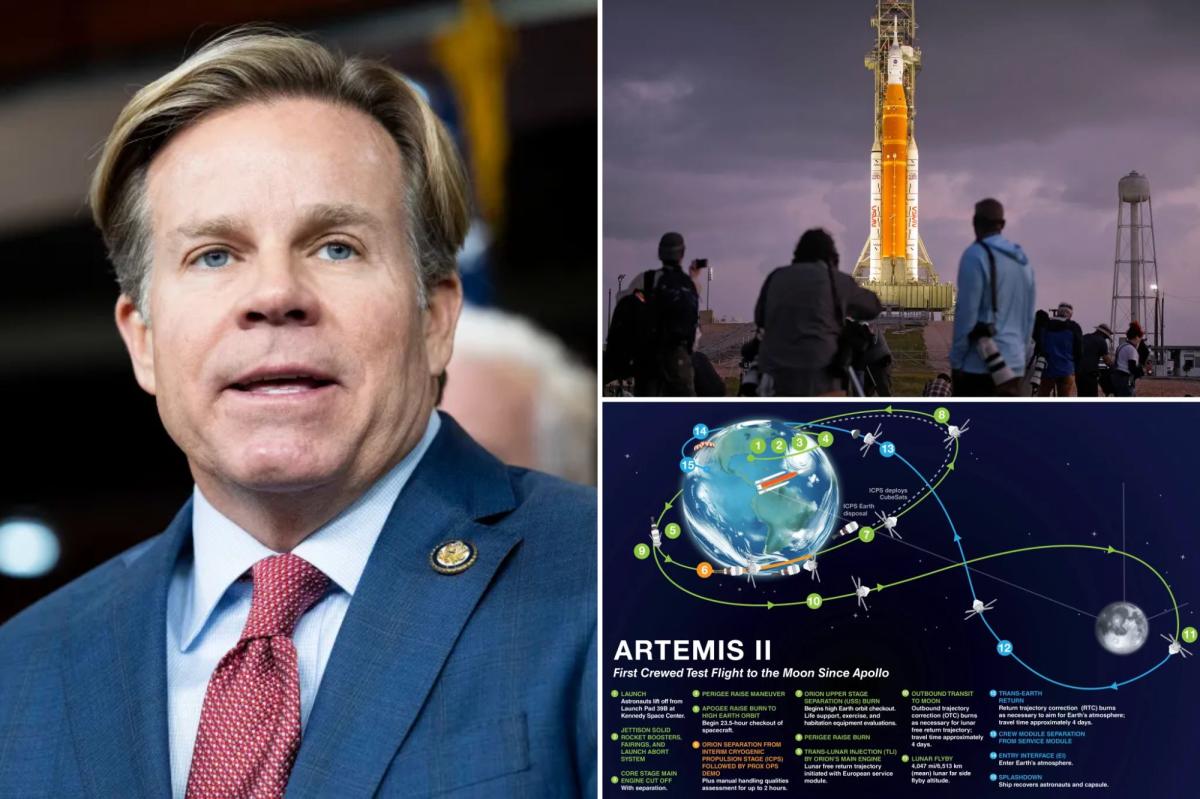
Rep. Mike Haridopolos (R-Fla.), who leads the House Subcommittee on Space and Aeronautics, highlighted that lawmakers envision the moon as a potential refueling hub, essential for propelling humans further into the cosmos than ever before.
“The moon holds various minerals that could help us cut down the costs of generating higher energy sources. Essentially, it could serve as a refueling station for space travel,” Haridopolos commented to The Post.
He elaborated, “Escaping Earth’s atmosphere demands powerful, immense engines. However, once past that barrier, propelling into deeper space becomes significantly easier.”
Artemis II, a mission lasting ten days, aims to transport humans farther into space than ever before, featuring a lunar flyby. This mission will be the first time astronauts have ventured beyond Earth’s low orbit since 1972, marking the last human visit to the moon.
The mission will ensure the Orion spacecraft’s life support systems are up to snuff.
Then, in 2028, NASA is planning to attempt a crewed moon landing in which humans will set foot there for the first time since 1972. That marks a delay from earlier plans of achieving that feat by next year.
Given the delays and technical snarls that have dogged the very expensive Space Launch System super-heavy lift rocket program and the fact that it isn’t reusable like SpaceX’s Starship, some critics have argued that Congress should scrap it.
“It is not an inconsequential cost, so we recognize that,” Haridopolos said. “We’re going to stick with the SLS until a replacement is ready to put us in the position we need to go around the moon and other potential [worlds].”
“We’re always looking for better, cheaper, more efficient engines.”
The Artemis program was set up during the first Trump administration and is intended to establish a base on the moon to lay the foundation for a trip to Mars in the 2030s.
“I think that again, in a couple of years, you’re going to see astronauts back on the moon trying to establish again, not only that base, but to … [investigate] the hydrogen waters that they call helium three,” the congressman said.
“Helium three is a derivative that you can get off the moon, and it helps to create nuclear [fusion] and it’s a very expensive product in which to acquire on Earth,” he added. “There’s so much of this here on the moon.”