
Share this @internewscast.com

In just a few days, an event of historic significance is set to unfold off the coast of San Diego, with the U.S. Navy poised to play a pivotal role. The USS John P. Murtha, based in San Diego, has been tasked with the crucial mission of retrieving NASA’s Artemis II astronauts following the spacecraft’s descent into the Pacific Ocean. This exciting operation is scheduled for later this week, as confirmed by Navy officials on Monday.
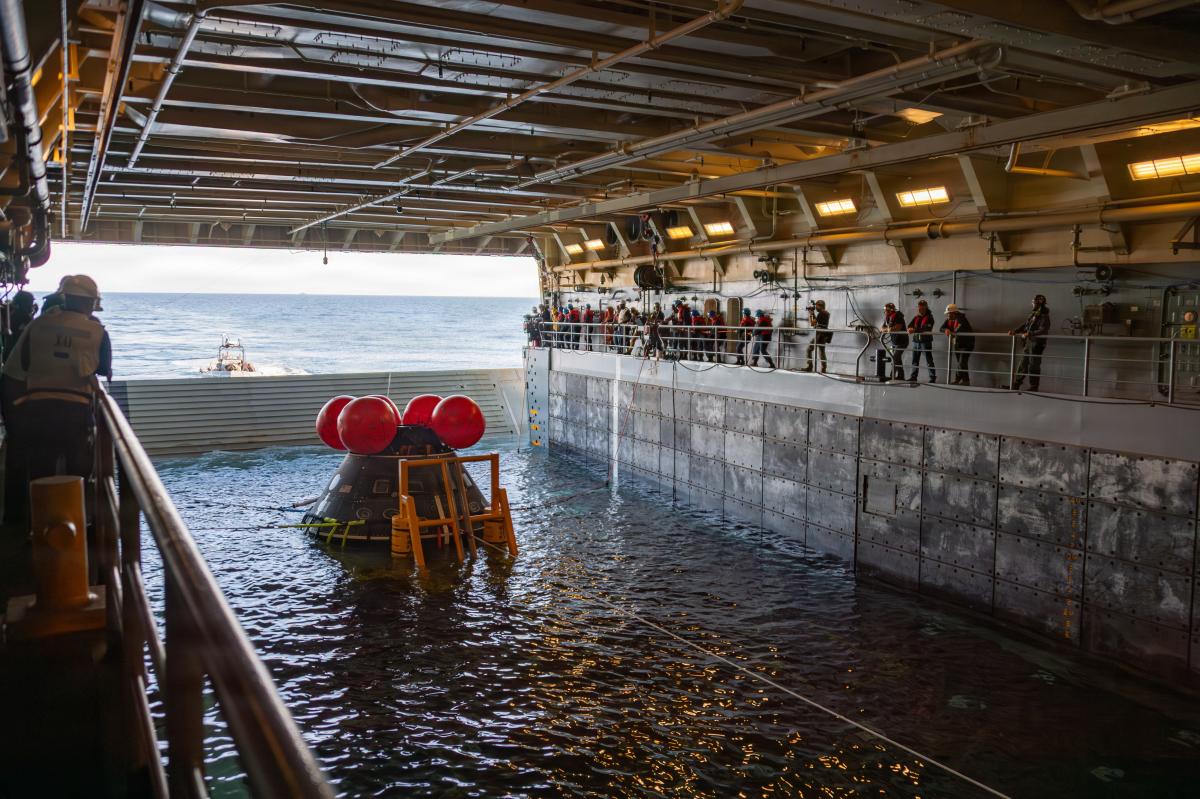
The crew aboard this amphibious transport dock has been rigorously preparing for the major task at hand. Their extensive training aims to ensure a seamless recovery of the crew’s capsule, which is expected to make its splashdown shortly after 5 p.m. on Friday.
According to a statement from the Navy, the USS John P. Murtha boasts “unique advantages” that will facilitate the recovery of the Orion capsule. The operation will also allow the collection of “critical data” crucial for the success of future Artemis missions, ensuring the safety and efficiency of astronaut retrievals.
Capt. Erik Kenny, the commanding officer of the ship, expressed that this mission serves as “a fitting tribute” to John P. Murtha, the Pennsylvania Congressman for whom the ship is named. “We are honored to carry on his legacy by supporting NASA and the Artemis II mission,” Kenny remarked, underscoring the significance of their involvement in this groundbreaking endeavor.
The ship’s commanding officer, Capt. Erik Kenny, called the mission “a fitting tribute” to its namesake, Pennsylvania Congressman John P. Murtha.
“We are honored to carry on his legacy by supporting NASA and the Artemis II mission,” Kenny said.
A Navy helicopter squadron based out of Naval Air Station North Island will track the capsule as it streaks through Earth’s atmosphere, then pick up the four astronauts and deliver them to the ship for evaluation, the Navy said.
Navy divers will also plunge into the ocean to recover the Orion capsule and haul it onto the ship’s deck.
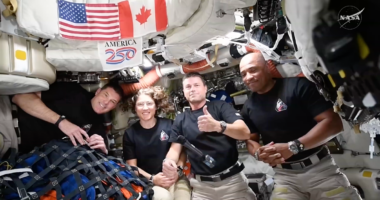
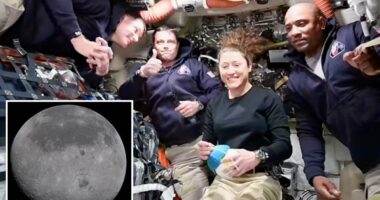
The dramatic return follows a history-making moment Monday, when the astronauts soared farther from Earth than any humans ever — breaking the Apollo 13 record of 248,655 miles set in 1970 during a lunar flyby, according to NASA.