
Share this @internewscast.com
Just before heading into a two-week recess, the Senate devised a plan to conclude the 42-day partial government shutdown, which primarily revolved around federal immigration enforcement issues.
Early in the morning, around 2 a.m., the Senate passed a measure by voice vote that provides funding for the Department of Homeland Security, excluding Immigration and Customs Enforcement (ICE) and certain functions of Customs and Border Protection (CBP). The approved legislation did not incorporate the majority of the reforms that Democrats had sought following the fatal shootings of two Americans in Minnesota during President Trump’s immigration enforcement efforts.
Although there seemed to be progress in negotiations earlier in the week, discussions ultimately broke down. Democrats argued that the Republicans’ proposal to fund the entire DHS fell short of addressing their concerns.
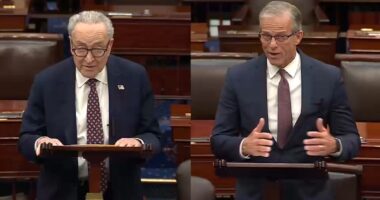
Senate Minority Leader Chuck Schumer from New York emphasized his party’s steadfastness.
“Throughout the process, Senate Democrats remained united, showing no signs of faltering,” Schumer declared on the Senate floor after the vote. “We made it clear: there will be no unrestricted funding for an unaccountable ICE and Border Patrol.”
On Thursday afternoon, Senate Majority Leader John Thune of South Dakota remarked that the Republicans had presented their “last and final” offer to the Democrats.
Shortly after, the Senate began a procedural vote on DHS funding, which was held open for more than six hours in hopes that there would be a breakthrough in negotiations. The vote ultimately failed.
But Mr. Trump said he would sign an emergency order to pay TSA agents as travelers face long waits in airport security lines, which Thune said alleviated “the immediate pressure” to reach a deal.
Mr. Trump’s announcement appeared to pave the way for ending the impasse, which threatened to cut short the Senate’s recess.
After Friday’s vote, Thune ruled out the possibility of immigration enforcement reforms, telling reporters that Democrats “kissed that opportunity goodbye” by failing to provide funding for those agencies.
“I think that ship has sailed,” he said.
Republicans have vowed to fund immigration enforcement agencies through the reconciliation process, though the strategy is expected to face more hurdles with the GOP’s narrow majority and a lack of Democratic support.