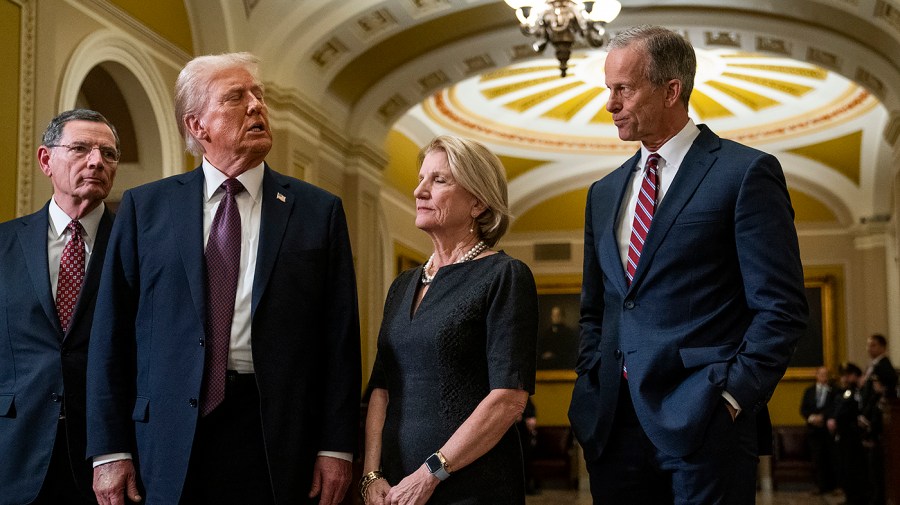


Senate Republicans are considering whether to follow President Trump’s suggestion to cut short or entirely cancel the August recess to focus on approving key nominees. Alternatively, they could dedicate the month to promoting their party’s tax and spending legislation to voters—an effort top Republicans believe is essential for their midterm election strategy.
After the successful passage of the party’s significant tax legislation and a measure to reduce funding for public media and foreign aid, the Senate intended to push forward with numerous Trump nominations in the upcoming two weeks before taking an extended break.
But Trump over the weekend urged Senate Majority Leader John Thune (R-S.D.) to keep everyone in town.
While some GOP members would support shortening the recess, many Republicans see a month-long campaign to promote the tax reform as crucial for electoral gains. This is especially true given Sen. Tim Scott (R-S.C.), the head of the National Republican Senatorial Committee, has recently acknowledged that the bill’s current polling results are not meeting expectations.
“That’s also an important part. We’ve got to go back and be able to talk to our constituents and explain to them what we just did in a way that will help in the midterm elections, which I know the president and we all care about,” said Sen. John Cornyn (R-Texas), who is up for reelection next year and staring down a tricky primary fight.
“This would be one time when we would be back home and be able to do that,” Cornyn said.
Thune on Monday kept the door open to keeping Republicans in Washington.
“We’re thinking about it. We want to get as many [nominations] through the pipeline as we can,” Thune said at the Capitol.
The GOP has more than 130 nominees awaiting floor action, including many out of the Senate Foreign Relations Committee and an initial batch of judicial choices, with more set to be advanced this week. Democrats have refused to concede time on any of the nominations, drawing each one out and forcing Republicans to consider their options.
Cornyn allowed that Trump had a “legitimate point” in complaining about the delay, and Thune noted that Trump is the first president who has not seen any of his nominees be greenlighted via voice vote or by unanimous consent.
“Not a single one,” Thune continued, adding that he and Trump have discussed possibilities of how to handle recess. “Trying to get his team in place is something that we’re very committed to, and we’re going to be looking at all the options in the next few weeks to try and get as many of those across the finish line as we can.”
In addition to nominations, the South Dakota Republican said government funding and the annual National Defense Authorization Act would top the to-do list if members are kept in town.
Keeping senators in D.C. in August wouldn’t be unprecedented — especially under a Trump presidency.
Sen. Mitch McConnell (R-Ky.), a former GOP leader, canceled the first week of the August break in 2017 in order to keep up work to repeal and replace the Affordable Acre Act after the late Sen. John McCain (R-Ariz.) tanked their “skinny repeal” push.
Just a year later, McConnell went a step further to scrap more than two weeks of the break in order to keep a sizable number of Senate Democrats in Washington instead of allowing them to return home to campaign ahead of the midterm elections.
Feelings about the possibility this go-around are mixed. Conservatives on Monday indicated they are enthusiastic about staying in town to advance the president’s nominees.
Sen. Roger Marshall (R-Kan.) said members can remain in Washington and still sell the “big, beautiful bill” in other creative ways. He noted that he did three tele-town halls last week that attracted 5,000 listeners each.
“Whatever it takes to get his [nominations] across the finish line, we need to do. … We can still get back [home] on weekends,” he said, saying that it’s possible only part of recess is affected.
Others, especially those up for reelection in 2026, are hoping Thune and Senate Minority Leader Chuck Schumer (D-N.Y.) can strike a deal to advance a group of less-controversial nominees in a single bloc.
Adding to that desire is that the chamber is hitting the tail end of a grueling six-month stretch. The Senate spent the first 10 weeks of the year in session, more than double the usual amount. Lawmakers also took part in four overnight vote-a-ramas and saw their July 4 recess significantly curtailed due to passage of the tax law.
“Cooler heads can prevail,” said Sen. Mike Rounds (R-S.D.), who is likely running for a third term next year. “Getting back home is our opportunity … to get back in when we haven’t had the chance because we’ve been in session so much lately. A lot of us were kind of planning on the August time to really get back in and reestablish with some of those organizations we haven’t had a chance to talk to this year.”
Rounds was also curt when asked if Thune should cancel the planned break.
“No,” he said. “Of course not.”
Sen. Lisa Murkowski (R-Alaska) concurred, as she represents a state that is not only furthest away and the most difficult commute from D.C., but also difficult to traverse within. Many communities in Alaska are only reachable by plane, and August is the only time she can visit some of them.
“How do I do all of this if I don’t have time out there?” Murkowski said. “Our states are big. This is part of my day job, too. You get us for the rest of the year back here, but there’s got to be some time when we can actually be addressing the needs of our constituents back home.”
“I guard this recess,” she said, taking issue with the phrase “recess.” “Do you realize all the pictures I’m getting from people back home? … People are dipnetting, they’re hauling in their fish, and I’m just looking at it thinking, ‘I haven’t even been able to do serious fishing, much less fun fishing.’”