
Estimates say 10.9 million more people would be without health coverage under the House-passed version of the bill.
WASHINGTON, D.C., USA — A significant unresolved challenge delaying advancement on President Donald Trump’s major legislation in Congress is notably difficult: How can billions be cut from healthcare without negatively impacting Americans or the institutions providing care?
Republicans are finding it tough to create a viable solution to the healthcare dilemma that their legislative package has introduced. It is already estimated that the version of the bill passed by the House would leave 10.9 million more people without health coverage. Some GOP senators have suggested even deeper cuts, which critics argue may be excessive.
“The Senate cuts in Medicaid are far deeper than the House cuts, and I think that’s problematic,” said GOP Sen. Susan Collins of Maine.
Senators have been engaged in private discussions with Trump administration officials as they hurry to complete the major legislation by the president’s Fourth of July deadline. While much of the proposal, which includes tax breaks and increased spending on border security, is largely prepared, determining the magnitude and specifics of the healthcare cuts remains one of the most challenging unresolved issues.
It’s reminiscent of the summer during Trump’s first term, in 2017, when Republicans struggled to keep their campaign promise to “repeal and replace” the Affordable Care Act, or Obamacare, only to see the GOP splinter over the prospect of Americans losing health coverage. That legislation collapsed when then-Sen. John McCain famously cast a thumbs-down vote.
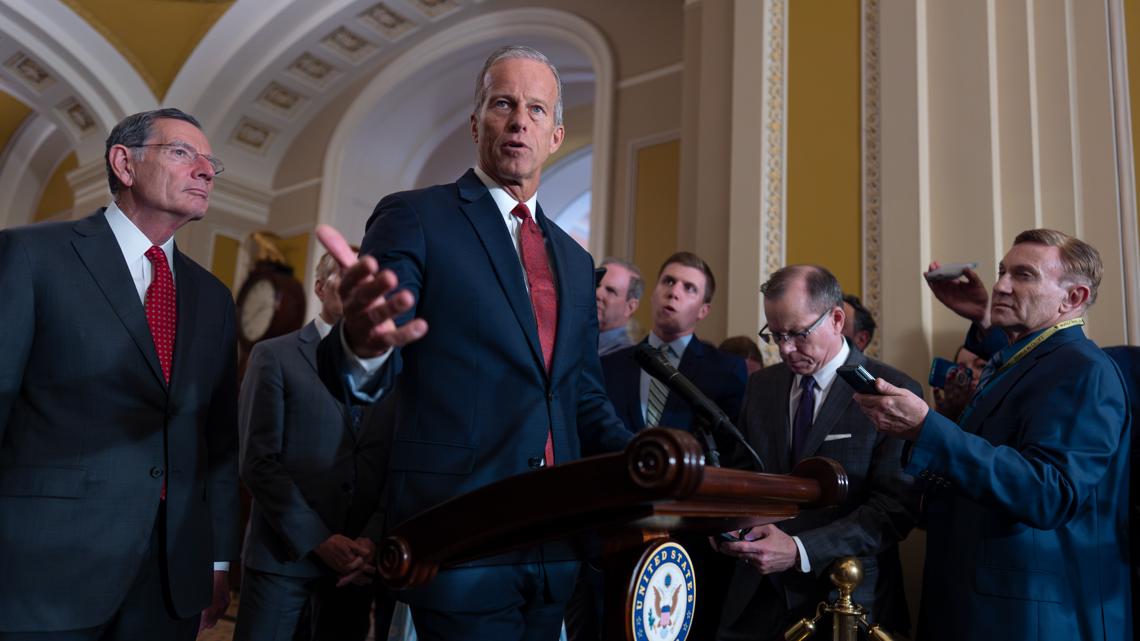
Senate Majority Leader John Thune is determined to avoid that outcome, sticking to the schedule and pressing ahead with voting expected by the end of the week.
“This is a good bill and it’s going to be great for our country,” Thune said Wednesday, championing its potential to unleash economic growth and put money in people’s pockets.
The changes to the federal health care programs, particularly Medicaid, were always expected to become a centerpiece of the GOP package, a way to offset the costs of providing tax breaks for millions of Americans. Without action from Congress, taxes would go up next year when current tax law expires.
The House-passed bill achieved some $1.5 trillion in savings overall, a large part of it coming from changes to health care. The Medicaid program has dramatically expanded in the 15 years since Obamacare became law and now serves some 80 million Americans. Republicans say that’s far too high, and they want to shrink the program back to a smaller size covering mainly poorer women and children.
House Democratic Leader Hakeem Jeffries said Republicans are “trying to take away healthcare from tens of millions of Americans.” Democrats are uniformly opposed to what they call the “big, ugly bill.”
Much of the health care cost savings would come from new 80-hour-a-month work requirements on those who receive Medicaid benefits, even as most recipients already work.
But another provision, the so-called provider tax that almost all the states impose to some degree on hospitals and others that serve Medicaid patients, is drawing particular concern for potential cuts to rural hospitals.
Sen. Josh Hawley, R-Mo., said several senators spoke up Wednesday during a private meeting indicating they were not yet ready to start voting. “That’ll depend if we land the plane on rural hospitals,” he said.
States impose the taxes as a way to help fund Medicaid, largely by boosting the reimbursements they receive from the federal government. Critics decry the system as a type of “laundering” but almost every state except Alaska uses it to help provide the health care coverage.
The House-passed bill would freeze the provider taxes at current levels, while the Senate proposal goes deeper by reducing the tax that some states are able to impose.
“I know the states are addicted to it,” said Sen. Roger Marshall, R-Kan. But he added, “Obviously the provider tax needs to go away.”
But a number of GOP senators, and the hospitals and other medical providers in their states, are raising steep concerns that the provider tax changes would decimate rural hospitals.
In a plea to lawmakers, the American Hospital Association said the cuts won’t just affect those who get health coverage through Medicaid, but would further strain emergency rooms “as they become the family doctor to millions of newly uninsured people.”
“And worse, some hospitals, especially those in rural communities, may be forced to close altogether,” said Rick Pollack, president and CEO of the hospital group.
The Catholic Health Association of the United States noted in its own letter that Medicaid provides health insurance coverage for one in five people and nearly half of all children.
“The proposed changes to Medicaid would have devastating consequences, particularly for those in small towns and rural communities, where Medicaid is often the primary source of health care coverage,” said Sister Mary Haddad, the group’s president and CEO.
Trying to engineer a fix to the problem, senators are considering creating a rural hospital fund to help offset the lost Medicaid money.
GOP senators circulated a proposal to pour $15 billion to establish a new rural hospital fund. But several senators said that’s too high, while others said it’s insufficient. Collins has proposed that the fund be set at $100 billion.
“It won’t be that big, but there will be a fund,” Thune said.
Hawley, who has been among those most outspoken about the health care cuts, said he’s interested in the rural hospital fund but needs to hear more about how it would work.
He has also raised concerns about a new $35 per service co-pay that could be charged to those with Medicaid, which is in both the House and Senate versions of the bill.
“Getting the fund is good. That’s important, a step forward,” Hawley said. But he asked: “How does the fund actually distribute the money? Who will get it to hospitals? … Or is this just going to be something that exists on paper?”
A new analysis from the White House Council of Economic Advisers estimates the package would result in up to $2.3 trillion in deficit reduction over 10 years, a markedly different assessment from other analyses. In contrast, the nonpartisan Congressional Budget Office’s dynamic analysis of the House-passed measure estimates an increase in deficits by $2.8 trillion over the next decade.
Associated Press writers Kevin Freking, Mary Clare Jalonick, Joey Cappelletti and Fatima Hussein contributed to this story.
Copyright 2025 Associated Press. All rights reserved. This material may not be published, broadcast, rewritten, or redistributed.