
Share this @internewscast.com

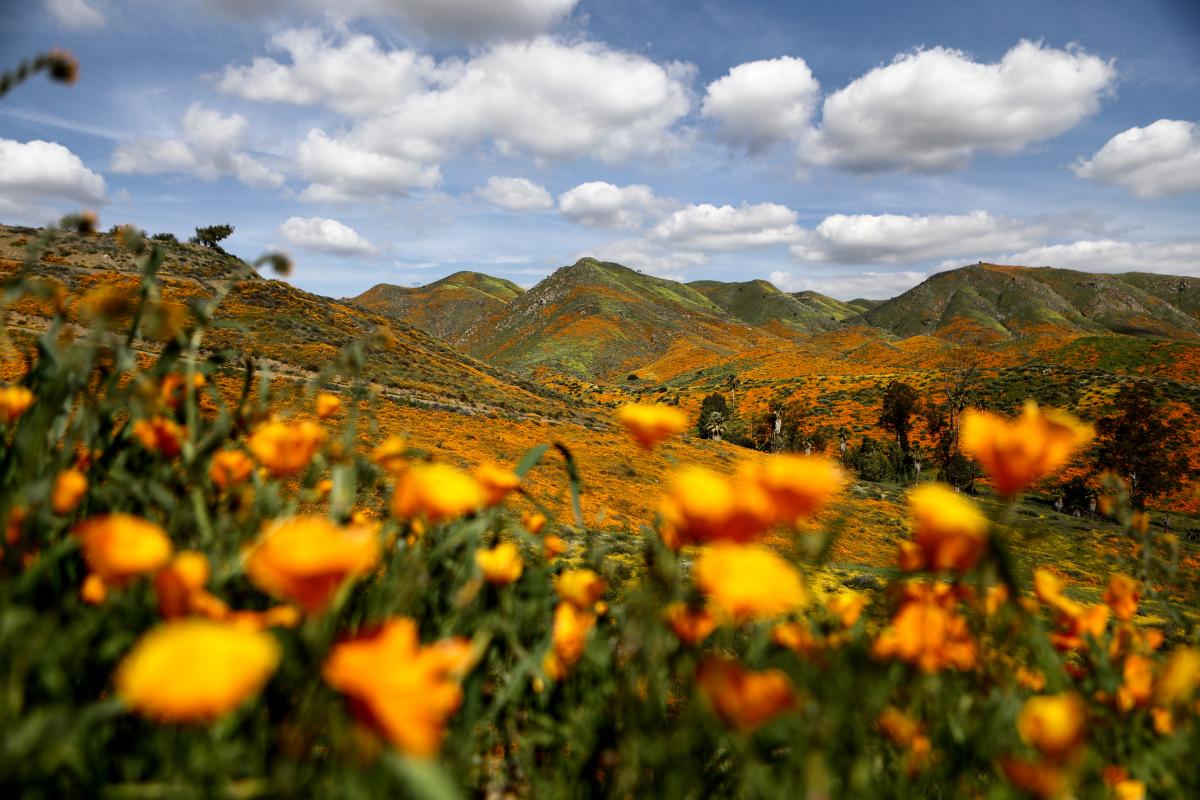
Southern California’s deserts are set to dazzle with a vibrant wildflower display this year, thanks to an unusually rainy winter. In Death Valley, visitors are witnessing the most impressive bloom in recent memory, although experts refrain from labeling it a “superbloom.”
According to experts, this year’s floral show in Death Valley National Park could be the most remarkable in ten years. The colorful spectacle is expected to continue through mid-to-late March, particularly in lower areas along Badwater Road and Highway 190.
The National Park Service announced in a Sunday update, “This year, we are experiencing a bloom that surpasses the average.”
“While we haven’t reached the levels of previous ‘superbloom’ years, the number of flowers is significantly higher than usual,” they added.
They further noted, “Flowers at lower elevations are currently blossoming throughout the park and should remain until mid-to-late March, weather permitting.”
“Higher altitudes can anticipate blooms from April through June,” the Park Service concluded.
The optimism surrounding this year’s bloom is rooted in hard numbers.
As of Sunday, Downtown Los Angeles had recorded 18.36 inches of rain since Oct. 1 — 84% above the normal mark — while Burbank logged 18.90 inches, or 202% of average.
Even arid Death Valley National Park measured 2.54 inches over the same period, also 202% of normal, following what park officials described as the wettest fall on record.
Those totals mark the kind of sustained, well-timed precipitation that historically sets the stage for an above-average wildflower season.
Death Valley’s 2016 wildflower explosion remains the modern benchmark for a true “superbloom,” when rare, perfectly timed winter storms transformed vast stretches of desert into sweeping carpets of color.
The event — linked to a strong El Niño pattern — produced landscape-scale displays that drew a surge of visitors, with March attendance jumping 37% compared with the previous year.
Park officials later described the phenomenon as a roughly once-a-decade occurrence driven by unusually consistent rainfall followed by favorable spring temperatures.
The contrast between 2016 and 2025–2026 is stark. During the Oct. 1–Feb. 29 window preceding the famed 2016 Death Valley superbloom, the Death Valley–area station recorded just 1.44 inches of rain — about 104% of normal — while Los Angeles sites were running well below average at roughly 46% to 52% of normal.
By comparison, the 2025–2026 season to date is dramatically wetter.
Even so, more rain does not automatically mean a superbloom. Park officials stress that timing and spacing matter as much as raw totals: soaking fall storms must be followed by steady winter moisture to keep seedlings alive, while heat spikes or strong spring winds can quickly dry out blooms before they spread across the landscape.
In 2016, Death Valley’s bloom was fueled by well-timed early rain despite modest overall totals, underscoring that precipitation alone is only part of the equation.
Professor Erica Newman, a plant ecologist at James Madison University, told the California Post that so-called superblooms typically occur “maybe like once every ten years or so” and depend on far more than rainfall totals alone.
“It’s a combination of a lot of rainfall during California’s rainy season, which is the winter — more rainfall than usual — but also the sequence of ecological cues, including temperature, that allows for a lot of germination,” Newman said.
“It’s quite possible that we will have a super bloom this year because of the moisture,” she added.
“But because there are so many factors that go into this super bloom, we don’t know how to predict for sure that it’ll happen.”
“There are so many factors — air temperature, soil temperature, the lack of freezes. Even strong winds can prevent a super bloom because they can damage young plants.”
Newman also noted that the term itself lacks a formal scientific definition.
“It’s kind of a made-up term for this massive ecological event that sometimes happens and sometimes doesn’t,” she said.
“It doesn’t have a definition — it’s not done by extent, it’s not done by count, it’s not done by number of species.”