
Share this @internewscast.com

Officials from Louisiana, Vermont, and Virginia have committed to ensuring that food aid continues for their residents, even if the federal program is interrupted next month due to a government shutdown.
The future of the Supplemental Nutrition Assistance Program (SNAP), which assists approximately 1 in 8 Americans in purchasing groceries, is raising significant concerns. This anxiety is mounting as November 1st approaches—a date when benefits could cease unless the federal shutdown is resolved or alternative measures are taken.
While some states have considered using their own resources to support the program, they have encountered technical challenges. It remains uncertain whether the newly announced plans from these three states can overcome these obstacles. In Vermont, legislative officials are awaiting guidance from the state administration on how benefits will be distributed.
Here’s the latest update:
Some states are announcing plans, but details have been scarce
In Virginia, Republican Governor Glenn Youngkin has declared a state of emergency to ensure that food benefits reach SNAP recipients. Further details on the implementation of this plan are expected soon, according to a spokesperson.
Louisiana’s Republican Governor, Jeff Landry, has emphasized his commitment to preventing hunger among seniors, individuals with disabilities, and children reliant on food stamps in the state. However, he has yet to provide specifics on the plan’s execution.
New Hampshire officials announced a plan to increase access to food through food banks and mobile pantries. It would require approval of a legislative committee in the GOP-controlled state.
Vermont lawmakers also said Thursday they intend to have the state cover both the food aid and heating fuel assistance that’s at risk.
California Gov. Gavin Newsom, a Democrat, said this week that he would deploy the National Guard to help food banks. “This is serious, this is urgent – and requires immediate action,” he said.
States have limited ability to help
Officials from Alaska, New Mexico and North Dakota have said that they’ve considered using state money to keep the food aid flowing but fear a federal government directive may make that impossible.
The U.S. Department of Agriculture, which oversees SNAP, told states earlier this month not to send information to the vendors who provide the debit cards because of uncertainty about whether the program would be funded in November.
Officials in the states say that federal control of the system appears to stand in the way of their attempts to fund the program on their own.
“Without action from USDA, I think it is highly unlikely that any states would issue November SNAP benefits,” Carolyn Vega, a policy analyst at the advocacy group Share Our Strength, said in an email. “On top of the technical challenges, states can’t shoulder that cost, especially with the risk it wouldn’t be refunded.”
It’s not certain the program will be paused, but it’s looking likely
Lower-income families who qualify for SNAP receive debit cards loaded each month by the federal government that work only for groceries at participating stores and farmers markets.
The average monthly benefit is $187 per person. Most beneficiaries have incomes at or below the poverty level.
Time is running short to keep benefits flowing in November.
Congress and President Donald Trump could strike a deal to end the federal shutdown that started Oct. 1.
It’s also possible that the Trump administration would allocate money for the program even if the shutdown continues. The liberal Center on Budget and Policy Priorities estimates that about $5 billion is available in a contingency fund and is calling on the administration to use that for partial benefits in November, but it’s not clear if that’s being seriously discussed.
Forty-six of the 47 Democrats in the U.S. Senate sent a letter Thursday to Agriculture Secretary Brooke Rollins calling on her to release the contingency money.
The USDA has not answered questions from The Associated Press about whether those funds might be tapped.
States have also indicated that there could be a delay in benefits even if a deal is struck to fund SNAP for November.
Losing SNAP could mean tough choices for beneficiaries
Sylvia Serrano gets $100 every month to help buy groceries for herself and the four grandchildren she’s raising in Camden, New Jersey.
Two of her grandkids have autism, and because of their aversions to certain textures they eat only certain foods that are unlikely to be available at food banks.
The act of getting food could also be harder for her without SNAP. She now does her shopping while the kids are at school, using a grocery store that’s close to home due to her not-so-reliable car.
She says that with SNAP, she can mostly stay up on her other expenses. Without it? “I would have to send less payment into a bill or something in order to cover the needs and then the bills are going to get behind,” Serrano said.
Some states are encouraging stocking up and seeking other help
Some states are telling SNAP recipients to be ready for the benefits to stop.
Arkansas is advising recipients to identify food pantries and other groups that might be able to help, and to ask friends and family for aid.
It’s unclear whether any benefits left on recipients EBT cards on Nov. 1 will be available to use. Arkansas officials suggest people who have balances on their cards to use it this month on shelf-stable foods.
Missouri and Pennsylvania officials, on the other hand, expect previous benefits will remain accessible and are telling beneficiaries to save for November if they can.
Oklahoma is encouraging people who receive benefits to visit a state website that connects people with nonprofits, faith-based groups, Native American tribes and others that may be able to help with food.
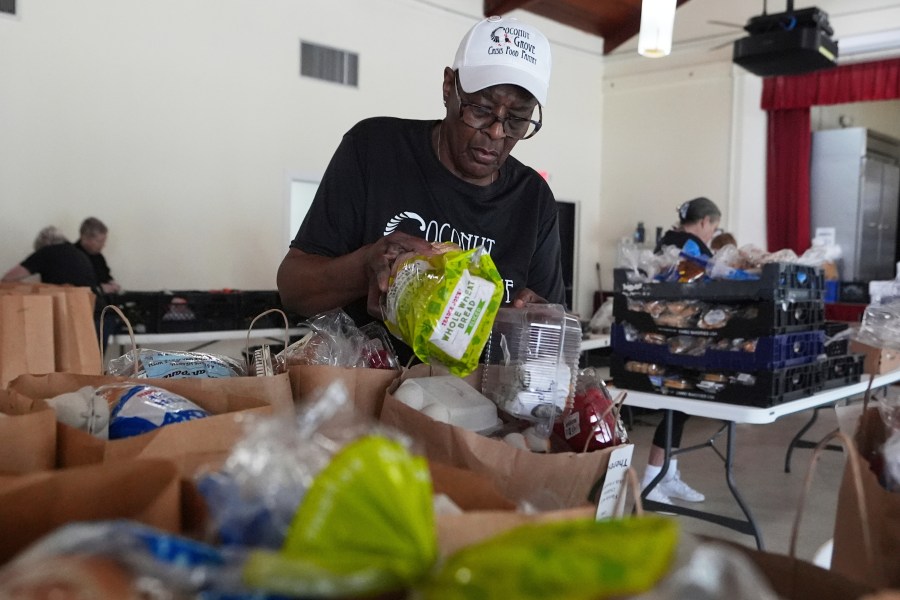
Food banks could be the fallback for many beneficiaries
Separate federal program cuts this year have already put food banks that supply food pantries in a tough spot, said George Matysik, the executive director of Share Food Program in Philadelphia.
So dealing with an anticipated surge in demand could be tough.
Matysik said it’s especially acute for his organization and others in Pennsylvania, where a state government budget impasse has meant at least a pause in another funding stream. He said the group has had to cut about 20% of its budget, or $8.5 million, this year.
“Any time we have a crisis, it’s always the working class that feels the pain first,” he said.
___
Associated Press reporters Sophie Austin in Sacramento, California; Scott Bauer in Madison, Wisconsin; Becky Bohrer in Juneau, Alaska; Jack Brook in Baton Rouge, Louisiana; Jack Dura in Bismarck, North Dakota; Susan Haigh in Hartford, Connecticut; John Hanna in Topeka, Kansas; Marc Levy in Harrisburg, Pennsylvania; Morgan Lee in Santa Fe, New Mexico; Michael Casey in Boston; and Sean Murphy in Oklahoma City contributed to this article.