

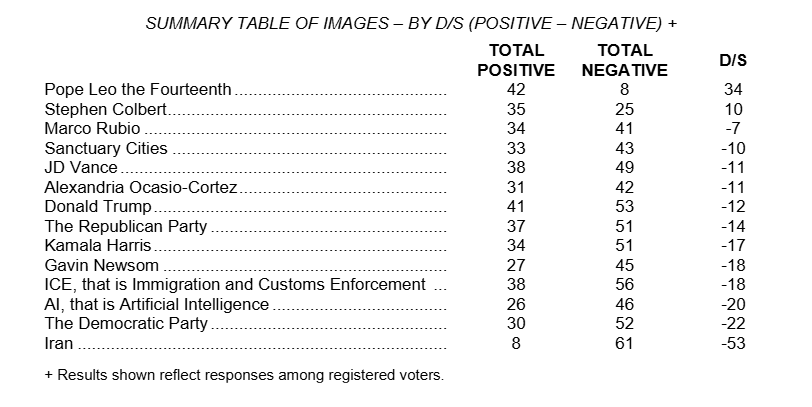
In a survey conducted by NBC from February 27 to March 3, which engaged 1,000 registered voters across the nation, findings reveal that President Donald Trump enjoys greater popularity than some of his most vocal critics. These include Stephen Colbert, host of CBS’s The Late Show, California’s Governor Gavin Newsom, former Vice President Kamala Harris, and Congresswoman Alexandria Ocasio-Cortez of New York.
According to the poll, President Trump garners a positive rating of 41 percent from participants, surpassing Colbert, who holds a 35 percent approval.
Governor Newsom, who has been subtly positioning himself for a potential presidential run, secures a mere 27 percent in positive feedback. Meanwhile, Kamala Harris, whose actions suggest she is eyeing a future White House campaign, achieves a 34 percent positive rating.
Similarly, Alexandria Ocasio-Cortez receives a 31 percent positive rating in the NBC poll.
Intriguingly, the topics of Iran, Artificial Intelligence, and Governor Newsom are among the least favored in the survey, with positive ratings of 8 percent, 26 percent, and 27 percent, respectively.
NBC News
On the contrary, Pope Leo the Fourteenth emerges as the most favored figure among the 14 subjects, achieving a 42 percent positive rating.
Vice President JD Vance (R) is tied with Immigration and Customs Enforcement with the second highest positive rating of 38 percent.
The NBC poll included 368 registered voters who said they’d vote in Democratic primaries and 319 who said they’d vote in Republican primaries.