
CRADLING her three-week-old son as shots rang out in the dark, Taffany Smith was instructed to scrape off his soiled nappies and reuse them. “We pee on the floor,” she cried. “We are like animals.”
Hurricane Katrina had already claimed nearly 2000 lives, with thousands more striving to endure amidst decomposing bodies, excrement, and the overpowering stench of misery and human suffering.


After the deadly storm obliterated their homes, the stifling Superdome was meant to serve as a temporary sanctuary for desperate displaced individuals with nowhere else to go, if only for a few hours.
Instead they were plunged into a terrifying hellscape where guns, knives and drugs were rife, fighting for survival for days.
Two people – including a child – were raped, blood stained the walls and used crack pipes littered the fetid floor.
Riots erupted as starving children screamed day and night, waiting for salvation that took days to come.
At the time petrified 11-year-old Stacey Bodden told reporters: “People started shooting last night.”
Her uncle, David Rodriguez said he heard at least seven shots and saw a man running with a gun. “Don’t shoot,” he pleaded.
Amid the crime and constant threat of violence there were terrifying reports of stabbings, looting, murder and suicide.
One man leapt 50 feet to his death, saying he had nothing left to live for.
“We’re not even dealing with dead bodies. They’re just pushing them on the side,” said New Orleans mayor Ray Nagin.
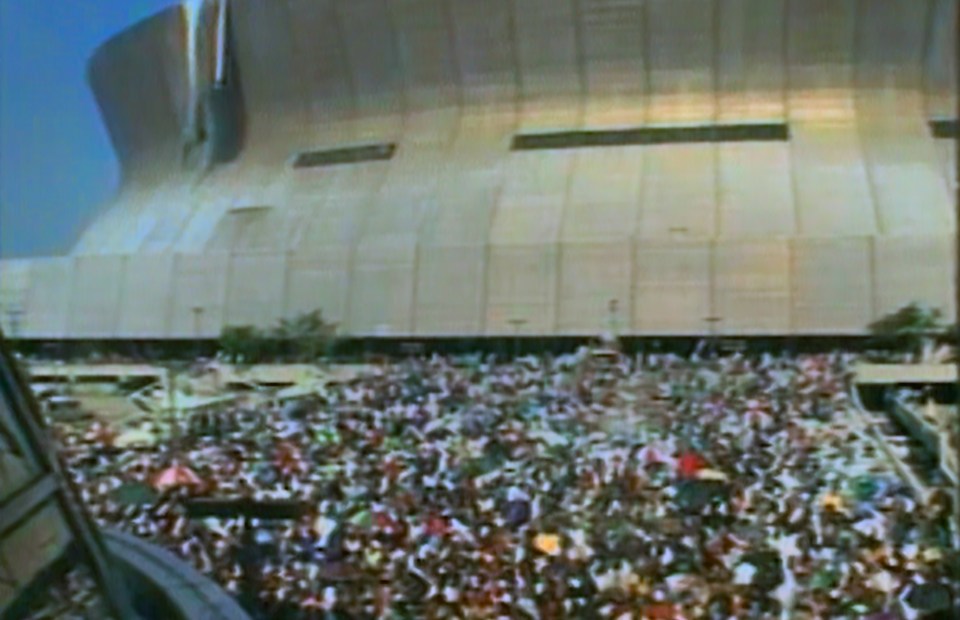
More than 30,000 exhausted and traumatised people were crammed into the dank arena with no power or water for almost a week.
Out of sheer desperation, humiliated survivors were left with no choice but to use the hallways and bins as toilets.
“There is faeces on the walls,” said survivor Bryan Hebert. “There is faeces all over the place.”
“This is a nuthouse,” added April Thomas who fled to the arena with her 11 children but was too afraid to sleep.
“You have to fend people off constantly,” she said. “You have to fight for your life. I wake up in the morning, and the first thing I say is: ‘Where are my babies? Is everyone here?’”
Evacuee Iiesha Rousell said at the time: “They’re housing us like animals.”
High winds tore off the roof of the stadium, and as filthy water seeped in, temperatures soared, food rotted and all access to the outside world was cut.
Crowds pressed against the metal barricades that stopped them leaving, crying out for help as they waited for buses to evacuate them to safety.


“People said they felt abandoned by humanity,” said local reporter Thanh Truong. “The only way I can describe it is the smell of human suffering.”
Now an unflinching new National Geographic documentary, Hurricane Katrina: Race Against Time, recalls the horror and chaos that unfolded as terrified residents struggled to survive not only the havoc wreaked by the brutal storm but then its tragic aftermath.
The gripping five part series exposes how a natural disaster two decades ago rapidly descended into a gut wrenching man-made national disgrace leaving an enduring legacy that shattered millions of lives.
Former marine Shelton Alexander was among those who believed they would shelter in the Superdome for hours – not days.
We are right here in the city and we’re about to starve to death
Superdome Survivor Shelton Alexander
He said: “The National Guard was there, but nobody really was in charge.
“There were so many breakdowns of communication—it was chaos.
“It started getting real crazy with the bathrooms getting backed up and everything.
“Everybody was on edge. That’s when it started getting a little chaotic.
“To watch the elders suffering, patients sitting in the corner all day, unattended, it was just really bad.
“We are right here in the city and we’re about to starve to death or get dehydrated.
Shots were fired
“Not knowing if they would just hold us in there against our will and starve us to death crossed our mind.
“We went to each gate, one by one, to see if they would let us out and they wouldn’t. They were really holding us back.”
But, along with 18 others, Shelton was able to flee from the dire conditions Superdome in his Ford truck which was parked nearby.
Ray Nagin, the then-mayor of New Orleans recalled: “I was among the people in the Superdome. I knew what was going on every minute. I did not have air conditioning nor shower facilities.”
Superdome manager Doug Thornton added: “We’re not a hospital, we’re not a hotel. We can’t house people for five or six days.”


But still today, many struggling to rebuild their lives blame government failure for the slow response and lack of aid – likening the widespread chaos that followed the storm to a war zone.
Due to a series of systematic blunders, authorities struggled to work out a plan to evacuate them to safety.
Prior to the storm, mandatory evacuation orders were issued but cops had struggled to move the poorest residents, who simply had no choice but to stay in their homes and hope for the best.
Hurricanes are common in that part of Louisiana, and Lynette Boute was among those who ignored the extreme weather warnings, preferring to stay and prepare for the city’s iconic Mardi Gras festivities.


“Every time this happens they try to make me leave,” she insisted. “I said I’m not leaving my property.”
But as the storm loomed the warnings became more severe and many attempting to flee had to turn back when traffic became gridlocked as the rain became torrential.
Community organiser Malik Rahim added: “Katrina hit at the worst time to be poor in America, by the end of the month you ain’t got no money.
“What makes a disaster a tragedy? A tragedy is when we fail to do what we should be doing.
“And the first tragedy of Katrina was not being prepared, not having an exit strategy for the 100,000 people that we knew didn’t have no means of escaping.”
People said they felt abandoned by humanity. The only way I can describe it is the smell of human suffering
Reporter Thanh Truong
But even after the Category Five hurricane had passed over the city, flood water continued to rise at a terrifying rate and conditions quickly deteriorated.
New Orleans is surrounded by a series of walls known as levees built to reduce the risk of flooding from lakes, canals and the Mississippi River – but the intensity of the storm smashed through the defences.
While President Bush flew over in Air Force One and declared the situation a natural disaster, locals believed the situation was man made and could have been avoided.
They put the crisis down to the shoddy design and construction of the levees in the wake of Hurricane Betsy in the 1960s.
As the levee walls collapsed, parts of the city flooded at an alarming rate, sweeping away hundreds of houses, and leaving thousands of terrified people trapped in theirs.


Resident Lucrece Philips said: “Everything changed that day.
“We heard something that sounded like an explosion. That’s when the water went from the bottom of the tyre of a car to the second floor of a house within twenty minutes.”
The force of the water rushing through the levees was so intense it even knocked houses off their foundations, leaving them teetering on their edges.
Residents frantically scrambling onto their rooftops and balconies in a desperate bid to reach higher ground.


Emergency services rushed to rescue as many as possible from dire situations by boat and helicopter.
But soon dead bodies were floating in the filthy water, which rose to more than 15 feet deep within hours.
Police officer Bobby Norton said: “Until you see it you can’t imagine it.”
Everything changed that day. We heard something that sounded like an explosion
Lucrece Philips
Meanwhile in the Superdome the situation was deteriorating fast – a second wave of more wounded and terrified people who had survived the worst night of their lives tried to cram inside.
With their houses in ruins, they had no choice.
Police officer Ed Bush said: “When the levees broke everything changed.
“They were brought to the Superdome because there was nowhere else to go.
“It was desperation – but they were coming to another hell.”
By day three 30,000 desperate people were crammed into the stadium – and armed guards were stationed at the doors to prevent people trying to fight their way out.


Critical situation
In the surrounding streets, the city descended into lawlessness as starving people gathered on motorway bridges and flyovers, while others resorted to looting shops and supermarkets as they waited for fleets of buses and ships which had been promised to evacuate the city.
Medical facilities were overloaded, there was no phone signal and the situation was declared critical.


It appeared that the police had lost control as violence broke out – and when police, helicopter pilots and SWAT teams were shot at, all rescue operations were abandoned.
After five days, tens of thousands were still waiting, struggling for survival and sharing what scraps of food they could find until the armed National Guard relief convoy finally rumbled into town in tanks and armoured vehicles.
Slowly elderly people and children were evacuated by school buses and sent to the airport, but main roads leading out of the city were blocked, and desperate families trying to leave on foot were stopped.
Malik Rahim added: “I’m not a naive person but nothing prepared me for what happened after Katrina.”
They were brought to the Superdome because there was nowhere else to go. It was desperation – but they were coming to another hell
Police officer Ed Bush
Over the following months almost a million displaced refugees were rehoused in 30 different states, in the largest mass migration the US had seen since the 1930s.
When the water eventually receded, many attempted to return to New Orleans but were heartbroken to find their homes vandalised and in ruins among the wreckage.
In October the search for survivors ended and the official death toll stood at 1,392.
Over the following years money was poured into rebuilding the levees and returning people to their communities.
A government scheme called The Road Home was set up to cover the cost of relocating, repairs and rebuilding the hardest hit areas – but thousands were told they were not eligible for payouts and found themselves caught up in overwhelming red tape.
One of the worst affected neighbourhoods, the Lower Ninth Ward is still a ghost town – before the hurricane the population was over 14,000, now it is just 4,630.
And, twenty years after the disaster that devastated New Orleans, experts fear that global warming and rising sea levels may mean that another natural disaster could turn into a tragedy again.
Hurricane Katrina: Race Against Time premieres 28 July from 8pm on National Geographic, with all episodes available to stream the same day on Disney+.