
Share this @internewscast.com

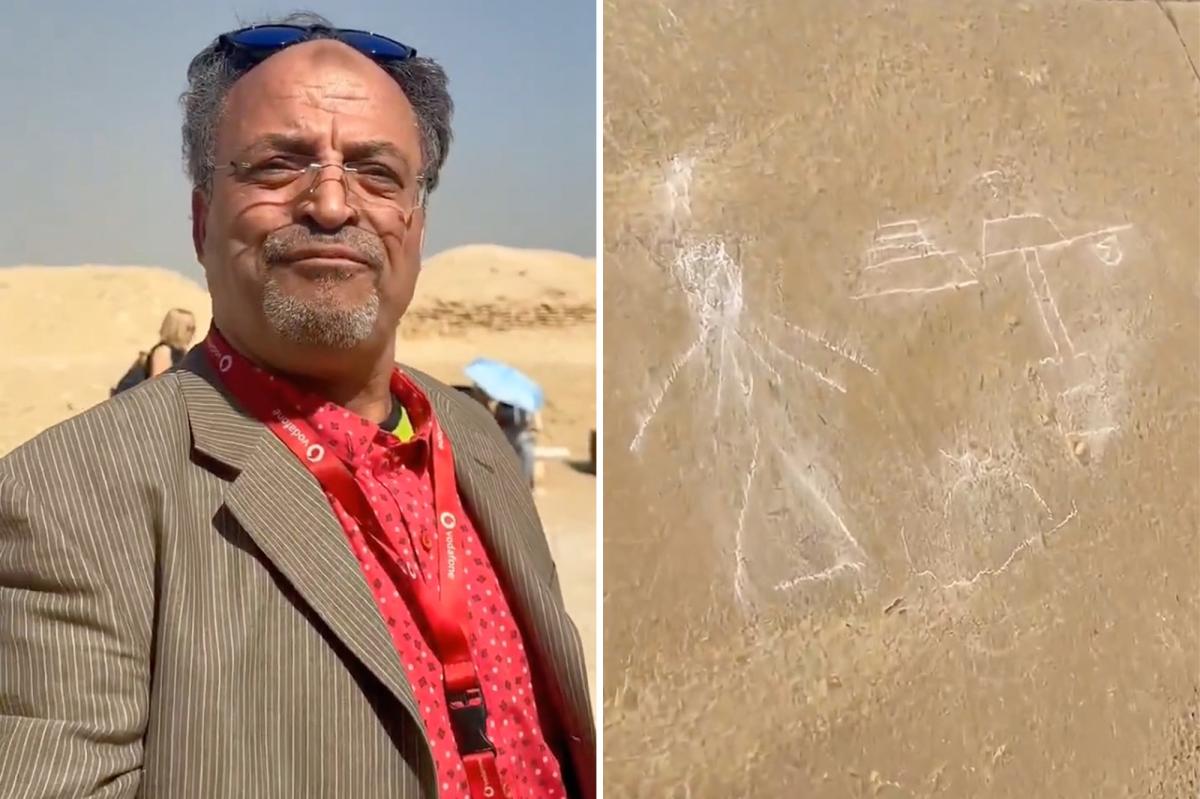
An Egyptian tour guide has been accused of etching a stick figure onto the wall of a pyramid that’s over 4,000 years old, according to reports.
While passionately recounting the history of the Pyramid of Unas to a group of tourists, the guide allegedly drew a stick figure on its ancient walls. This incident, captured on video by the Egyptian Ministry of Interior, appears to show the guide marking the lower portion of the pyramid.
The footage further reveals the guide’s futile attempt to erase the drawing after realizing the gravity of his actions.
Following a report about the incident, local police detained the man for breaching Egyptian laws protecting antiquities. The ministry confirmed that he was taken into custody for “damaging an antiquity by drawing on the outer casing of one of the pyramids.”
The guide reportedly admitted to the act, and authorities have since removed the drawing, according to the ministry’s statement.
While the ministry confirmed that “legal measures” have been initiated against the guide, no further specifics were disclosed regarding the consequences he might face.
Under Egypt’s 1983 Antiquities Law, anyone who defaces an antiquity can be put behind bars for at least one year, plus face a fine of 500,000 Egyptian pounds — or roughly $10,400.
The Pyramid of Unas — situated just 20 miles away from the main Pyramids of Giza — is widely acclaimed for featuring the earliest-known examples of Pyramid Texts.
Upwards of 200 religious spells were inscribed on the texts to ensure the protection and resurrection of the Egyptian pharaoh Unas, whose tomb lies in the heart of the pyramid.
It was constructed in the 24th century BC for Unas’ impending death. He was the ninth and final king of the Fifth Dynasty; an era marked by a clear cultural shift toward worshipping the sun god, Re, and the subsequent establishment of multiple sun temples.