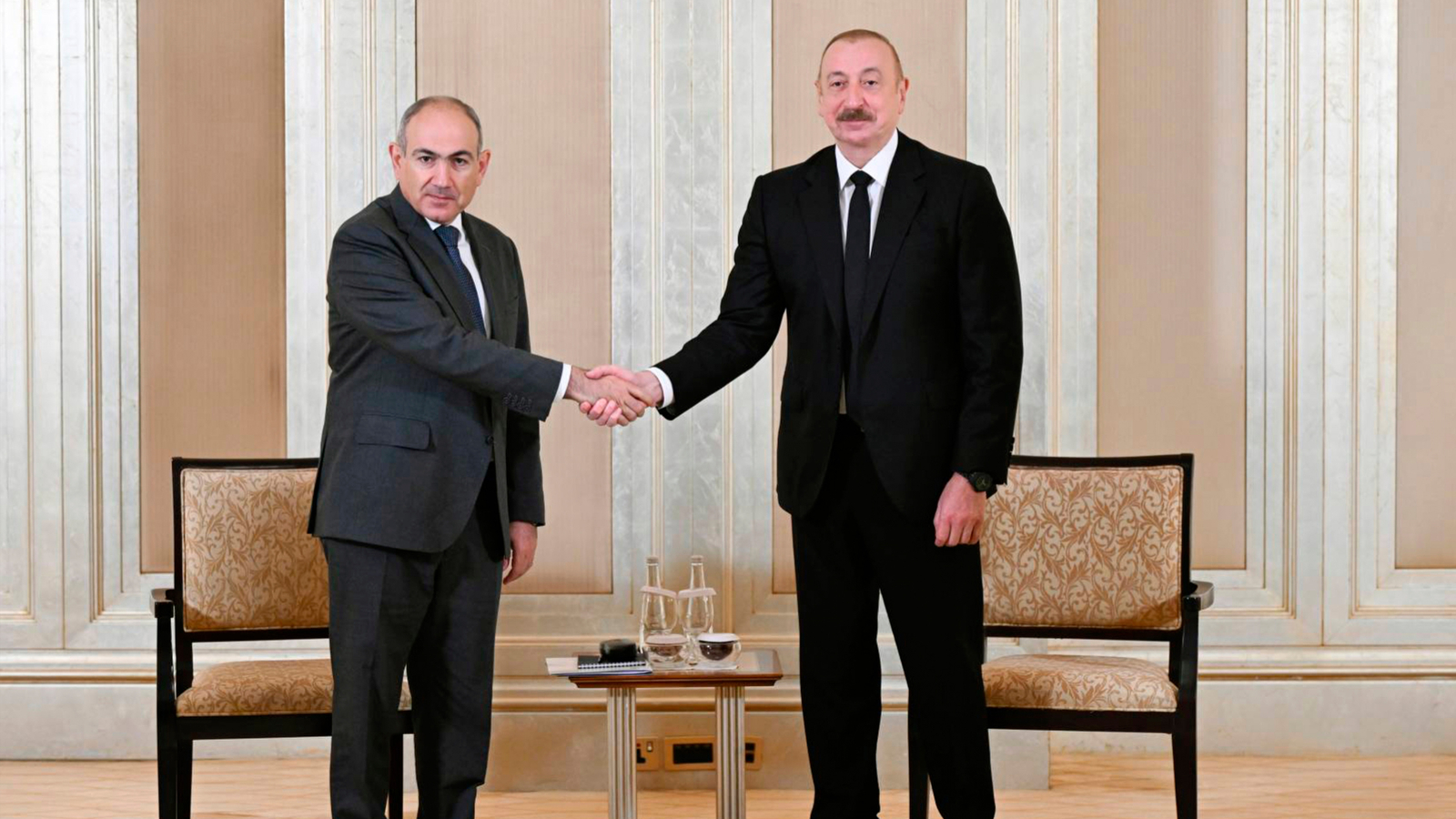

WASHINGTON — President Donald Trump announced that on Friday, Armenia and Azerbaijan’s leaders are anticipated to sign a peace agreement at the White House, which might conclude years of conflict.
Trump noted that Armenian Prime Minister Nikol Pashinyan and Azerbaijani President Ilham Aliyev will also be entering into agreements with the U.S. aimed at “exploring economic opportunities together to fully realize the potential of the South Caucasus Region.”
“Many Leaders have tried to end the War, with no success, until now, thanks to ‘TRUMP,'” Trump wrote Thursday night on his Truth Social site.
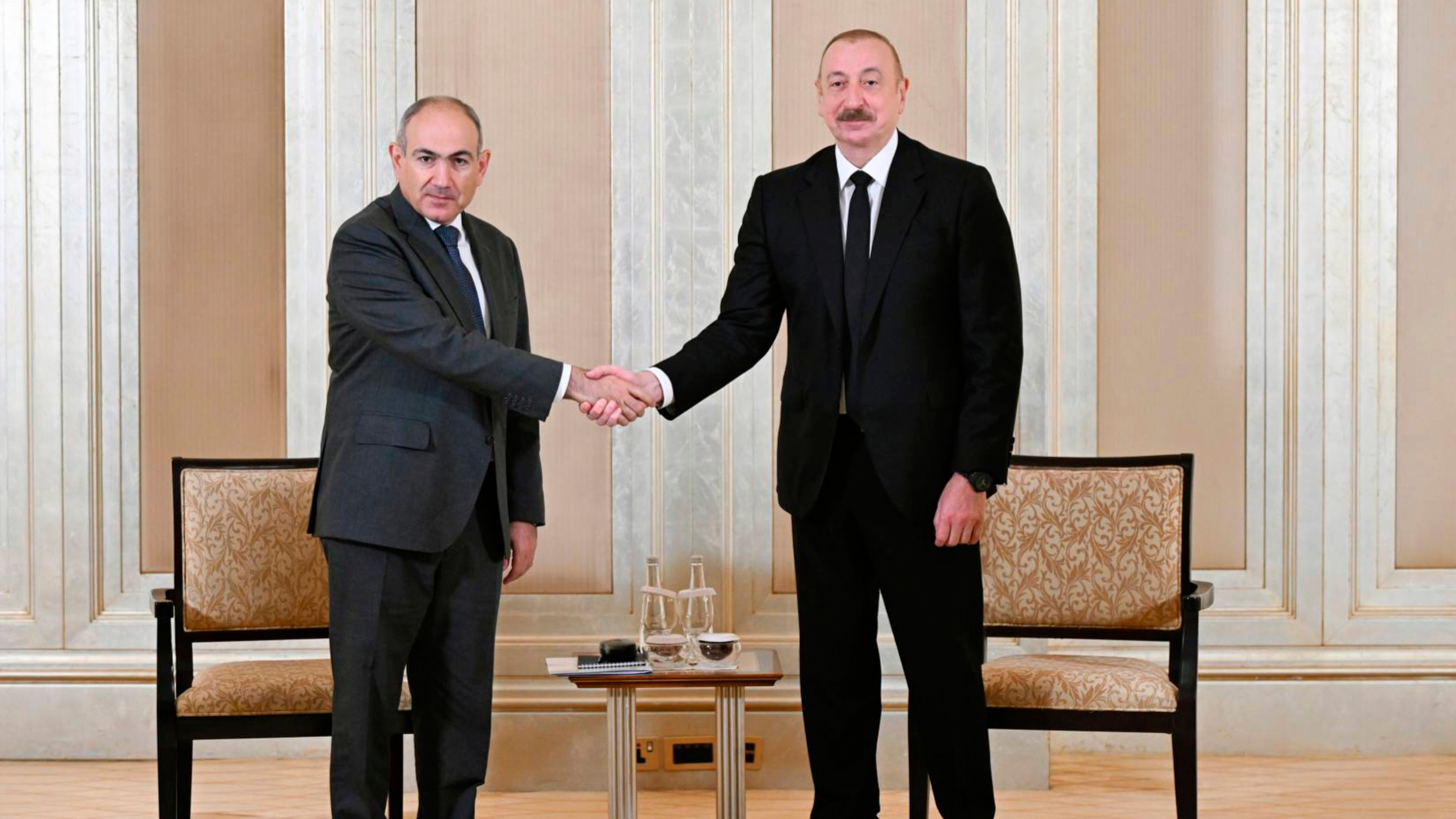
Azerbaijani President Ilham Aliyev, right, and Prime Minister of Armenia Nikol Pashinyan pose for a photo before their discussions in Abu Dhabi, United Arab Emirates.
Azerbaijani Presidential Press Office via AP
This potential peace accord could end decades of strife and pave the way for reopening key transportation routes in the South Caucasus that have been closed since the early 1990s.
According to three U.S. officials, who requested anonymity as they were not authorized to speak publicly before the announcement, the agreements mark a significant milestone with the establishment of an important transit corridor across the region, a major point of contention in peace negotiations.
Officials stated that this agreement would grant the U.S. leasing rights to develop the corridor and it would be called the Trump Route for International Peace and Prosperity.
It would link Azerbaijan to its Nakhchivan region, which is separated from the rest of the country by a 32-kilometer (20-mile) patch of Armenia’s territory.
The transit corridor is expected to eventually include a rail line, oil and gas lines, and fiber optic lines, allowing for the movement of goods and eventually people. The deal does not call for the U.S. to pay for the construction of the transit corridor, but instead for private corporations to develop it.
The deal was reached after a visit earlier this year by Trump’s special envoy Steve Witkoff to Azerbaijan’s capital of Baku and continued talks between the parties.
Nearly four decades of bloodshed between the two
Armenia and Azerbaijan faced off for nearly four decades of fighting for control of the Karabakh region, which was known internationally as Nagorno-Karabakh.
During the Soviet era, the mostly Armenian-populated region had an autonomous status within Azerbaijan. Long-simmering tensions between Christian Armenians and mostly Muslim Azerbaijanis – fueled by memories of the 1915 massacre of 1.5 million Armenians by Muslim Ottoman Turks – boiled over as the Soviet Union frayed in its final years.
Clashes erupted in 1988 when the region made a bid to join Armenia. As the USSR collapsed in 1991 and Armenia proclaimed independence, hostilities escalated into a full-blown war that killed an estimated 30,000 people and displaced about 1 million.
When the war ended with a cease-fire in 1994, ethnic Armenian forces backed by the government in Yerevan not only took control of the region but also captured broad swaths of Azerbaijan.
Decades of international mediation efforts failed. In September 2020, Azerbaijan launched an operation to reclaim the region. NATO-member Turkey, which has close ethnic, cultural and historic bonds with Azerbaijan, gave it strong support.
In six weeks of fighting involving heavy artillery, rockets and drones that killed more than 6,700 people, Azerbaijani troops drove Armenian forces from areas they controlled outside Karabakh. They also reclaimed broad chunks of Karabakh. A Russia-brokered peace deal saw the deployment of about 2,000 troops to the region as peacekeepers.
Azerbaijan then reclaimed all of Karabakh in September 2023 in a lightning military campaign. Over 100,000 people, nearly all of Nagorno-Karabakh’s ethnic Armenian population, fled to Armenia in a week, fearing Azerbaijani rule.
Russia, busy with its war in Ukraine, didn’t intervene, angering Armenia’s leadership, which responded by scaling down its ties with Moscow and bolstering relations with the West.
Prospects for peace and better relations
After reclaiming Karabakh, Azerbaijan engaged in talks with Armenia on normalizing ties. As part of the negotiations, Armenia agreed to hand over several border villages to Azerbaijan.
Azerbaijan also has demanded that Armenia rewrite its constitution, which contains a reference to the prospective reunification of Armenia and the Karabakh region. The authorities have yet to present a revised draft in the face of public protests.
A key stumbling block in peace talks was Azerbaijan seeking a land bridge to its Nakhchivan region. Azerbaijan doesn’t trust Armenia to control the so-called Zangezur corridor, while Armenia had staunchly resisted control by a third party, seeing it as a breach of its sovereignty.
It was not clear how that resistance had been overcome in the deal.
Russia, which has a military base in Armenia, had previously proposed deploying its troops to secure the corridor. Armenia, bent on scaling down ties with Russia in favor of closer relations with the West, rejected the idea.
“Russia has been left on the sidelines, because the Kremlin has nothing to offer to Armenia and Azerbaijan,” said Olesya Vartanyan, a South Caucasus expert, noting that Moscow’s regional influence withered after it focused on the war in Ukraine.
“Russia now lacks resources to deal with Armenia and Azerbaijan,” Vartanyan said.
The prospective peace deal also would pave the way for Turkey and Azerbaijan to reopen borders with Armenia that have been shut for nearly four decades, leaving the landlocked country to rely on limited transit routes via Georgia and Iran.
Turkey views the prospective agreement as part of its efforts to expand its influence in the South Caucasus, while Armenia sees the reopening of the border and resuming trade with Turkey as a top priority. Pashinyan, who visited Turkey in June in the first such visit by an Armenian leader, has made normalizing ties with Turkey a key goal.
“For Armenia, it would guarantee stability and allow access to the Turkish market, ports and investments, as well as its inclusion into key regional transport corridors,” Vartanyan said, adding that a peace deal would help make Armenia a key link between Europe and Asia.
“Armenia has an extensive transport infrastructure since the Soviet times, including railways and highways that could significantly expand trade routes via South Caucasus,” she said.
Copyright © 2025 by The Associated Press. All Rights Reserved.