Share this @internewscast.com

Open wide!
During a recent trip with her husband, a woman’s quest for fossils took an unexpected turn when she stumbled upon a bizarre and somewhat eerie formation that looked strikingly like human teeth.
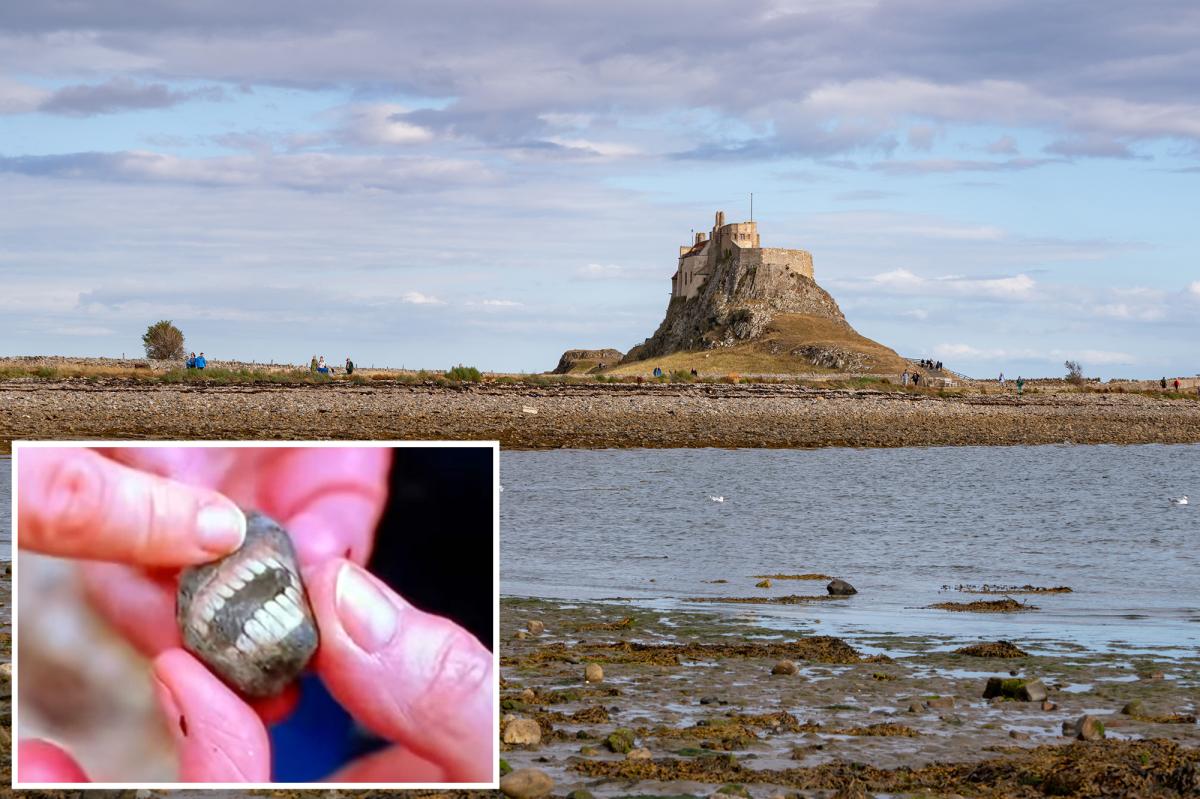
While exploring Holy Island in Northumberland, 64-year-old Christine Clark discovered a small stone that seemed to be flashing her a “smile.”
“It resembled a set of false teeth,” she recounted to the BBC about her unusual find.
Indeed, the lower half of the rock uncannily features what looks like a set of open jaws framing a dark “mouth,” all on an otherwise plain pebble.
After sharing photos of the stone on a fossil identification Facebook group, she determined that her peculiar discovery was actually an ancient marine invertebrate known as a crinoid.
Crinoids, which belong to the same phylum as sea urchins and sea cucumbers, first appeared some 500 million years ago during the Cambrian period. Although it’s one of the oldest complex animals on the planet, modern versions of it still exist today.
The creatures attach themselves to the sea floor with a flexible stem, and their bodies are surrounded by a series of branching arms that somewhat resemble a flower — earning them the nickname “sea lilies.”
“The stem consists of these little discs, called ossicles, and what Christine has found is a number of these ossicles connected together, in what is called a columnal,” Dr. Jan Hennissen, senior paleontologist at the British Geological Survey, told the outlet.
So the “mouth” formation in the stone Clark found weren’t teeth at all, but one of those stems bending and forming in just the right shape.
“It is probably from a rock formation called the Alston formation, which is a dark limestone, and that is about 350 million years old,” Hennissen surmised.
Clark said she’s gotten a number of offers to buy the fossil, but so far plans on keeping the unusual artifact.
“It brings a lot of amusement to many people,” she said.