
Share this @internewscast.com

During the installation of a new sewer line in Scotland, workers stumbled upon an unexpected discovery: ancient human remains and traces of a much older settlement.
According to a press release from Scottish Water dated January 28, the burial site is believed to originate from the 6th century AD.
This remarkable find occurred at Windhill in the Scottish Highlands.
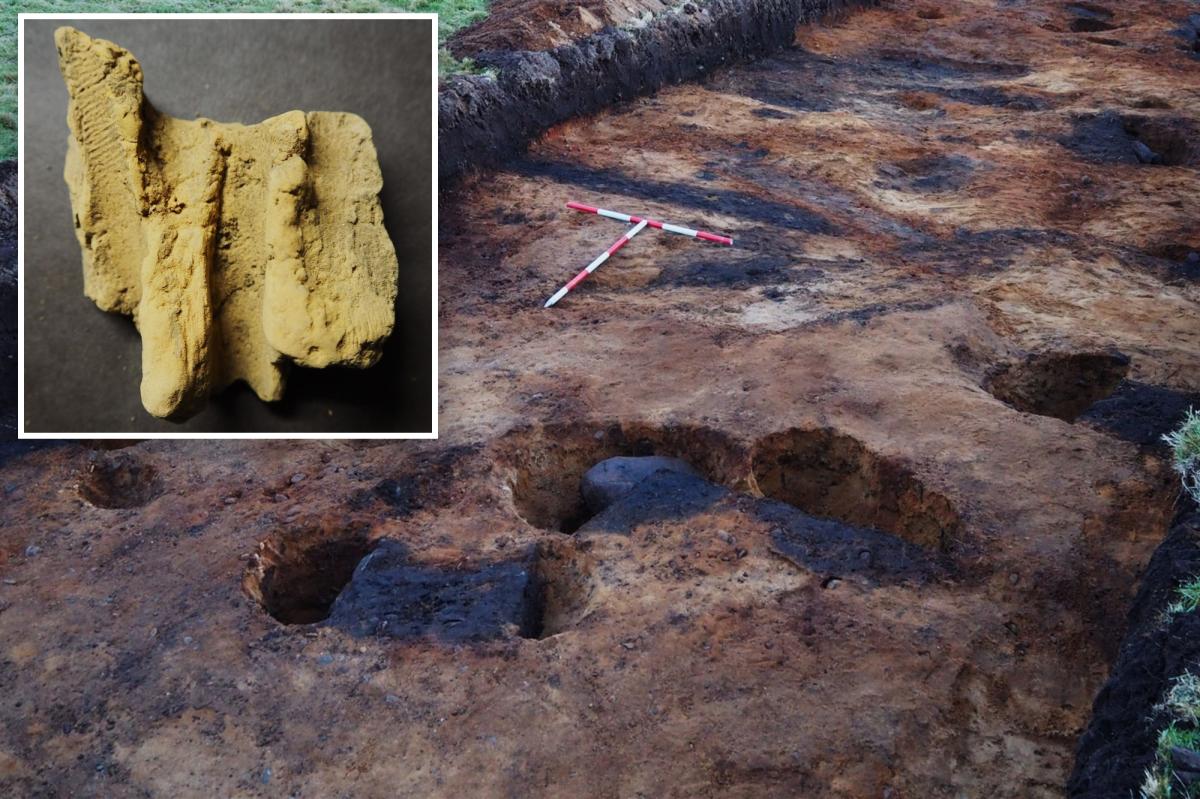
In a striking revelation, archaeologists also uncovered two roundhouses tracing back to the Iron Age, with origins possibly reaching back 3,000 years.
Additionally, the excavation team discovered stone tools and a pair of smelting furnaces, which, as stated by Scottish Water, “would have been housed in structures outside the roundhouses.”
The press release further explained that “the furnaces would likely have produced significant heat and fumes, precluding them from being set within an enclosed space.”
“This is evidenced by the arcs of post holes that were much shallower than the settings for the roundhouses and likely formed ancillary, temporary structures.”
Artifacts and environmental materials from the site can reveal “much about daily life,” both during the Iron Age and the 6th century AD, said Steven Birch, an archaeologist at West Coast Archaeological Services.
“The two smelting furnaces and a smaller [blacksmith’s] hearth were relatively well-preserved and during the excavations I was able to reveal much detail about their construction and use,” he said.
One of the 6th-century burials had been placed in a log coffin, Birch said — and although most of the remains did not survive, a soil stain marked where it had been laid, along with a few cranial fragments.
“There were no grave goods, which is typical of graves from this period in Scotland — unlike the well-furnished Anglo-Saxon burials of this period in England.”
Experts were aware that the site held some archaeological potential, as “a large number of prehistoric features” were found a few years ago, Birch said.
Birch also described the condition of the two prehistoric roundhouses as “excellent,” contributing to new evidence of a settlement at the site.
“Within a wider context, these types of discoveries add to a growing corpus of sites around the Moray Firth Basin, suggesting the area was a well-populated one during prehistory, and with widespread evidence for industrial activities including metalworking,” he said.
He added, “These sites produced no pottery, but [rather] a range of stone tools for grinding grain, some small fragments of copper-alloy, and iron objects, which require further analysis.”
He also said, “Environmental materials recovered from bulk samples include charcoal, burnt hazelnut shell and some burnt grain… likely six-rowed barley.”
Because the soil is highly acidic, few bones survived from the burial site, though several fragments were recovered.
The most surprising discovery was clay daub in the roundhouse — or mud plaster that was used to cover woven wooden walls.
What made the daub so unusual was its decoration — particularly its chevron, or V-shaped, patterns.
“I can confirm that such decoration is incredibly rare and this is the first instance found within Scotland, if not the U.K., although additional research is required here,” he said.
He also said that, by the time that 6th-century people lived there, some evidence of the earlier Iron Age roundhouses was still visible.
“We know that, during the early medieval period, although Christianity was coming to the fore, people still had respect for [their pagan] ancestors, and that prehistoric standing stones and earlier burial monuments were linked to the deep past and ancestors,” he said.
“These later barrows are often focused on these earlier monuments.”
He added that remains from the site — including burnt plant remains, animal bones and human teeth — can “provide some insights into diet and subsistence.”
Researchers are now conducting radiocarbon dating and isotope analysis on the remains in hopes of building a clearer timeline of the site.