Share this @internewscast.com
Earlier this year, Argentine President Javier Milei made significant strides in transparency by declassifying documents concerning some of the most notorious Nazi criminals. Among these files, one figure looms large: Josef Mengele, infamously known as the “Angel of Death.” The revelations highlight how Mengele led a life of relative freedom in Argentina, avoiding capture due to a lack of international cooperation.
Josef Mengele was a physician in the Nazi regime, notorious for his horrific medical experiments conducted at Auschwitz, particularly on twins. His experiments, carried out under the pretense of scientific inquiry, were marked by extreme brutality. The declassified Argentine documents contain chilling eyewitness testimonies that describe Mengele’s sadistic methods, including forcing twins to endure experiments in each other’s presence after their parents were sent to their deaths.
One entire binder from the declassified documents is devoted to tracking the infamous Auschwitz doctor and SS officer, detailing his movements and activities.
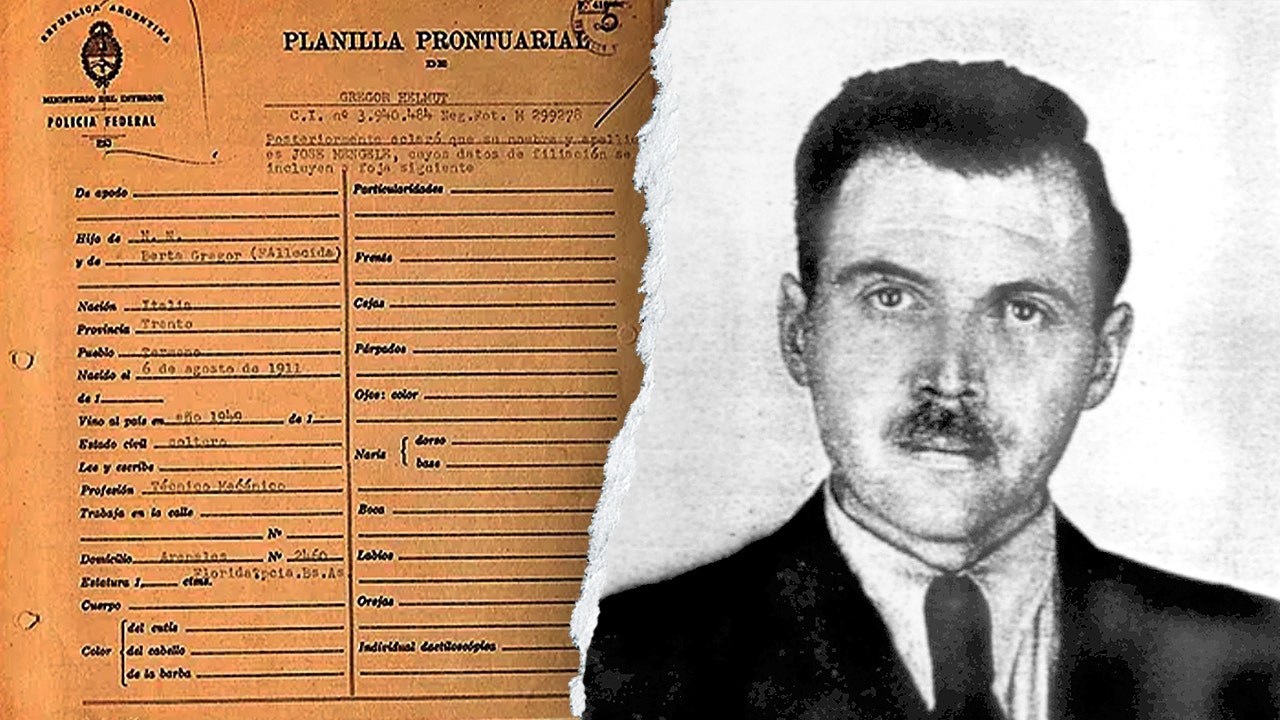
The declassified records reveal that Argentina was fully aware of Mengele’s identity and presence by the late 1950s. Authorities knew he had entered the country in 1949 with an Italian passport under the alias Helmut Gregor, which he used to secure an official immigration ID in 1950.
The Argentine archives illuminate the networks that shielded Mengele. Despite being fragmented and multilingual, with documents in Spanish, German, Portuguese, and English, the files offer a glimpse into how authorities documented, mismanaged, and often ignored critical information regarding this infamous war criminal.
Included in the collection are photographs, intelligence notes, immigration records, surveillance reports, and correspondence that map out decades of investigative efforts. These materials illustrate how he moved across Argentina, Paraguay, and eventually Brazil. The presence of documents in German suggests the involvement of foreign intelligence or information from émigré communities, while Portuguese documents indicate coordination with Brazilian sources, and English notes point to interactions with U.S. or British intelligence agencies.
The files contain an undated press clipping of an Argentine citizen born in Poland, José Furmanski, who was a victim of Mengele, showing Argentinian intelligence were aware of the accusations against the Nazi criminal.
“I met Mengele. I knew him well. I saw him many times in the Auschwitz camp, with his SS colonel’s uniform and, on top of it, the white doctor’s coat,” says Furmanski in the interview.

An Argentine file on Josef Mengele (left) and a photo taken by a police photographer in 1956 in Buenos Aires for Mengele’s Argentine identification document. (General Archives of the Government of Argentina/Universal History Archive/Universal Images Group via Getty Images)
The interview goes on to explain that Furmanski, who had a twin, gave his vivid testimony of the experiences performed on them. The report labeled Mengele as a pathological sadist.
“He gathered twins of all ages in the camp and subjected them to experiments that always ended in death. Between the children, the elderly, and women… what horrors. I saw him separate a mother from her daughter and send one to certain death. We will never forget,” Furmanski said.
Dozens of scanned images without embedded text and internal labeling of hundreds of pages signal a systematic effort by Argentine intelligence to compile a complete personal file of Mengele, including copies of foreign passports under aliases, photographs of suspected associates, handwritten operational notes, immigration ledgers or border-crossing logs, investigative summaries prepared for political superiors and correspondence between Argentine officers and international investigators.
The files corroborate Argentina’s ambiguous postwar position of cooperating with Western democracies, extremely disjointed bureaucracy, lack of will or understanding regarding the serious nature of crimes committed by former Nazis in its territory and a reluctance by higher-hierarchy authorities to confront how deeply Nazi fugitives were embedded within the country’s social and political landscape.
In 1956, trying to expand his business partnership, he obtained a legalized copy of his original birth certificate from the West German Embassy in Buenos Aires, requested his ID be judicially amended to reflect his real biographical data and — surreally — began using his original legal name, a sign of how safe he felt in Argentina.
Argentine agencies by this point not only knew who he was, where he lived, and the fact that he married his brother’s widow and was raising their son, but also had full details regarding his business interests in the country. Reports in the files cite a possible visit by Mengele’s father to Argentina to help him financially, investing in a medical laboratory business in Buenos Aires.
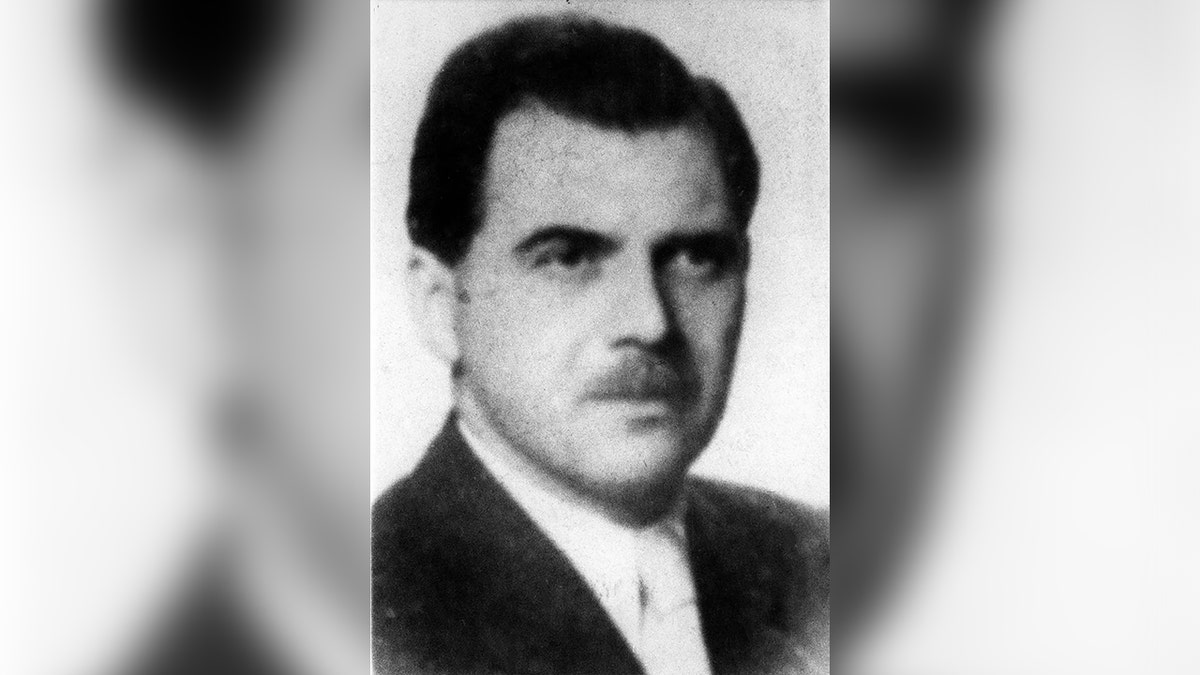
This file picture of 1956 shows the WWII war criminal Josef Mengele. Archaeologists in Berlin have unearthed a large number of human bones from a site close to where Nazi scientists carried out research on body parts of death camp victims sent to them by sadistic SS doctor Mengele. (AP Photo, file)
The overt nature of his life in the country prompted West Germany to issue an arrest warrant and request his extradition in 1959, which was denied without further action by a local judge, citing that the request was unofficially based on “political persecution” of Mengele, which didn’t allow for the case to be taken up.
Despite all the hard evidence accumulated, it is clear that the information was fragmented among various different agencies that did not fully communicate with one another. There was also a lack of direct communication with the country’s presidency and executive branches. This led to action on the case being decided in a disconnected manner, and often too late — or after press leaks had already alerted Mengele of possible concern by authorities — to yield fruitful results. Arrest warrants, searches, and surveillance requests were often carried out or decided after the fact, leading to dead ends.
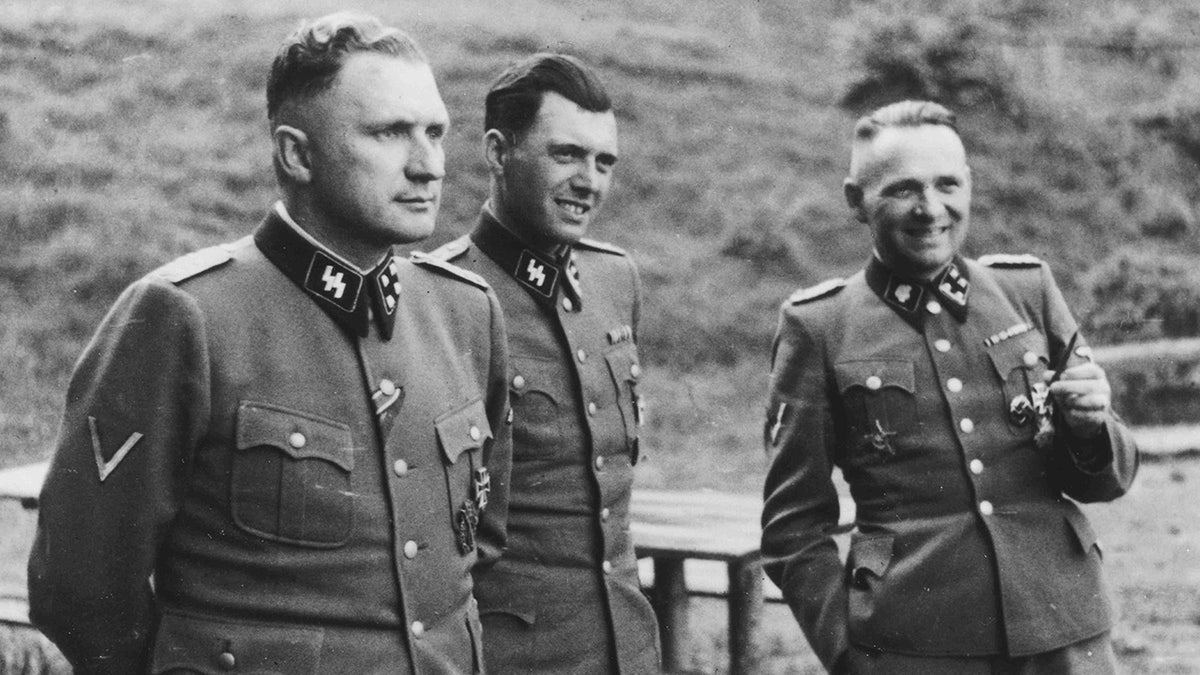
Josef Mengele seen with two other SS officers socializing on the grounds of the SS retreat outside of Auschwitz, at ÒSolahutteÓ, 1944. From left to right they are: Richard Baer (Commandant of Auschwitz), Dr. Josef Mengele and Rudolf Hoess (the former Auschwitz Commandant) (Universal History Archive/Universal Images Group via Getty Images)
After the 1959 extradition request and with increased international pressure on Argentina, Mengele escaped the country to Paraguay, while his wife and stepson moved to Switzerland.
This is evident from a memo from the Federal Coordinate Directorate marked as strictly secret and confidential detailing a search for Mengele and his business interests dated July 12, 1960 — a point when Mengele had already left Argentina for Paraguay.
“I bring to the knowledge of the Chief that from the investigations carried out in order to fulfill the referenced O.B., it follows that JOSÉ MENGELE, served as a partner of the medical laboratories “FADRO-FARM” located at Drysdale 3573 Street, in Carapachay, District of Vicente López, and with offices, since July of this year, at Cramer 860 Street, Capital. The subject, listed as a medical doctor, was entered into the firm on July 10, 1958, as a contributing partner of $10,000 pesos in capital, and withdrew from the partnership in April of 1959,” the report stated.
“Since entering Argentina, the subject resided on the property of the Mengeles, using the name of Dr. GREGOR […], the subject manifested that he had arrived in Argentina using a different name and distinct from his profession […]. Thus, it appears that, while maintaining his real name, the subject belonged to the SS Society […] during which time he demonstrated being nervous, having stated that during the war he acted as a physician in the German S.S., in Czechoslovakia, where the Red Cross labeled him a “war criminal”. He had studied Anthropology and was known to the Justice in the courts of Nuremberg, especially regarding the study of skulls and bones, but that union was considered a crime in National Socialist Germany,” the report states about Mengele when, in the course of changing his name from his fake alias to his real identity, the Nazi “explained” his motives for originally not using his real identity,” it said.
Argentina’s intelligence community kept following Mengele mostly through press reports and contacts with foreign agencies. Mengele acquired Paraguayan citizenship and was protected by the government of Paraguayan dictator Alfredo Stroessner, whose family originated in the same Bavarian town as him.
The archives reveal Mengele entered Brazil clandestinely at some point in 1960 through the tri-border area near Paraná state. He was helped by German Brazilian farmers who were Nazi sympathizers and provided multiple rural safehouses for several years.
Though the Argentine files are thin on details and rely heavily on media clippings at this point, Argentina was aware that Mengele had adopted the alias Peter Hochbichler, though sometimes he also used a Portuguese version of his real name — José Mengele. For the latter part of the 1960s and throughout the 1970s, he began living in properties belonging to the German Bossert and Stammer families in São Paulo state, Brazil.
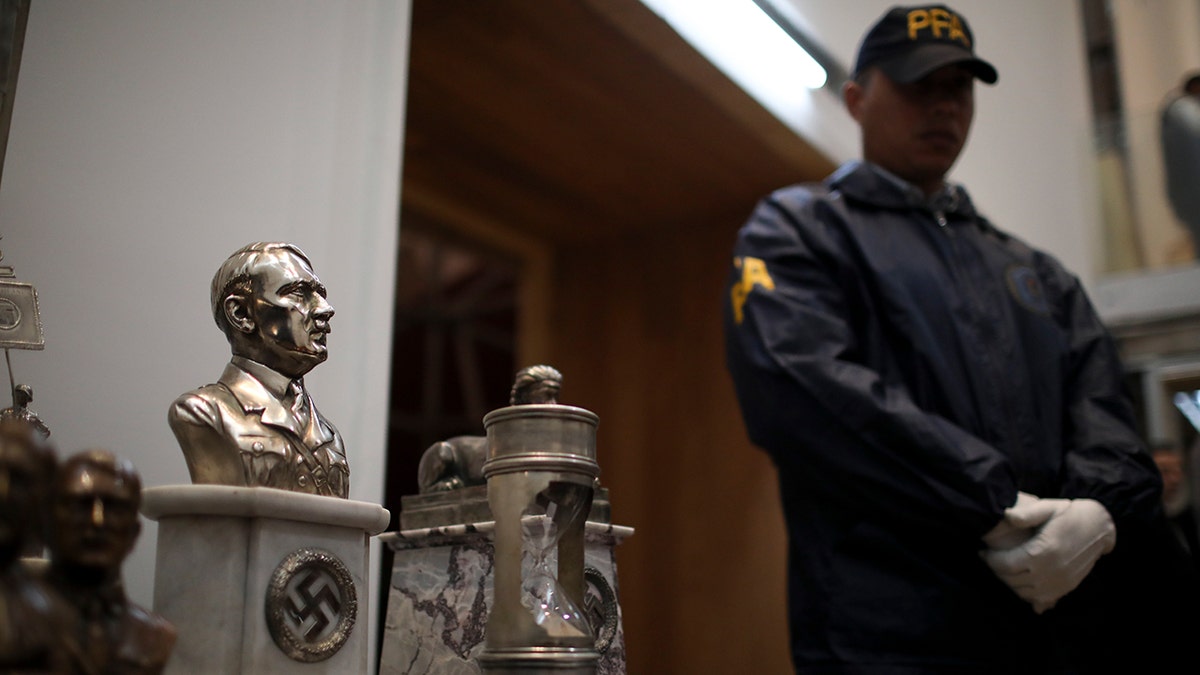
A police officer stands in front of a cache of Nazi artifacts discovered in 2017, during a press conference in Buenos Aires, Argentina, Wednesday, Oct. 2, 2019. Argentine authorities found the cache in a secret room behind a bookcase and had uncovered the collection in the course of a wider investigation into artwork of suspicious origin found at a gallery in Buenos Aires. (Natacha Pisarenko/AP Photo)
Mengele died in 1979 when he suffered a stroke while swimming at sea in the coastal town of Bertioga. He was buried under the false name of Wolfgang Gerhardt, but multiple leads led to his body being exhumed and his remains being positively identified by Brazilian authorities in 1985. DNA testing further confirmed the findings in 1992.