
Share this @internewscast.com

Historically, military conflicts in the Middle East have not led to sustained downturns in financial markets, but the current surge in oil prices could have lasting impacts.
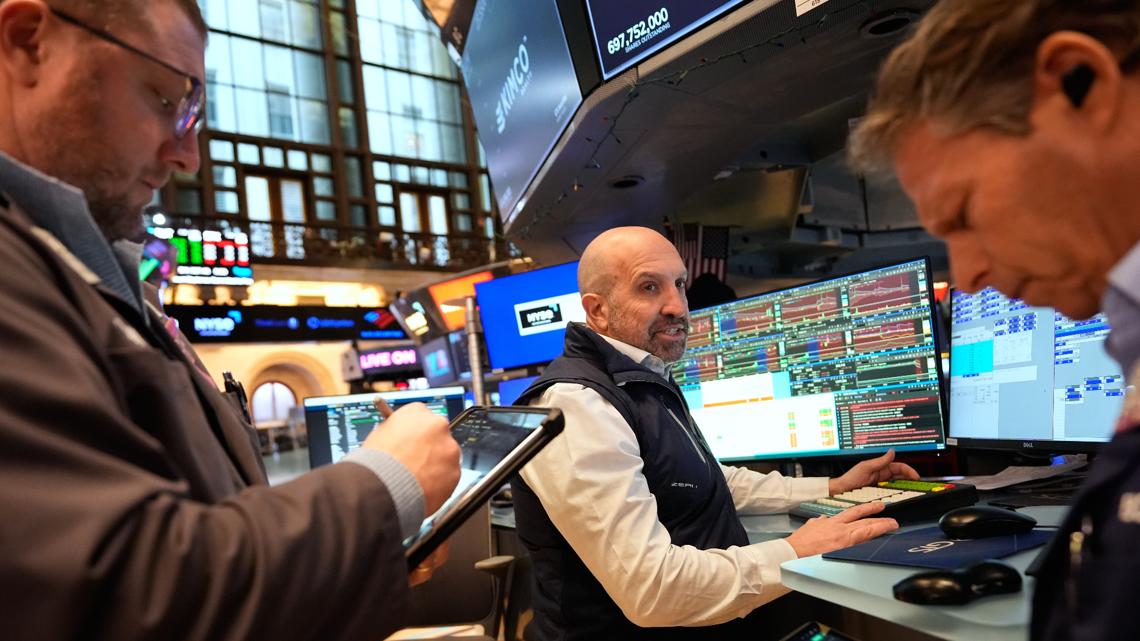
WASHINGTON D.C. — U.S. stock markets are experiencing declines this Monday as oil prices surge amid fears that ongoing conflict in the Middle East might disrupt the global oil supply and exacerbate inflation issues.
The price of crude oil has surged by 6%, which is expected to soon translate into increased prices at the gas pump. This rise would not only affect American households, whose consumer spending is a major component of the U.S. economy, but also impact businesses facing substantial fuel expenses.
The S&P 500 experienced a 0.3% decrease, with the most significant losses observed in the cruise line and airline sectors. Initially, the index fell by as much as 1.2% in early trading before recovering slightly.
The Dow Jones Industrial Average dropped by 199 points, or 0.4%, at 10:45 a.m. Eastern time, and the Nasdaq composite saw a decline of 0.1%.
Natural gas prices also saw an uptick, potentially leading to higher heating costs for the rest of the winter. This comes after a key supplier of liquefied natural gas to Europe announced a halt in production due to the conflict. Meanwhile, gold prices rose by 2.1% as investors sought safer assets, while U.S. officials worked to reassure the global community that the conflict is not expected to be prolonged.
“This is not Iraq,” U.S. Defense Secretary Pete Hegseth said Monday. “This is not endless.”
Typically, Treasury yields also fall when investors are feeling nervous. But yields instead climbed, in part because higher oil prices will put upward pressure on inflation, which is already worse than what nearly everyone would like. That could tie the Federal Reserve’s hands and keep it from cutting interest rates.
Lower interest rates can boost the economy and job market, while also worsening inflation. Higher rates can do the opposite.
Past military conflicts in the Middle East have not caused long-term drops for markets. For this war to knock down U.S. stocks in a significant and sustained way, the price of oil would perhaps need to jump above $100 per barrel, according to strategists at Morgan Stanley led by Michael Wilson.
Oil prices are still well below there. A barrel of benchmark U.S. crude rose 6.4% to $71.31. Brent crude, the international standard, climbed 7.8% to $78.59 per barrel.
That helped the U.S. stock market pare some of its steep, opening loss. Morgan Stanley says the S&P 500 has climbed an average of 2%, 6% and 8% in the one, six and 12 months following “geopolitical risk events” historically. That’s going back to the Korean War, which began in 1950, and the 1956 Suez crisis.
At the moment, though, fear is still running through markets.
Stocks of airlines were some of Monday’s sharpest losers. Not only do higher oil prices threaten their already big fuel bills, the fighting in the Middle East also closed airports and left travelers stranded.
United Airlines fell 3.2%, and American Airlines lost 4.2%.
Norwegian Cruise Line Holdings fell even more, 9.8%. It needs customers to have plenty of cash to spend after paying for their gasoline bills and other essentials.
The cruise operator also reported weaker revenue for its latest quarter than analysts expected, though its profit was better. Its forecast for profit this upcoming fiscal year was lower than analysts expected.
Hotels, discount retailers and other companies that benefit when customers have more cash in their pocket from lower fuel bills also lagged the market. MGM Resorts fell 3.1%, and Dollar Tree lost 2.5%.
Stocks in the housing industry also struggled as higher Treasury yields could translate into more expensive mortgage rates. Paint company Sherwin-Williams fell 2.9%, and homebuilder D.R. Horton lost 3.9%.
Helping to limit Wall Street’s losses were oil companies, which benefited from the rising prices for crude. Exxon Mobil climbed 0.9%, and Occidental Petroleum rose 2.1%.
Companies that make equipment for the military also strengthened. Lockheed Martin climbed 3.1%, and RTX rallied 4.3%.
In stock markets abroad, indexes fell across much of Europe and Asia. Germany’s DAX lost 2.5%, France’s CAC 40 fell 2.3% and Hong Kong’s Hang Seng dropped 2.1% for some of the world’s larger losses.
Stocks in Shanghai were an outlier and rose 0.5%.
In the bond market, the yield on the 10-year Treasury rose to 4.04% from 3.97% late Friday. A report showing growth for U.S. manufacturing was better than economists expected last month also helped to lift yields.
AP Business Writers Matt Ott and Elaine Kurtenbach contributed.