Share this @internewscast.com

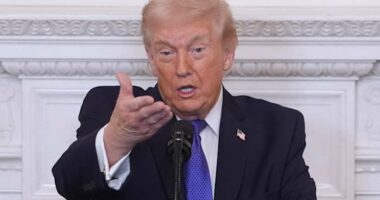
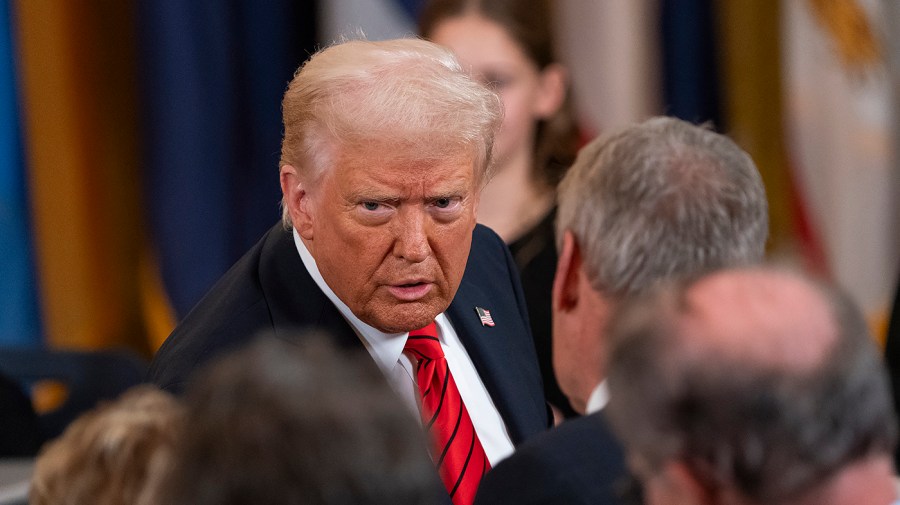
President Trump’s efforts to upend the conventional understanding of birthright citizenship heads to the Supreme Court this week, the first time in his second term that the justices will consider a major administrative action from the bench.
The justices won’t be directly addressing the constitutionality of Trump’s order blocking automatic citizenship for children born on U.S. soil to noncitizens, for now. The administration has so far only asked the justices to narrow the nationwide reach of several district judges’ injunctions, contending they went too far.
But the case has already invigorated a debate on the legal right about whether the president’s shake-up is valid.
Trump suddenly disrupted the status quo on his first day back in office. He issued an executive order that would restrict birthright citizenship for children born on U.S. soil whose parents don’t have permanent legal status. He promised such action on the campaign trail.
The order has been challenged in 10 different lawsuits, several of which are now before the Supreme Court on its emergency docket.
In a rare move for an emergency appeal, the justices on Thursday will hold oral arguments on the matter of nationwide injunctions before deciding whether lower courts can issue such injunctions when ruling against Trump’s order.
But looming in the background is the major debate over the 14th Amendment’s Citizenship Clause, a dispute contested across the political spectrum, including in conservative legal circles, that could ultimately reach the high court.
Most academic scholars have long espoused the view that birthright citizenship applies to nearly anyone born in the country, with few exceptions.
Within the conservative legal community, the debate has already come to the forefront in digesting Trump’s order through a competing series of academic papers, legal blog posts and even live, in-person debates.
Two law professors raised the debate’s profile in February when they signaled in a New York Times op-ed that Trump might emerge victorious if the Supreme Court weighed the matter.
“When they finally consider this question, the justices will find that the case for Mr. Trump’s order is stronger than his critics realize,” wrote University of Minnesota law professor Ilan Wurman and Georgetown University law professor Randy Barnett.
Proponents of Trump’s plan have zeroed in on a qualification in the Citizenship Clause that narrows birthright citizenship to children born in the U.S. who are “subject to the jurisdiction thereof.”
That exception has traditionally been interpreted to exclude foreign diplomats’ children, foreign enemies in hostile occupation or Native American children subject to tribal laws. But some say the children of noncitizens fall under that umbrella, too.
Kurt Lash, a law professor and constitutional scholar at the University of Richmond, made that case in a paper first published to the online research platform Social Science Research Network in February. His latest updates have included input and critiques from a broader group of legal minds.
He argues that children born to noncitizens today are “analogous” to Native Americans at the time of the 14th Amendment who did not recognize the United States’s sovereign authority, positing that noncitizens intentionally entered the country without authorization and likewise refuse to “formally present themselves” to American authorities.
“Although the children would have presumptive citizenship, that presumption would be rebutted by their birth into a familial context of refused or counter-allegiance to the American sovereign,” he wrote.
The burst of support for narrowing birthright citizenship has drawn plenty of critics.
Evan Bernick, a law professor at Northern Illinois University who describes himself as an originalist, wrote in post to the legal blog The Volokh Conspiracy that he expects Lash’s paper to be the “leading academic defense” of the constitutional position set out in Trump’s order. Then he proceeded to dismantle it.
Bernick argued that Lash’s analogy between noncitizen children and the children of Native Americans contains “fatal shortcomings,” pointing to the fact that the “reality” faced by noncitizens and their children doesn’t match that of Native Americans at the time.
He noted that Native Americans could not be sued, prosecuted or bound without treaty-based consent. That’s not true for noncitizens and their children.
“Denying the children of undocumented people citizenship subjects them to all that power without affording them any protection, contrary to the basic allegiance-protection framework that undergirds Lash’s theory,” he wrote.
Bernick and Wurman, the op-ed author, squared off on the topic at a Federalist Society event last month, one of several in-person legal conferences where birthright citizenship has become a hot topic.
There, Bernick said the conventional wisdom about birthright citizenship is correct, and “obviously so.” Wurman also an originalist pushed back that the matter is “plainly not” settled.
Though opinions still differ between conservative legal scholars, minds have been changed as well.
U.S. Circuit Judge James Ho, a member of the conservative-leaning 5th U.S. Circuit Court of Appeals, who is seen as a possible Supreme Court nominee if a vacancy arises during Trump’s term, seemingly shifted his views on the subject after insisting that the widely accepted view of birthright citizenship is the right one.
“Birthright citizenship is guaranteed by the Fourteenth Amendment. That birthright is protected no less for children of undocumented persons than for descendants of Mayflower passengers,” Ho wrote in a 2006 paper.
Ho, himself a Taiwanese immigrant, advanced those views for years, including in a 2011 Wall Street Journal op-ed. But in an interview with conservative law professor Josh Blackman in November, days after Trump was elected president, the judge walked back his position.
“No one to my knowledge has ever argued that the children of invading aliens are entitled to birthright citizenship,” he said.
Despite being hotly debated, these questions will not be directly before the justices on Thursday.
Instead, they are tasked with deciding whether lower courts can as they’ve done issue nationwide injunctions when striking down Trump’s order, as opposed to issuing relief to only those directly involved in litigation or living in states that sued the administration.
However, the appeal has opened Pandora’s box. Dozens of states, lawmakers, scholars and advocacy groups weighed in with the court over whether the Constitution guarantees citizenship to the children of noncitizens born on U.S. soil.
“The President must participate in the political process and adhere to our constitutional structure, not simply ignore them,” more than 180 Democratic lawmakers wrote in a friend-of-the-court brief, countering the government’s stance. “And unless and until Congress changes the laws, the President must follow them.”