
Share this @internewscast.com
Few illnesses are as devastating as dementia, yet my mother-in-law managed to hold onto glimpses of her personality right up until her passing.
Joanne, ever the mischievous spirit, charmed the wonderful staff at her care home. Drawing from her background as a nurse and midwife, she often offered them assistance.
Some staff members even considered her more a colleague than a resident until she peacefully passed away last Wednesday at 84, three years after her Alzheimer’s diagnosis.
The gradual decline of memory is a stealthy adversary, and in Joanne’s case, signs were apparent long before her condition was formally diagnosed.
She adeptly concealed her forgetfulness and frequent repetition, downplaying her increasingly frequent episodes of getting lost on her walks around her hometown in Perthshire. She valued her autonomy deeply.
Though she lost that independence upon moving into the care home, she remarkably maintained a resilient sense of cheerfulness.
In its later stages, the anxiety is more likely to be felt by relatives than the sufferer.
It can be alleviated, briefly, when a fragment of music reignites a memory, or a fleeting flash of recognition (for Joanne, it was a haunting Beatles B-side, Yes It Is, and Neil Diamond, with a dash of Dame Vera Lynn thrown in for good measure).

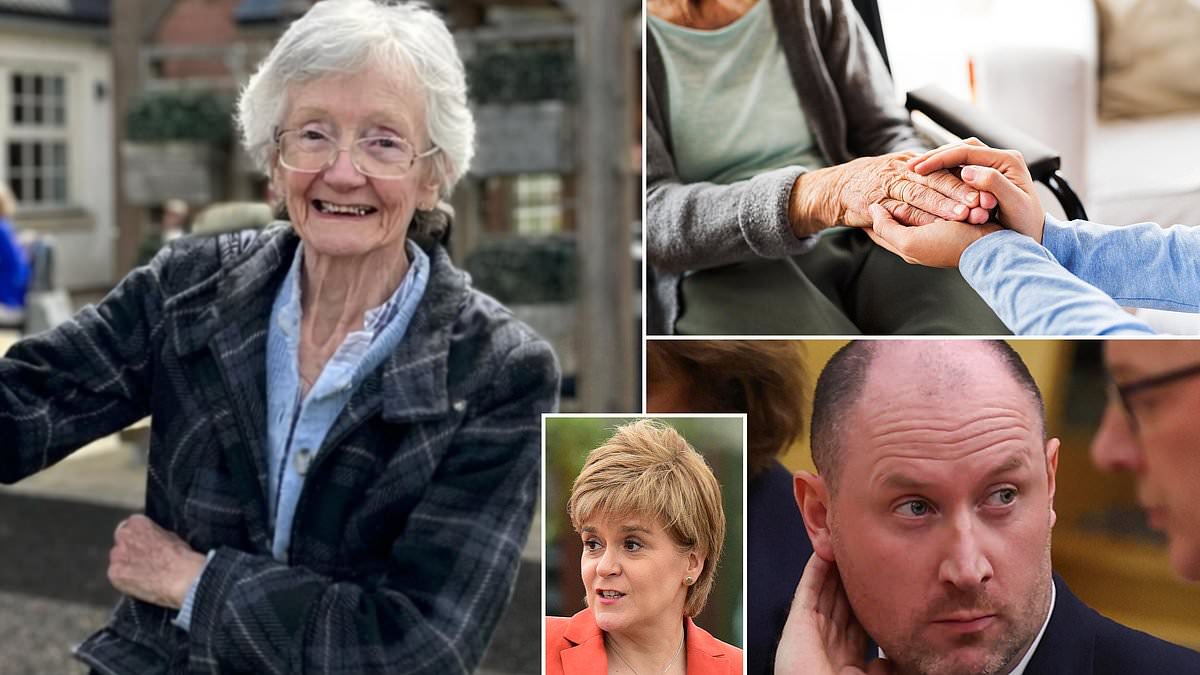
Joanne Burns died last Wednesday at the age of 84 – three years after she was diagnosed with Alzheimer’s

A total of 6,612 deaths were attributable to Alzhemier’s and other dementias in Scotland in 2024 – around one in 10 of all deaths
Our family is far from alone in confronting Alzheimer’s. There are around 90,000 people struggling with dementia in Scotland (with numbers projected to rise by more than 50 per cent by 2044), and one million in the UK.
In December, the Mail launched its Defeating Dementia campaign, in association with the Alzheimer’s Society, aiming to raise awareness of the disease, increase early diagnosis, and boost research and improve care.
It followed startling figures which showed dementia accounts for one in nine deaths in the UK – and claims 76,000 lives each year.
There were 6,612 deaths in Scotland caused by Alzheimer’s and other dementias in 2024, equivalent to around one in ten of all deaths, and the rate per 100,000 has almost doubled over the past two decades.
Yet there is a sense that the country is under-prepared and ill-equipped for the surge in cases – and the strain it will place on the NHS and on the families affected.
One of the early obstacles to getting help is denial on the part of the person with dementia – and relatives who may not want to accept what’s happening.
In our own case there were signs of looming problems which on reflection were plain enough. GPs
conduct cognitive tests which don’t always detect dementia in its earliest stages – so it was heartening last month to learn of an international trial examining whether a simple finger-prick blood test could be used to help diagnose Alzheimer’s.
It wasn’t until Joanne, pictured, could no longer safely live alone that she was taken into care, and mercifully that was a relatively quick process. But by then she couldn’t have spent much longer living on her own.
An initial stay in a nearby care home was short-lived as it wasn’t geared up to dealing with dementia patients.
And we were fortunate, as many others aren’t, that Joanne then spent nearly three years in a home where she was well looked after.
But it took near-crisis for any meaningful intervention to occur. Yet it’s far from clear that government is taking these problems seriously, when you consider the major cuts it’s inflicting on dementia care and support.
Alzheimer Scotland says it has been ‘overwhelmed by public support’ for its Stop the Cuts campaign – fighting to stop almost £154million from being cut from services for older people and community care across Scotland.
It points out that on other major health conditions such
as cancer, heart disease and diabetes, Scotland already has ‘clear national care pathways’.
These guarantee timely diagnosis, consistent treatment, and specialist care no matter where someone lives – but for dementia, there are no such safeguards.
This is remarkable, given the prevalence of the condition and its devastating repercussions.
Join the debate
What needs to change for dementia care to truly support families facing this devastating disease?

Health Secretary Neil Gray tried to buy tickets for an Oasis concert while he was supposed to be chairing a conference session on tackling dementia

Plans for a ‘national care service’ – hailed by Nicola Sturgeon – were axed after projected costs ballooned to £2bn
We also have a Health Secretary, Neil Gray, who tried to buy Oasis tickets while he was meant to be chairing a conference session on tackling dementia.
That was a slur on the thousands of families trying to cope with the disease – and one many won’t forgive.
The reality is that Mr Gray and his government are entirely unequal to the massive task of providing effective dementia treatment and care.
Around £30million was spent on botched plans to bring in a ‘national care service’, which Nicola Sturgeon said in September 2020 would ‘match the post-war National Health Service’. It was originally estimated to cost between £644million and £1.26billion over five years but the projected costs soon ballooned to £2billion.
The failure of the scheme merely succeeded in kicking the can of social care reform further down the road.
In the meantime, not a single hour of extra care was delivered and the taxpayer was left to pick up the tab.
As Alzheimer Scotland’s chief executive Henry Simmons says, ‘long-term residential care for people with dementia has been developed largely through an open market approach, with no meaningful local plans or strategy’.
This has led to a ‘financially driven sector that is in a critical state – and in some areas at risk of collapse’.
The charity is calling for a plan to ‘design services that can meet these needs going forward’. The logic is indisputable but it’s rarely backed up by concrete action from a government with a long record of waste and inefficiency.
Yet there are grounds for cautious optimism that medical science holds the key in the longer term to turning the tide against dementia.
Because it is caused by different diseases, it is unlikely that there will be a single cure.
But it’s reckoned that up to 40 per cent of people will be able to reduce their risk of developing it through stopping smoking, reducing their blood pressure, or getting involved in activities that help them be less socially isolated.
Researchers believe that within five to ten years, they will develop treatments that are ‘truly life-changing’.
The Covid pandemic and the development of vaccines showed what can be achieved and how quickly when there is sufficient political willpower, backed up by investment. The same approach should be taken on dementia.
Alzheimer’s and related conditions have been too far down the list of priorities for too long.
Every sinew should be strained to curb this silent killer – and provide some respite for families forced to witness the inexorable decline of their loved ones.