
Share this @internewscast.com
Beginning Thursday, a significant snowstorm is predicted to hit the UK, marking the most severe cold spell of the winter season and causing widespread disruptions.
Today, numerous schools remain shut, and the UK is experiencing turmoil on the roads, railways, and airports. Health authorities have issued urgent warnings in light of the situation.
This morning, the Met Office announced that Storm Goretti is set to deliver extensive snowfall, torrential rain, and intense winds to England and Wales on Thursday and Friday.
Weather experts have placed new yellow alerts for snow and wind across South West England, the Midlands, and Wales in anticipation of the approaching storm, which has been named by Météo-France.
In Devon and Cornwall, coastal winds could reach speeds of up to 70 mph, while regions with higher elevations in England and Wales might see snowfall as deep as 8 inches (20 cm).
Concurrently, the UK Health Security Agency (UKHSA) has extended its amber cold health alerts in England until Sunday, citing worries over an increase in mortality rates.
The UK’s overnight low into this morning was -12.5C (13.8F) at Marham in Norfolk; while London, Birmingham, Bournemouth and Southampton all fell to -8C (18F).
The heaviest snow has fallen in Scotland with 52cm (1ft 8in) recorded by the Met Office at Tomintoul in Banffshire, but there was also snowfall in London today.
At least 775 schools closed due to the weather today – including 183 in Northern Ireland , 159 in Aberdeenshire, 104 in Carmarthenshire, 82 in Staffordshire, 74 in Gwynedd, 72 in Moray, 45 in North Yorkshire, 41 in Ceredigion and 14 in Wrexham.
This morning, severe weather conditions again disrupted road, air and rail travel for commuters with some train lines blocked after heavy snow drifted onto the tracks.

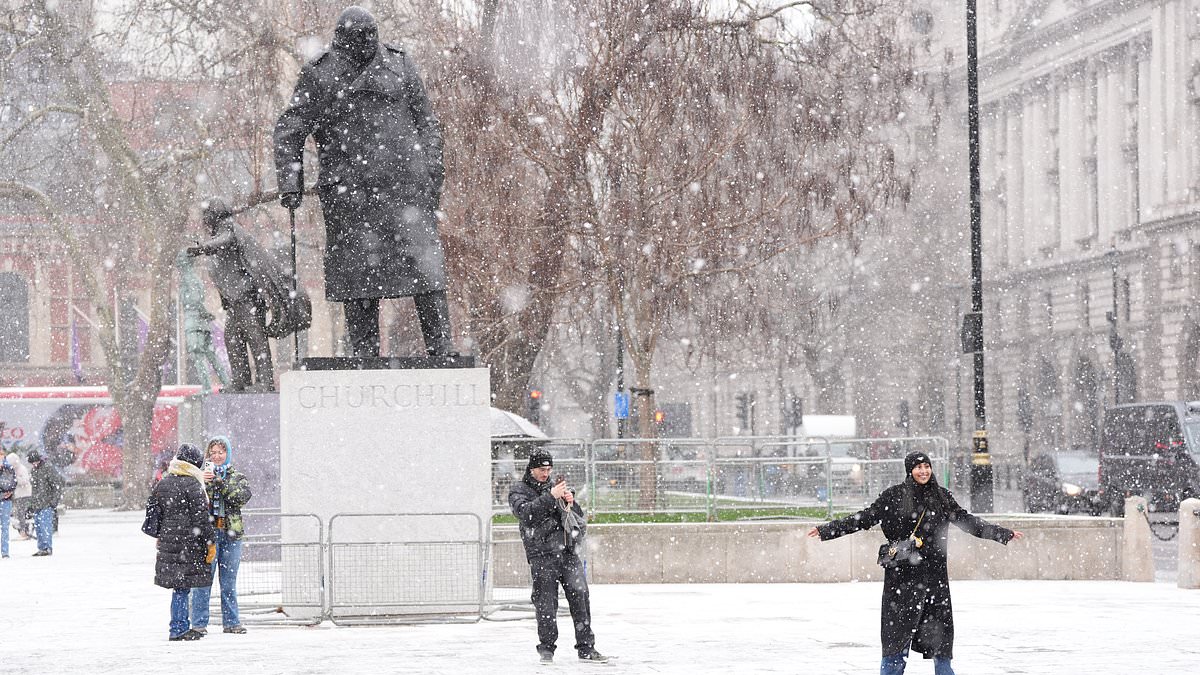
People enjoy the snow in Westminster this afternoon as the UK is hit by severe weather

A double-decker bus crashed on an icy surface on Aigburth Drive in Liverpool this morning

The A97 in the Aberdeenshire village of Rhynie today amid severe snowy and icy conditions

Snow falls on the ground at Hyde Park in London today as temperatures fall well below zero

Riley Sutcliffe sledges at Keele Hall in the Staffordshire village of Keele this morning

A man drives a small gritting vehicle to help clean the roads in Glossop, Derbyshire, today

People walk along a frozen Regent’s Canal in Central London this morning

The Met Office has issued amber and yellow snow and ice warnings for the UK today


Met Office yellow warnings for snow and ice in place for tomorrow (left) and Thursday (right)
Eurostar cancelled trains from London to Rotterdam and Amsterdam today due to severe weather on the Dutch network, with services only going as far as Brussels.
LNER told passengers travelling between London King’s Cross, Leeds and Edinburgh to ‘defer travel until further notice’ due to a broken rail, and also issued a separate ‘do not travel’ warning between Edinburgh and Aberdeen because of significant snowfall.
Great Northern said a frozen set of points in Norfolk today meant trains could not run between Kings Lynn and Ely; while the conditions also cancelled Merseyrail’s Wirral services between Maghull and Rice Lane and between Liverpool and Rock Ferry.
Those in West London using the Elizabeth line, Great Western Railway or Heathrow Express also faced major disruption after damage to the overhead electric wires. Further points failures impacted services through Bristol Parkway, Clacton and Selby.
Transport for London said the Northern line was part-suspended between Kennington and Battersea Power Station due to a points failure; while the Piccadilly line had no service between Oakwood and Cockfosters this morning because of a faulty train.
The Metropolitan line had delays from Wembley Park to Aldgate due to engineering work; while the Central, Circle and District lines were disrupted due to faulty trains.
ScotRail reported disruption due to the snow on its routes between Inverness and Aberdeen, Kyle of Lochalsh, Elgin and Wick; as well as from Aberdeen to Montrose.
In Glasgow, services on the city’s subway network were suspended this morning on the inner and outer circles after ice on the third rail caused a power failure.

The man is rescued by a passer-by at Connaught Water in Epping Forest, Essex, on Sunday

The hero passer-by got the man out of the water during the rescue mission in Essex on Sunday

The passer-by took the man to safety, while the dog was also okay and reunited with its owner

The two men were helped by paramedics from the East of England Ambulance Service
Five flights from Aberdeen Airport were cancelled – four KLM planes to Amsterdam and an easyJet service to Gatwick; while three arrivals from Amsterdam were axed. Flights to and from Amsterdam were also cancelled at Inverness Airport this morning.
Meanwhile a video showed the moment a hero passer-by fell into a frozen lake while trying to pull out another man who had gone through the ice during a dog rescue mission.
The man was desperately attempting to save the stricken animal after it walked onto the ice at Connaught Water in Epping Forest, Essex, on Sunday afternoon.
But he fell through into the freezing water, and a passer-by then went onto the ice himself to try to save the man – with both ending up in the water.
Video footage captured by a member of the public showed the rescue as both men struggled to get out of the water, before they eventually made it to safety.
The pair were treated by paramedics with one of the men taken to Whipps Cross Hospital in Leytonstone, East London, for further assessment and care.

Bamburgh Castle surrounded by snow in Northumberland this morning

People walk through the snow in Westminster this afternoon as the UK is hit by severe weather

A man clears snow from a road with a digger near Gartly in Aberdeenshire this morning

Snow falls on the ground at Hyde Park in London today as temperatures fall well below zero

A man walks down a snow-covered street in the Derbyshire town of Glossop this morning

Snow falls on the Basingstoke Canal near to Dogmersfield in Hampshire this morning

A pedestrian walks their dog across a snow-covered cricket pitch today in Glossop, Derbyshire

A man passes Botriphine Primary in Drumuir, Aberdeenshire, today as schools remain shut

A train arrives into Glossop railway station in Derbyshire in the snow this morning

People walk through the snow in Westminster this afternoon as the UK is hit by severe weather

Agency refuse workers collect rubbish in the Saltley area of Birmingham in the snow today

Snowy rooftops are pictured in the Derbyshire town of Glossop this morning
The dog was safely reunited with its owners, but Essex Fire and Rescue Service urged others not to go into frozen water and instead call 999 for help.
In Epping Forest, witness Ozgur Ontas from Chingford, who filmed the footage, said the men were in the water for ten to 15 minutes before they managed to get out.
Mr Ontas, who was at the lake with his wife and daughter, also told BBC News that the emergency services arrived soon after.
He added: ‘It’s problematic for dog walkers – it wasn’t just this man, other people’s dogs also went into the lake and ran on the ice. This could happen again.’
The fire service’s watch manager Gary Dyer said: ‘We completely understand why people want to help in situations like this, but cold water can overwhelm the body very quickly.
‘The safest thing to do is stay out of the water and call us – we have the training and equipment to respond safely.’
The incident happened at 2.20pm on Sunday – with Met Office data showing air temperatures at the time were at about 3C (37F) in the Epping Forest area, along with 16mph wind gusts.
The East of England Ambulance Service confirmed one of the two men was taken to Whipps Cross Hospital.

Botriphine Primary School in Drumuir, Aberdeenshire, is among the schools closed today

Snow falls on the ground at Hyde Park in London today as temperatures fall well below zero

Bamburgh Castle surrounded by snow in Northumberland this morning

People walk through the snow in Westminster this afternoon as the UK is hit by severe weather

A man walks his dog across a snow-covered field in the town of Glossop, Derbyshire, today

A Barbary macaque in the snow at Trentham Monkey Forest in Staffordshire this morning

A man clears snow from a road with a digger near Gartly in Aberdeenshire this morning

Snow falls on the ground at Hyde Park in London today as temperatures fall well below zero

A Network Rail drone view of snowdrifts blocking a railway line in the Highlands this morning

A woman walks along a snow-covered street in the Derbyshire town of Glossop this morning

Bamburgh Castle surrounded by snow in Northumberland this morning

Agency refuse workers collect rubbish in the Saltley area of Birmingham in the snow today

Snow falls on the ground at Hyde Park in London today as temperatures fall well below zero
Firefighters said if someone or an animal gets into difficulty in cold water, people should not enter the water but instead call 999 and ask for the fire service.
They should also maintain visual contact and reassure the person or animal from a place of safety.
The service also asked people to ‘take extra care around frozen lakes and waterways and avoid walking on ice, which can look solid but is often thin and unstable’.
It comes as disruptive snow, wind and rain could hit parts of southern England this week, as an Atlantic low-pressure front meets an Arctic airmass over the country.
The Met Office said that even parts of the south may see some snow on higher ground on Thursday and Friday, while northern and central areas of England could face more snow, with rain and strong winds, depending on the path of an approaching Atlantic low-pressure system.
Forecaster Aidan McGivern there is a 20 per cent chance the system takes a northern route, which would bring widespread ‘disruptive’ wind and rain to much of England and Wales, and possibly more snow in northern England, southern Scotland and Northern Ireland.
But he said there was a 30 per cent chance that the front moves through northern France, bringing disruptive snow to southern counties in England, especially in higher areas.
The most likely outcome is wind and rain in southern parts of the UK, with central England seeing the risk of disruption from snow, he added.
Rain turning to snow will hit Scotland and northern England today, with 1cm to 5cm likely in northern England and 10cm to 15cm in central and eastern Scotland, the Met Office said.

A kingfisher dives through a break in the ice to hunt for its dinner near Saxmundham in Suffolk

The kingfisher swoops down through a break in the ice and catches a three-spined stickleback

The kingfisher flies away from the ice with its catch near Saxmundham in Suffolk
Two amber snow warnings have been issued in northern parts of Scotland until this evening, while there are also yellow snow and ice warnings across southwest England, northern England, eastern England and Wales.
A yellow ice warning is in place in Northern Ireland.
A yellow warning means some disruption is possible, such as travel delays, but many people can continue with their daily routine, according to the Met Office.
An amber warning indicates a higher risk, with severe weather likely to cause travel disruption, power cuts and the potential risk to life and property and people are advised to take precautions.
The areas covered by the amber warnings include parts of Aberdeen, Aberdeenshire, Moray, Highland, Angus and Perth and Kinross.
The UK Health Security Agency (UKHSA) has issued amber cold health alerts for England as an early warning that adverse temperatures are likely to affect health and wellbeing, running until Friday.
Temperatures dropped to -10.9C at Shap in Cumbria overnight into yesterday, and 52cm (1ft 8in) of snow was recorded by the Met Office at Tomintoul in Banffshire.
CalMac Ferries said services on the west coast of Scotland would be disrupted during today.
Meanwhile, hundreds of thousands of households are getting £25 cold weather payments to help with heating costs amid the dropping temperatures, the UK Government said.

Tower Bridge (back left) is silhouetted on a frosty clear day in central London this morning

Sunrise this morning over a frosty Glastonbury Tor in Somerset as the cold weather continues
They are made to vulnerable people, including pensioners, to help them pay for heating when the temperature dips below freezing.
Cold weather payments have been triggered on four separate days – December 30, January 1, January 2 and January 3 – covering a total of 451 postcode areas in England, Wales and Northern Ireland.
The Alzheimer’s Society urged people to check in with family and neighbours with dementia to ensure they are kept warm by dressing in layers, keeping rooms warm, using blankets or hot water bottles, staying active, getting natural daylight, maintaining routines, taking care on icy surfaces and eating and drinking regularly.
Angelo Makri of the Alzheimer’s Society said: ‘There are currently around one million people in the UK with dementia, and for many families caring for a loved one with the condition, winter can be a worrying time.
‘Knowing how to best support someone with dementia during the challenging colder months, by regularly checking in with them and following these useful tips, can help to make sure they are comfortable, safe and able to stay as independent as possible. This can also give carers important peace of mind.’
Today, an MP called for the military to be mobilised to deliver essentials to communities in Scotland cut off by extreme weather.
Andrew Bowie warned the ‘critical’ situation in the north and east of the country has left some without food and medical supplies.


In a letter to First Minister John Swinney, he urged him to ‘mobilise all available resources’ to help those impacted and request military support from the UK Government.
In the letter, which was also sent to the UK Government, Mr Bowie warned the situation is now ‘critical’.
The Tory MP for West Aberdeenshire and Kincardine said: ‘The situation has now become critical. Many people are increasingly cut off, with access to essential food supplies and medical provisions becoming extremely difficult and, in some instances, impossible.
‘There is a real and growing risk that individuals may be left without basic necessities unless urgent action is taken.
‘While emergency services, gritters, farmers and volunteer groups are going above and beyond to support their communities, in many cases they are quite simply overwhelmed by the scale and persistence of the conditions.
‘Given the seriousness of the situation, I would ask that the Scottish Government urgently considers mobilising all available resources, including the armed forces, to assist with snow clearance, the delivery of essential supplies, access to remote communities and transportation to hospitals.
‘In addition, I would urge the Scottish Government to take further steps to inform and reassure the public, through leaflets and online resources, with clear guidance on how to keep you and your family safe and how to request help during emergencies.’


Police Scotland Assistant Chief Constable Alan Waddell said: ‘The forecasted heavy snow showers and ice means driving conditions are likely to be hazardous in some areas.
‘Our advice is to plan ahead and consider if your journey is really necessary during the weather warnings.’
Ministers met police, local authorities, utilities companies and other bodies yesterday to discuss recovery efforts and to prepare for further snow and ice warnings.
After the meeting, Mr Swinney said snow across northern Scotland has had a ‘significant’ impact, and that a ‘huge effort’ was going into keeping transport moving and public services open.
‘At present, there is still some travel disruption but trunk roads are open and rail, ferry and air services are working to get back to normal as quickly as possible,’ he said.
‘Likewise, many schools are closed today but remote learning is in place for young people while contingency plans are in place for affected health and social care services.
‘There will be further snow and ice, with yellow warnings in large parts of Scotland and temperatures set to remain cold, so impacts will continue to be felt in the coming days which could include transport problems and I would encourage everyone to plan ahead, look out for each other and pay close attention to the range of weather and travel advice available.’
Mr Swinney also paid tribute to the ‘truly exceptional’ efforts of farmers, volunteers and members of the public in helping clear roads, dig out cars and keep people safe, which he said showed ‘heartening’ community spirit.
He added that ministers will continue to keep the situation ‘under review’.