
Share this @internewscast.com
Shortly after 6 a.m., with temperatures dipping just below freezing, the 30-pound press-labeled body armor was becoming increasingly uncomfortable.
It marked the second day the Daily Mail was embedded with Immigration and Customs Enforcement (ICE) officers from the bustling Minneapolis hub, just weeks after a tragic incident where two Americans were killed by federal officers.
The back seat of the blacked-out Nissan felt like a secret hideaway as two ICE officials—a field agent and a public affairs officer—recounted tales from Operation Metro Surge.
Their 12-hour shifts frequently extended to 14 or even 16 hours. Dining out on the government-funded per diem had turned into a burden, with activists ready to confront any ICE agent. They longed for their families back in Texas and Arizona.
Border Czar Tom Homan is well-informed about how the heightened outrage in the city has increased the risks for agents and complicated already challenging operations.
Speaking at a Minneapolis press conference on Wednesday, he announced that 700 federal immigration agents would be withdrawn from the chilly city and sent home, acknowledging that the operation had been far from perfect.
The number of federal officials will drop to around 2,000, about 1,000 short of the peak deployment of approximately 3,000 agents. Anti-ICE protests from Minnesota to the Grammy’s stage have called for the agency to lessen its deployments, if not dissolve altogether.
Back in the deadly cold, the truck hummed as it pumped heat into the cramped cab on the ice-packed street. A block and a half away, a Laotian man with a criminal history of rape and kidnapping was presumably starting his day.

The Daily Mail set out on two early morning ICE operations from February 2 to 3

The ICE teams were made up of eight to ten agents spread across multiple vehicles

Between the two three-hour patrols on Monday and Tuesday two arrests were made
But after 90 minutes with no movement at his residence, the team called it and moved to another target nearby who was expected to be at work soon.
Idling behind a Hispanic and Asian food market, the team was eager to make an arrest with the press in tow. After another hour passed, the mood grew restless.
But the scene reflected the slow-moving, tedious watch-and-wait game that is not captured in the news footage or headlines.
Buzzing online was a video of agents surrounding a car with their guns drawn in a south-side neighborhood.
‘You can record, but you guys need to stand back,’ an agent barks at a camera-wielding onlooker as another demands that a suspect open the door.
The video attained tens of thousands of views.
Back inside the Nissan, a radio call finally arrived: another target was running errands. A follow-up indicated that a Honduran national, wanted for criminal trespass, was headed to a restaurant. The vehicle whipped around. The hunt was on.
The ICE and Homeland Security Investigations (HSI) agents radioed that they had soon reached the location where an official was tailing the Honduran man.

Anti-ICE protesters have descended on Minneapolis following the shootings of Renee Good and Alex Pretti. Agents say the disdain from agitators has made the job more dangerous, stressing how they regularly target rapists, kidnappers and violent criminals

Memorials to Renee Good and Alex Pretti have grown large as people still visit to pay their respects
What seemed like another fruitless ride-along became a high-speed dash to get multiple officers on scene.
The Nissan whipped into a strip mall so fast that everyone grabbed their assist handles. Another sharp turn and the subject appeared on foot, trying to enter a taco shop with a friend.
The driver lit up the unmarked car’s lights.
The two men frantically tried the shop’s front door. It was locked. They turned to face the agents.
Other agents in their vehicles pulled up instantly, one blocking the men’s car.
An agent speaking Spanish asked if they had identification.
One produced a Honduran passport. The other handed over documents.
The Honduran man had a prior criminal history for trespassing and was wanted for illegal entry, agents explained. He’d already been flagged for immigration proceedings.
His companion was in the country on a worker authorization issued by the Biden administration. He, too, would face removal proceedings.
The loud, frantic drive went by in a blur of speed and adrenaline.
After stepping out, the arrest and initial screening whizzed past.

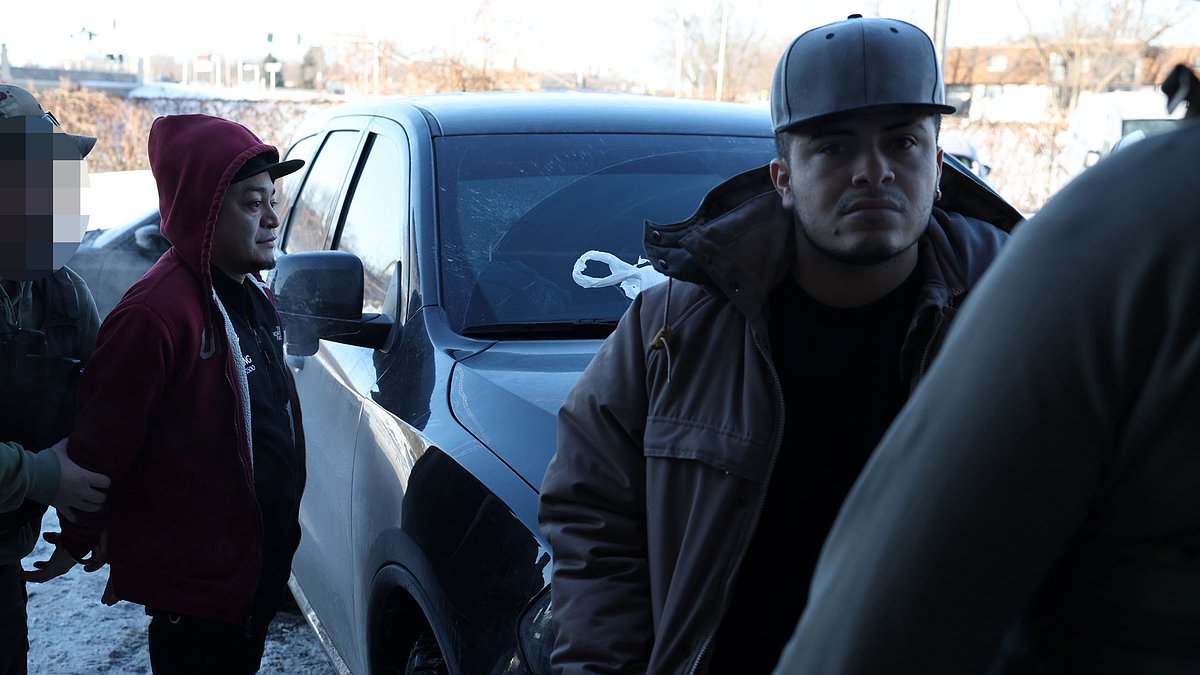
ICE agents claimed that one suspect had a criminal trespassing violation last year and was in the country illegally from Honduras

The man later produced a Honduran passport when asked for identification
The men answered basic questions and emptied their pockets: phones, vapes, papers, wallets, keys.
Within five minutes of the Daily Mail’s arrival, they were loaded into another unmarked vehicle and driven off.
Their belongings were bagged, and they headed to the Whipple Federal Building for processing.
Blink, and you’d have missed the surprisingly cordial arrests.
The operation was peaceful, even professional.
The brief arrest contrasted starkly with viral ICE videos. No crying, no screaming, no attempts to flee.
The most upset person was a woman who emerged from a coffee shop to film the interaction.
The white woman in her early to mid-twenties kept her distance and stayed silent, but was clearly displeased.

Evolving tactics are used to keep pace with the ever more sophisticated methods protestors are using to try and burn Agent vehicles and locations aimed at disrupting operations.

The target’s friend would also face immigration proceedings, the agents claimed, noting how that is the much more lengthy portion of deportation operations

At least one agent had been trailing the individual for some time, waiting for the proper moment to approach the target with multiple other agents for maximum safety
But unlike other operations taking place in the city, she did not insert herself into the action – surely a relief for the half-dozen agents involved in the arrests.
The ride back to the federal building had a decidedly more upbeat tone.
Staking out targets with criminal histories and removal orders can take days or weeks until agents find the right time and place for arrest.
Investigators determine where these migrants live, work, and spend time, building a pattern of life that indicates when and where an arrest can be made most safely.
If the target leaves early, makes a detour, or breaks pattern, that information goes in the files.
The agents were thankful the men pulled into a strip mall off the main street. They might have been harassed had they stayed on the main drag.
It took half a dozen ICE and HSI agents in six vehicles all morning to make two arrests.
A success by their standards, as operations get foiled consistently, especially now with all the anti-ICE protestors that have descended on the city and made their jobs more dangerous, they say.
But they were most happy to return to the federal building, safe – one day closer to rotating out of Minnesota and returning to their families.