
A recent court filing in the high-profile case against Tyler Robinson, the alleged murderer of conservative activist Charlie Kirk, has unveiled new details that have sparked widespread interest and debate. The revelations pertain to the bullet that claimed Kirk’s life and the firearm purportedly used by Robinson.
Robinson, only 22 years old, is currently facing charges of capital murder, with the possibility of a death sentence looming over him. The tragic incident occurred at Utah Valley University on September 10, thrusting the case into the national spotlight.
The forensic analysis of the bullet involved has become a focal point of the case, igniting numerous discussions and fueling conspiracy theories. This intensified after a recent court filing by the defense revealed that the Bureau of Alcohol, Tobacco, Firearms and Explosives (ATF) could not definitively link the bullet recovered during the autopsy to Robinson’s alleged rifle.
In a significant development, an ATF report, included in documents filed by the defense in January, was unsealed by a judge this past Wednesday. This report sheds light on the forensic examination and evidence gathered from the crime scene.
The forensic findings disclosed that a bullet jacket fragment retrieved from Kirk’s autopsy matched the characteristics of a .30 caliber class bullet. Additionally, four other lead bullet fragments were collected during the investigation.
The ATF laboratory described the key piece of evidence as a “.30-caliber class deformed/damaged bullet jacket fragment,” as detailed in the court filing. This description follows a comprehensive analysis conducted by the FBI lab, which examined the bullet jacket fragment in question.
That matches the same caliber as the Mauser 98 30-06 rifle recovered near the scene, that prosecutors claim was allegedly used by Robinson to kill Kirk. Robinson received the gun as a gift from his grandfather, authorities said.
The report also reveals that the rifle recovered near the scene was tested and found operable and that the recovered cartridge case bears a ‘Remington headstamp’ designating its proper caliber for the rifle.

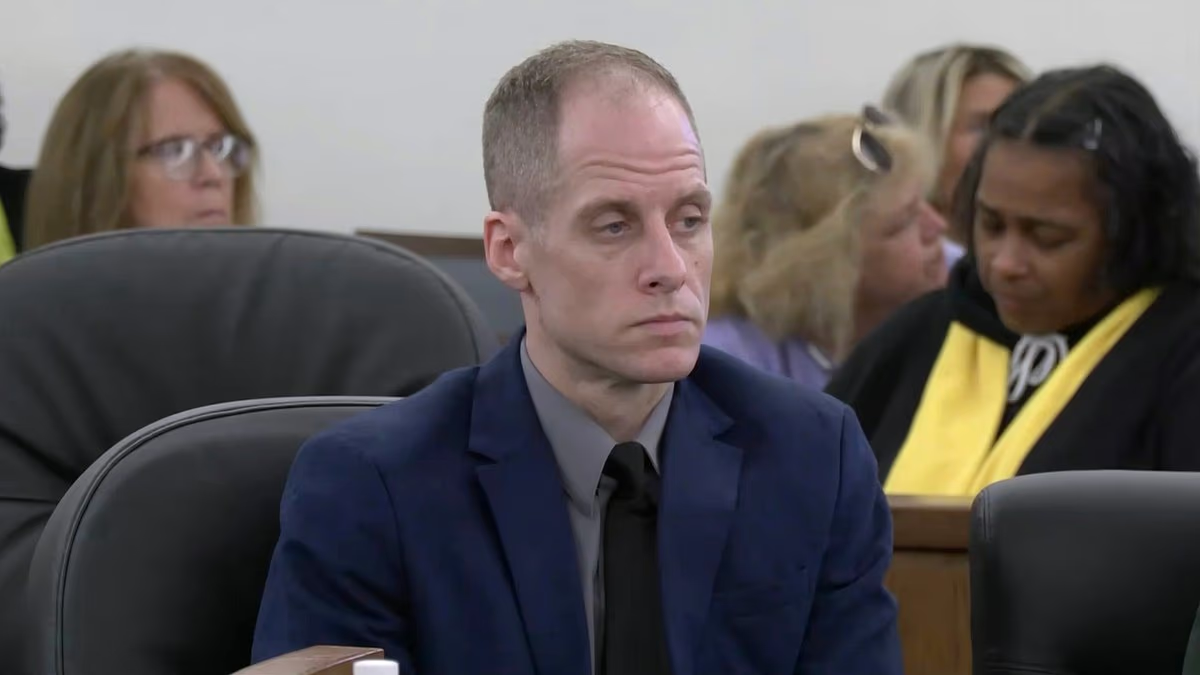
Tyler Robinson, accused of the murder of Charlie Kirk, reacts during a hearing in Fourth District Court in Provo, Utah.

Details of the alleged murder weapon and the bullet that struck activist Charlie Kirk are revealed in the ATF forensic report
The cartridge case, ATF investigators wrote in the report, was identified as having been fired in the ‘Exhibit 1 rifle,’ the alleged murder weapon.
The remaining bullet jacket fragment, however, could not be ‘conclusively linked or excluded’ as having been fired by Robinson’s specific gun, as the examiner concluded that the shattered bullet was too damaged for conclusive findings.
While the defense focused on the inability to link the bullet fragments directly to the bullet, the report notes that it does not exclude the possibility either.
The new information s a blow to Robinson’s defense, which continues their efforts to stop further testing on the bullet jacket fragment after it was revealed that the bullet recovered during Kirk’s autopsy had shattered upon impact.
Other evidence examined by the ATF includes the 30-06 rifle recovered near the scene, a 30-06 Springfield caliber cartridge case, and three 30-06 Springfield caliber cartridges.
Evidence uncovered by the ATF demonstrates that the bullet matching the caliber of Robinson’s rifle, plus a confirmed match with the spent casing, offers a fuller picture of the alleged murder weapon, making it more difficult for the defense to argue that Robinson did not fire the bullet that killed Kirk.
The state wants to conduct further testing of the bullet fragment to produce additional details about the rifle that fired it.

Robinson is now due back in court on April 17, when his defense attorneys and prosecutors will debate the issue of allowing cameras and microphones in the courtroom

Kirk’s widow, Erika Kirk, has called for transparency in the case
Robinson and his attorneys are asking that additional testing be stopped because it could alter the evidence, citing investigators using ‘pliers or similar gripping tools’ in the jacket of the bullet casing fragment.
The defense filed a motion asking the court to require FBI investigators to allow a defense examiner to be present for further testing of the fragment or videotaping of the examination. That could serve as a stalling tactic by the defense, as prosecutors revealed in the document that the FBI does not allow that.
The defense team is working to push back Robinson’s preliminary hearing scheduled for May 17. Robinson is also due back in court April 17 for a hearing on a defense motion to ban cameras from the courtroom.