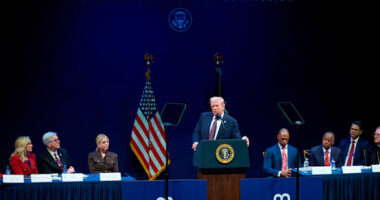


An important report on Tuesday is anticipated to reveal that inflation rates rose in July, hinting that President Donald Trump’s tariffs might be increasingly burdening consumers.
Trump’s response to this report — particularly if it indicates a rise in inflation — could be notably significant following his dismissal of the federal agency head responsible for the data.
Trump alleged that Erika McEntarfer, the top official at the Bureau of Labor Statistics, allowed the agency to manipulate jobs data, a claim that hasn’t been proven. Her recent dismissal has sparked concern in Washington and among most mainstream economists, who warn it might compromise the integrity of the Labor Department’s data. Although the data often undergoes revisions, there is no proof these adjustments were politically driven.
A spokesperson for the BLS stated that Tuesday’s Consumer Price Index report, which gauges price increases paid by consumers, won’t be influenced by McEntarfer’s removal. No official methodology changes have been announced recently.
The president is now particularly focused on the data, amidst growing evidence that his unusual tariff strategy is having economic effects. While he continues to assert that the trade duties are making the U.S. “strong and rich,” recent job growth has been slow and focused in a limited range of sectors such as health care and government at the state and local levels.
The impact on consumer prices seems even more noticeable. Tariffs are taxes collected by the government on imported goods, with hundreds of billions flowing into the U.S. monthly.
There has been debate about who actually ends up footing the cost of the import taxes, which economists agree shows up as inflation. Analysts with Goldman Sachs now estimate that consumers paid approximately 22% of tariff costs through June. In a note to clients, they said that figure could climb to as much as 67% by year’s end as businesses and supply chains adjust to the new regime. In that scenario, a separate inflation measure preferred by the Federal Reserve would rise to 3.2% in December, well ahead of the central bank’s official 2% target, the analysts said.
Some economists are now raising the prospect that the tariffs are nudging the U.S. economy toward stagflation, where the job market weakens even as price growth accelerates.
This is considered one of the worst scenarios for the Federal Reserve, which is tasked by Congress with keeping both unemployment and the rate of inflation low. Fed Chair Jerome Powell has indicated that if it weren’t for Trump’s tariffs, the Fed would have lowered interest rates by now in order to make borrowing in the economy cheaper and thus help boost employment.
Under current conditions, with price pressures increasing, cutting rates becomes more difficult.
“In a stagflationary environment, it is dangerous to cut without clear evidence that inflation has peaked,” Bank of America economists wrote in a recent note to clients. In other words, lowering rates too soon risks further stoking inflation pressures by increasing overall economic activity.
Two of Trump’s Fed appointees have a different view. In remarks delivered Saturday, Michele Bowman, the Fed’s vice chair for supervision, said any inflationary impact from tariffs should be considered a “one-off,” and that excluding those effects reveals a pace of price growth that is much more subdued. Fed Governor Chistopoher Waller offered a similar view earlier this month.
“Standard central banking practice is to ‘look through’ such price-level effects as long as inflation expectations are anchored, which they are,” Waller said.
That view is not shared by Powell, who said it remains unclear whether the inflationary impact from tariffs will prove to be short-lived.
“It is also possible that the inflationary effects could instead be more persistent,” he said in congressional testimony in June. “Avoiding that outcome will depend on the size of the tariff effects, on how long it takes for them to pass through fully into prices, and, ultimately, on keeping longer-term inflation expectations well anchored.”
Some economists estimate it could take as long as 18 months for the tariffs’ impact to fully make their way through the economy.
“The bulk of the effects are still ahead of us,” Diane Swonk, chief economist at KMPG consulting firm, told the “TODAY” show.
Beyond tariffs, consumers continue to feel the pinch of high prices on a variety of fronts, something the president promised to address on the campaign trail last year. Ground beef prices are now at an an all-time high as droughts have devastated herd counts. Electricity prices, too, are now at records, while homeowners insurance costs have also begun to reaccelerate. While inflation-adjusted weekly earnings ticked up last quarter, approximately 43% of workers saw their paychecks grow less than the cost of living as of June according to Indeed, with most concentrated at the low-to-middle end of the pay spectrum, according to Indeed.
A separate measure of current and future family financial situations tracked by the Conference Board research and consulting group deteriorated in July, with the share of consumers expecting a recession over the next 12 months still above the levels seen in 2024.
Last month, CNBC tracked price movements of 50 items at Walmart, finding some have increased by as much as 50%. Walmart said “pricing fluctuations are a normal course of business and are influenced by a variety of factors.”
Earlier this year, a Walmart executive was more direct about the impact tariffs were having.
“We’re wired for everyday low prices, but the magnitude of these increases is more than any retailer can absorb,” Chief Financial Officer John David Rainey told CNBC in May.