
Share this @internewscast.com
Donald Trump tasked his senior military leaders with developing a strategy to seize Iran’s nuclear materials, potentially setting the stage for one of the most audacious and hazardous missions in recent history.
This mission, which would predominantly depend on elite U.S. special forces such as Navy SEALs or Army Rangers—already stationed in the Middle East—envisions deploying substantial ground forces into Iran to secure its nuclear assets.
According to several officials, the Pentagon’s blueprint for this mission involves capturing nearly 1,000 pounds of highly enriched uranium. They note that if approved, the extraction operation could take several weeks.
Initially, Trump claimed that Operation Epic Fury would conclude within six weeks. However, the current plan suggests that the mission’s duration could significantly exceed that timeframe. As of Thursday, the conflict has persisted for 4 weeks and 5 days.
In an address to the nation on Wednesday night, Trump assured that the conflict with Iran would end ‘very shortly.’ He further vowed that the U.S. would respond ‘extremely hard’ over the forthcoming ‘two to three weeks’ if necessary.
The operation would also require transporting heavy excavation equipment, constructing a runway for large cargo planes, and retrieving the highly radioactive materials—much of which lies buried beneath debris following U.S. and Israeli attacks.
Insiders would expect the operation to excavate the uranium, which Trump has called ‘nuclear dust,’ to take weeks, and that while doing so, US forces would be exposed to attacks from Iranian forces.
Trump was briefed on the dangerous plan within the last week after he requested a proposal from the military.

President Donald Trump requested that the military present him with a plan to obtain Iran’s nearly 1,000 pounds of enriched uranium

Insiders familiar with the planning have said the daring operation could take weeks, require heavy excavation equipment, and would open up US forces to hostile fire deep within Iran

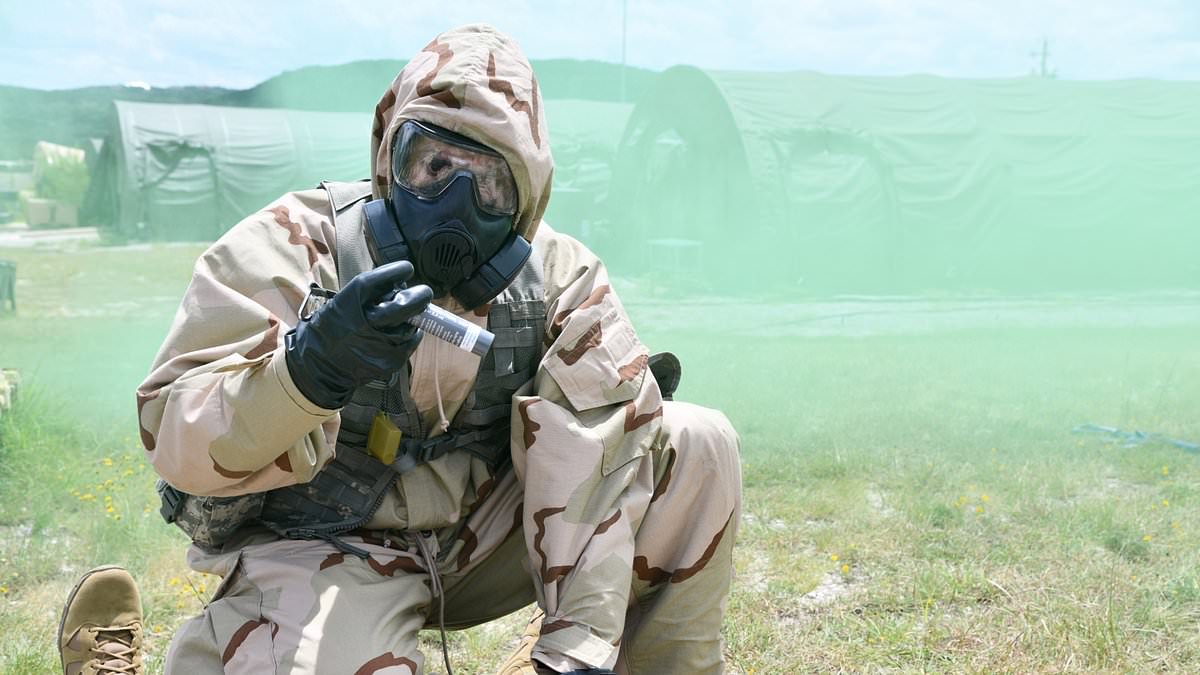
Complicating the matters is the highly radioactive material and its impacts on soldiers potentially tasked with digging it up and shipping it out of the country. Soldiers would likely need to wear MOPP protective gear, shown above, while conducting the risky potential operation
‘This would be one of, if not the largest, most complicated special operations in history,’ Mick Mulroy, a retired CIA and Marine officer, told the Washington Post. ‘It’s a major risk to the force.’
The plan underscores the administration’s adamance to prevent Iran from obtaining a nuclear weapon – even if the enriched components are buried deep underground and US special forces may come under fire.
‘It’s the job of the Pentagon to make preparations in order to give the Commander in Chief maximum optionality,’ White House Press Secretary Karoline Leavitt has said of the plan. ‘It does not mean the President has made a decision.’
After the US bombed Iran’s nuclear sites at Isfahan, Natanz and Fordow in June 2025, many of the Islamic Republic’s enrichment capabilities were buried under tons of concrete.
In order to access the nuclear material at Isfahan, ‘you have to get excavation equipment, break through the concrete and the lead shield … and then you somehow have to get to the bottom of this silo and remove the containers full of nuclear material and fly them out,’ sources familiar with the plan told the Post.
Several officials noted the plan is feasible, and special forces are trained for these types of missions, though it would be exceptionally dangerous and would expose the operators to Iranian attacks.
The plan would likely kick off with targeted strikes on Iranian defenses to create a safe path for soldiers from the Army’s 82nd Airborne and Rangers to parachute into the nuclear sites to set up a secure perimeter.
Then, engineers would need to quickly craft an airstrip to ensure that excavation equipment and more could be brought in for soldiers to begin digging out the nuclear material.
The logistics behind the mission would be daunting and require scores of soldiers, pilots, mechanics, drivers, refuelers, resuppliers and even potentially civilian nuclear experts to help mentor the troops as they handle the dangerous material.

Any potential operation would likely require troops to parachute into Iran behind enemy lines and close to their nuclear sites

Then soldiers would need to clear the sites and set up a secure perimeter before building an airstrip to bring in supplies and bring out the nuclear material

US forces would need to begin blasting through concrete and sawing through metal to dig up the material, which is thought to be buried under rubble after US strikes
Food, water and gasoline would all need to be sent in at a steady pace to keep operations going around the clock.
The operation would be akin to setting up a forward operating base deep within enemy territory while US forces dig up and then fly out any discovered uranium.
But blasting through reinforced concrete rubble to gain access to the radioactive ‘dust’ would be grueling work and full of treacherous pitfalls.
Commandos may be forced to do all this work while wearing restrictive protective equipment and air filtration systems.
In addition, determining exactly where the nuclear material is has been difficult, and US forces tasked with its discovery could face challenges without obtaining detailed layouts of the facilities.
According to the International Atomic Energy Agency (IAEA), Iran has roughly 970 pounds of uranium enriched to 60 percent.

Satellite image reveals multiple buildings damaged or destroyed at the Isfahan nuclear technology center after the airstrikes. Charring and roof collapses are visible across the compound
Weapons-grade uranium is enriched to 90 percent, and the process of going from 60 to 90 would take a matter of days.
Trump has repeatedly stated that Iran was either weeks or days away from having nuclear weapons.
‘We haven’t seen big movements,’ showing Iran is trying to unearth the material, IAEA Director General Rafael Mariano Grossi has said. He noted there may have been trucks or cars visiting the bombed sites, but ‘not bulldozers digging things out.’