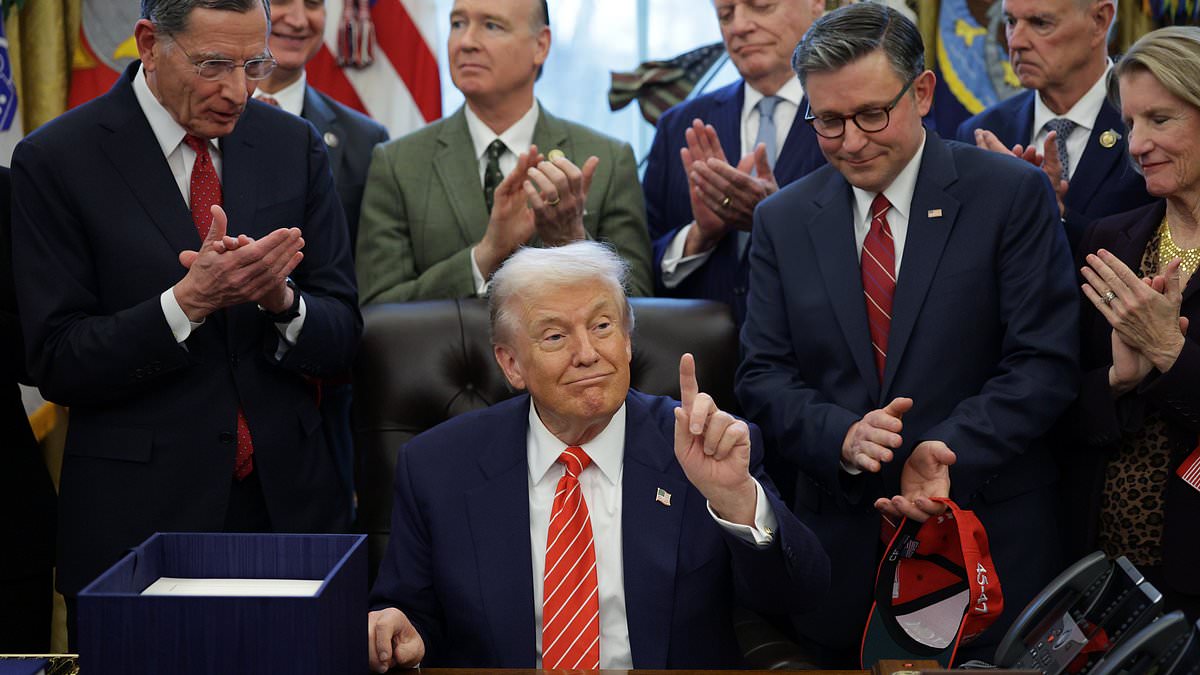

In a significant move to conclude a partial government shutdown that began over the weekend, Donald Trump has enacted a $1.2 trillion funding bill. This decision came amid considerable discontent surrounding the Department of Homeland Security (DHS).
While speaking in the Oval Office on Tuesday, Trump hailed the bill as “a great victory for the American people,” accompanied by key Republican figures, including House Speaker Mike Johnson.
The US House of Representatives had earlier passed the bill with a narrow margin of 217 to 214 votes. The vote saw a mix of support and opposition, with 21 Republicans dissenting and 21 Democrats crossing party lines to approve the measure.
This funding bill ensures that federal agencies will remain operational until the end of the fiscal year on September 30. However, it only extends funding for the DHS for two weeks, until February 13, hinting at another impending congressional showdown.
The current impasse stems from a wave of outrage following the fatal shooting of Alex Pretti by Border Patrol agents in Minneapolis last month. This incident has intensified scrutiny and criticism of the DHS.
House Democratic Leader Hakeem Jeffries has expressed a firm stance, stating that his party will not entertain any additional temporary funding for the DHS unless there are substantial reforms to its immigration practices.
‘We need dramatic change in order to make sure that ICE and other agencies within the department of Homeland Security are conducting themselves like every other law enforcement organization in the country,’ Jeffries said.
Speaker Johnson said he expects the two sides will be able to reach an agreement by the deadline.

President Donald Trump signs the budget bill bringing to an end the partial government shutdown on Tuesday
‘This is no time to play games with that funding. We hope that they will operate in good faith over the next 10 days as we negotiate this,’ said Johnson. ‘The President, again, has reached out.’
But Johnson’s counterpart across the Capitol, Senate Majority Leader John Thune of South Dakota, sounded less optimistic of a deal.
‘There’s always miracles, right?’ Thune told reporters.
The funding bill that cleared Congress Tuesday had provisions that appealed to both parties.
Republicans avoided a massive, catch-all funding bill known as an omnibus as part of this year’s appropriations process. Such bills, often taken up before the holiday season with lawmakers anxious to return home, have contributed to greater federal spending, they say.
Democrats were able to fend off some of Trump’s most draconian proposed cuts while adding language that helps ensure funds are spent as stipulated by Congress.
Still, Johnson needed near-unanimous support from his Republican conference to proceed to a final vote on the bill.
He narrowly got it during a roll call that was held open for nearly an hour as leaders worked to gain support from a handful of GOP lawmakers who were trying to advance other priorities unrelated to the funding measure.
The final vote wasn’t much easier for GOP leaders. In the end, 21 Republicans sided with the vast majority of Democrats in voting against the funding bill, while that exact same number of Democrats sided with the vast majority of Republicans in voting yes.
Join the debate
What changes do you think are truly needed to fix America’s immigration and border policies?

Senate Minority Leader Chuck Schumer, a New York Democrat, speaks at a press conference at the U.S. Capitol in Washington, DC on January 28, 2026

Speaker of the House Mike Johnson, R-La., pauses for questions from reporters as he arrives for an early closed-door Republican Conference meeting on how to end the partial government shutdown and deal with demands over immigration enforcement operations, at the Capitol in Washington, Tuesday, February 3rd, 2026
Trump had weighed in Monday in a social media post, calling on Republicans to stay united and telling holdouts, ‘There can be NO CHANGES at this time.’
The partial shutdown now ending differed in many ways from the fall impasse, which affected more agencies and lasted a record 43 days.
The debate then centered on extending temporary coronavirus pandemic-era subsidies for those who get health coverage through the Affordable Care Act. Democrats were unsuccessful in getting those subsidies included as part of a package to end the shutdown.
Congress made important progress since then. Some of the six appropriations bills it passed prior to Tuesday ensured the current shutdown had less sting. For example, important programs such as nutrition assistance and fully operating national parks and historic sites were already funded through September 30.
The remaining bills passed Tuesday mean that the vast majority of the federal government has been funded.
‘You might say that now that 96 percent of the government is funded, it’s just 4 percent what’s out there?’ Johnson said. ‘But it’s a very important 4 percent.’
Democrats sharpened attacks on Homeland Security Secretary Kristi Noem, who faces growing demands to rein in the aggressive border operations.
Senate Minority Leader Chuck Schumer last week blasted DHS leadership, accusing Noem, Trump, and senior adviser Stephen Miller of unleashing an immigration crackdown ‘without guardrails.’
Democrats seized the moment — and public anger — to peel DHS out of the larger appropriations package, forcing a separate fight over the agency’s conduct and future funding.
The maneuver not only gave them leverage in upcoming border negotiations but also underscores how the Pretti shooting has changed the dynamics around immigration, long considered one of Trump’s greatest political strengths.