
Share this @internewscast.com

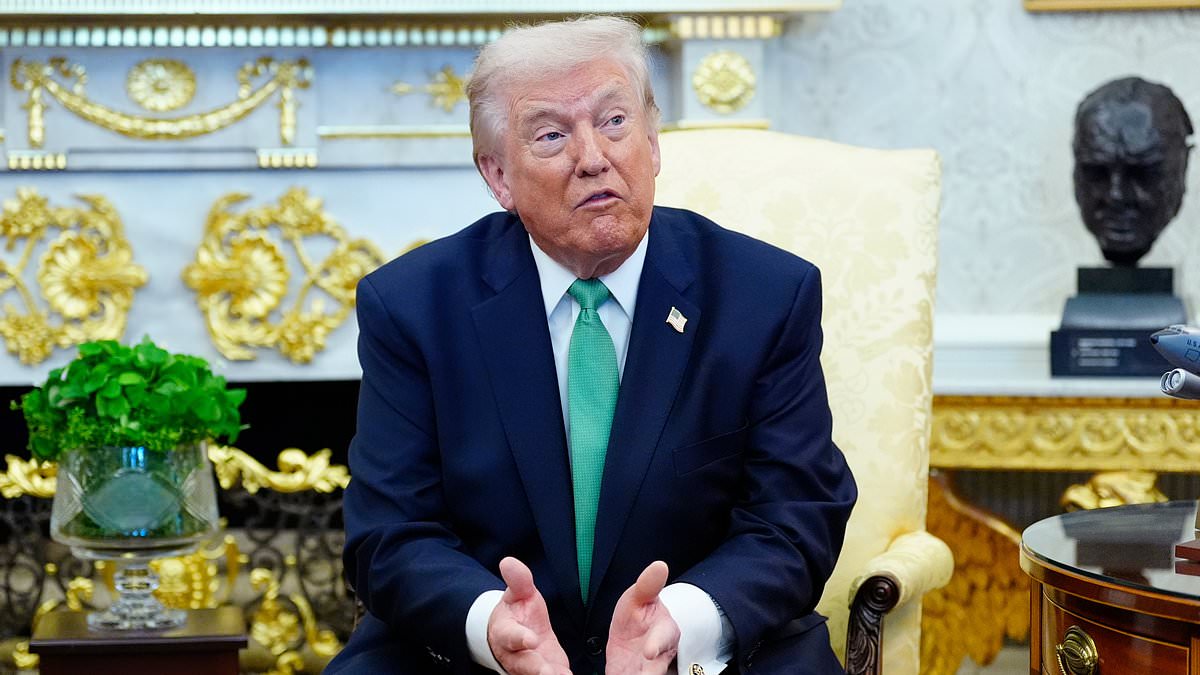
President Donald Trump declared on Tuesday that he is “not afraid” to send U.S. ground troops into Iran, underscoring his determination to escalate military involvement in the Middle East. During a session in the Oval Office with Ireland’s Taoiseach Micheál Martin, the President addressed numerous questions concerning the conflict with Iran. When asked by a reporter if he feared that deploying troops could lead to a situation akin to the Vietnam War, Trump responded confidently, “No, I’m not afraid of anything.” Although he has previously mentioned the possibility of deploying ground forces if deemed “necessary,” he has yet to specify the circumstances under which this would occur.

In the same meeting, Trump hinted at the possibility of targeting Iran’s energy infrastructure, stating, “We could take out their electric capacity in one hour,” while asserting, “there’s nothing they can do.” Despite Trump’s assertion that the conflict might last only a few weeks, some administration insiders express concerns that it could extend much longer. Sources informed Axios that the military engagement in the Middle East could potentially continue into September, far beyond any public timelines provided by the President. Furthermore, Trump faced questions regarding the resignation of Joe Kent, his key counterterrorism advisor, who left the position in protest of the ongoing conflict.

Reflecting on Kent’s departure, Trump remarked, “I always thought he was a nice guy, but I felt he was very weak on security. Very weak on security.” He added that while he didn’t know Kent well, he seemed “like a pretty nice guy.” Trump continued, “But when I read his statement, I realized that it’s a good thing that he’s out because he said Iran was not a threat.” Kent, who resigned earlier that day, publicly announced his decision, expressing that he “cannot in good conscience support the ongoing war in Iran.” In his statement, Kent argued that “Iran posed no imminent threat to our nation,” asserting that the conflict was instigated by “pressure from Israel and its powerful American lobby.”

Evidence that the US is considering a ground invasion in Iran is mounting. Last week, the military ordered 2,000 US Marines and their equipment, along with several Naval vessels, to be deployed to the Middle East from the South Pacific near the Philippines. The Marines and Sailors aboard the USS Tripoli and USS New Orleans, along with the supporting Navy vessels, are a part of an Amphibious Ready Group (ARG) that is close to 5,000 service members in total. The ARG’s primary objective is to land Marines in coastal environments using aircraft and landing vessels. The USS Tripoli also maintains an arsenal of aircraft, like F-35 fighter jets and attack and transport helicopters, to ferry troops and project power. It is estimated that the ARG will arrive in the Middle East ten to 15 days from its initial deployment late last week, meaning the force should arrive near Iran at the end of this month.

Concerns about sending US troops to Iran have been rippling around Capitol Hill. ‘We seem to be on a path toward deploying American troops on the ground in Iran to accomplish any of the potential objectives here,’ Democratic Senator Richard Blumenthal of Connecticut said last week after a classified briefing from military officials. ‘So the American people deserve to know much more than this administration has told them about the cost of the war, the danger to our sons and daughters in uniform and the potential for further escalation and widening of this war,’ the Democrat added. Americans are against sending in troops, too, according to the latest Quinnipiac survey of 1,000 US voters published March 9. The results showed that 74 percent of respondents oppose sending ground troops into Iran. A majority, 53 percent, said they are against the war altogether.