
Share this @internewscast.com
A captivating new exhibition invites visitors to explore Queen Elizabeth II’s enduring legacy through her wardrobe, from the christening gown commissioned by Queen Victoria to the cherished tartans and tweeds she favored in her later years.
This remarkable showcase, featuring over 300 items from the late monarch’s collection—more than half of which are debuting for public view—opens at the King’s Gallery in London this Friday, commemorating what would have been her centenary.
The exhibition includes iconic attire from pivotal moments in her life, such as the glamorous Norman Hartnell-designed wedding and coronation gowns, and the salmon pink outfit she famously wore during the theatrical stunt for the 2012 Olympics. Additionally, it offers a glimpse into more intimate selections.
Among these personal items is a specially crafted maternity evening dress from 1948, ingeniously designed to conceal her pregnancy with the future King Charles III, a pair of check trousers worn at private estates like Balmoral and Sandringham, and a rare transparent plastic coat from the 1960s, which curators have yet to find photographic evidence of her wearing.
Curator Caroline de Guitaut, leading the Royal Collection Trust team as Surveyor of the King’s Works of Art, was granted full access to Queen Elizabeth’s extensive wardrobe, consisting of 4,500 meticulously preserved pieces accumulated over her extraordinary lifetime.
This exceptional display, 18 months in the making, stands as the largest exhibition ever dedicated to the late Queen and her fashion, offering a preview to the Daily Mail earlier this week before welcoming the general public.
The first few weeks of the exhibition ‘Queen Elizabeth II: Her Life In Style’, which opens its doors on Friday, are already a sell-out.
The late monarch, de Guitaut concedes, was not a woman obsessed with fashion, but after finding herself hailed a style icon became determined to make it work as a tool of her trade.

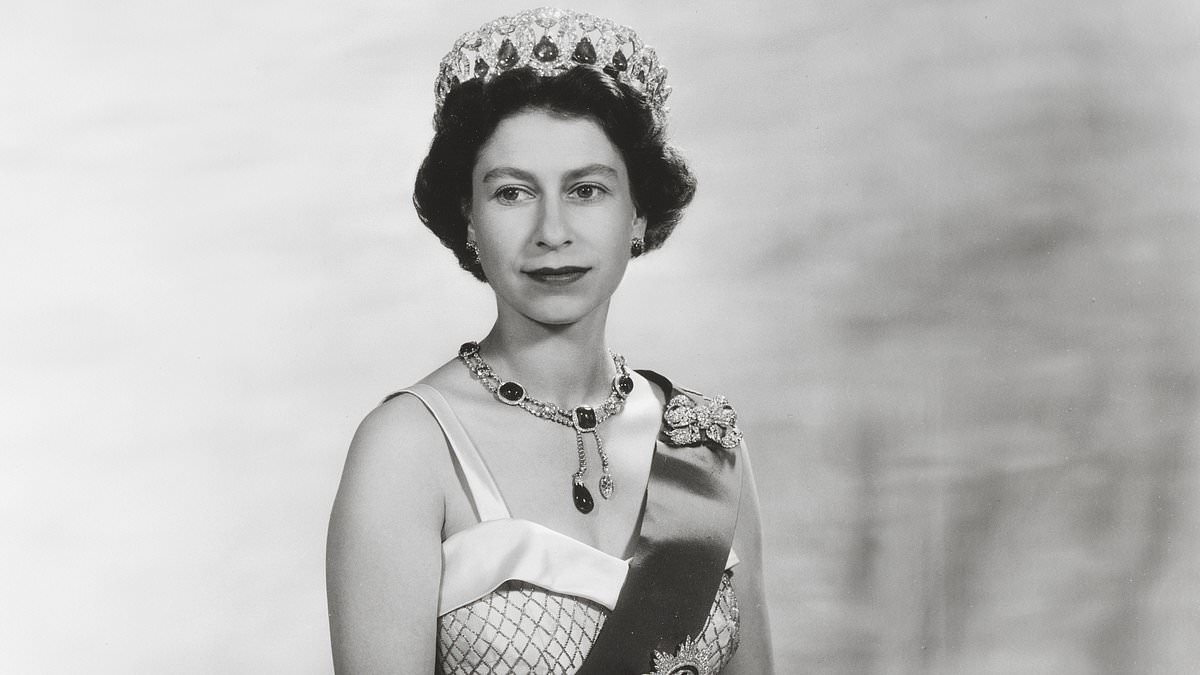
The first few weeks of the exhibition ‘Queen Elizabeth II: Her Life In Style’, which opens its doors on Friday, are already a sell-out (pictured, Elizabeth in 1956)

Norman Hartnell designed the gown for the above portrait in 1956

The Queen used fashion as ‘diplomacy’, according to curator Caroline de Guitaut (Queen Elizabeth pictured welcoming the ambassador of Iraq, Dr Salah Al Shaikhly, in 2004)
‘Queen Elizabeth took a deep and thoughtful interest in every aspect of her wardrobe, using fashion as diplomacy while consistently championing the UK’s fashion industry,’ she says.
Commissioned by Queen Victoria in 1841 and worn by 60 royal babies over 130 years, the royal christening robe that baby Elizabeth herself was once dressed in is on show for the first time, alongside several patched and darned youthful hand-me-downs, fancy dress outfits and bridesmaid dresses.
In the 1930s and ’40s, as she developed into a young woman, the young princess (as she then was) had a much stronger idea of how she wanted to present her public image, favouring ‘New Look’-style suits with nipped-in waists to show off her own tiny figure.
An impeccably tailored white ‘yachting suit’ from her South Africa tour of 1947 needed special permission from King George VI to have naval buttons sewn onto it. He agreed, on the understanding they were removed later.
Even the young Elizabeth clearly wasn’t immune to a little youthful rebellion, however, and those buttons remain there today.
Covering her years as a wartime worker, wife and mother, the exhibition provides a fascinating insight into Elizabeth’s style development.
In the 1940s she began to insist that details of her outfits were given to press in advance or at the time of her visits and tours so that their predominantly British designers could be properly acknowledged and benefit from the public exposure, de Guitaut reveals.
It’s an interesting insight given that in recent years the Princess of Wales has insisted that details of her outfits are not given out to the public any more, as she is concerned about being seen as just a ‘clothes horse’.

This is the gown Princess Elizabeth was christened in. Commissioned by Queen Victoria in 1841, the dress has been worn by 62 royal babies

Elizabeth wore this gown, designed by Norman Hartnell, for the Coronation of her father King George VI in 1937

Transparent rain coat, Hardy Amies, 1960s. Patterned silk day dress and coat, Hardy Amies, 1970s

A close-up on the collar of the transparent raincoat by Hardy Amies


Hardy Amies designed a periwinkle blue dress and coat combo, while Philip Somerville made a matching stole and hat. Right, Elizabeth attends a service at Westminster Abbey in 2000


The Queen wore a pink dress decorated with tree peony blossom – the national flower of China – to a State Banquet in Peking, China. It was designed by Ian Thomas

Silver lamé dress, Norman Hartnell, 1972. It was worn for a state visit to France that year

A never-seen-before illustration for the dress by Norman Hartnell, 1972

Dress with maple leaf embroidery, Norman Hartnell, 1967. She wore this dress for the centennial celebrations of the Confederation of Canada

The late monarch met Marilyn Monroe in this black velvet evening gown in 1956

Yellow dress, Hardy Amies, 1961. The Queen requested the colour as it represents health and prosperity in Pakistan, where she first wore the dress. She re-wore it during a tour of Australia


Coat, Angela Kelly, 2010s


Three evening gowns, Ian Thomas, 1970s
Among the exhibits are Elizabeth’s breathtaking wedding and coronations gowns, including, for the first time, the fan she used in 1953.
Her wedding gown is reunited, for the first time in more than 20 years, with the glittering Queen Mary’s Diamond Fringe tiara (although the arms of the dress have since been replaced as the material had sadly deteriorated).
There are eye-catching items, too, such as the Queen’s ‘poodle skirt’ worn for a square dance in Canada, an extraordinary embroidered coat and matching slippers which she wore in Malaysia in 1989 and a purple dress that actually conceals, extraordinarily, a pair of culottes.
A maternity evening dress made by Hartnell, dating from around 1948, is a rare example of its type. De Guitant says she was ‘very excited’ to have found it and that the tailoring is so clever that from the front you wouldn’t even have known she was pregnant. ‘It’s quite a rare survival,’ she says.
The display of evening gowns and day dresses for State Visits and banquets is almost overwhelming, many featuring specific colours or national symbols in honour of the countries she was visiting, as well as accessories from her many tours over the years including binoculars, sunglasses and suitcases.
The Queen was apparently very much involved in the process of creating her outfits, examining sketches submitted to her and commenting back on the silhouette, or sleeve or skirt length.
‘The Queen would want to see the fabric samples too, she was absolutely insistent on having at her fingertips every single piece of information about how this finished garment might look,’ de Guitaut explains.
Join the discussion
Is Queen Elizabeth II the ultimate royal style icon?

The Queen’s Coronation dress, Norman Hartnell, 1953

The Queen wore the gown on June 2, 1953, for her coronation

Queen Elizabeth wore this hacking jacket when away from public duties

Gold tissue and lace evening gown, Norman Hartnell, 1957

The gown is displayed in the Red Drawing Room at Windsor Castle

Harris Tweed jacket and Balmoral tartan kilt, Norman Hartnell, 1950s

She often wore the tweed jacket and kilt combo while walking in the countryside

Evening gown, Norman Hartnell, 1957. It was worn for a state banquet given for President Eisenhower at the British Embassy in Washington, DC

The gown displayed in the Green Drawing Room at Windsor Castle

Evening gown, Norman Hartnell, 1961. Elizabeth wore it for a State Banquet in Karachi, Pakistan


The Queen’s fifth wedding anniversary bracelet, designed by Prince Philip and crafted by Boucheron in 1952

Commissioned by the Queen in 1957, the Brazilian Aquamarine Tiara is stunning

Elizabeth beams as she wears the tiara to a banquet in Canton, China, in October 1986

Queen Mary’s Fringe Tiara was made by E. Wolff and Co. for Garrard in 1919. Immortalised as Elizabeth’s wedding tiara, Princess Anne and Princess Beatrice have also worn it

The Burmese Ruby Tiara was made in 1973 using 96 rubies given to the Queen by the people of Burma (now Myanmar) as a wedding present

Queen Elizabeth wears the tiara at a Royal Gala performance in Covent Garden during her Silver Jubilee celebrations on May 30, 1977

Ivory dress and coat, Angela Kelly, 2012

The Queen wore this dashing ensemble on her Diamond Jubilee in June 2012

Bridesmaid’s dress, Edward Molyneux

Princess Elizabeth in 1934

Hat worn for the wedding of Princess Margaret, Claude St Cyr, 1960

This Norman Hartnell dress, bolero jacket and belt was worn by Elizabeth for her sister’s wedding in 1960. It is a beautiful kingfisher blue

Elizabeth at Princess Margaret’s wedding with the Queen Mother and then Prince Charles

Cherry blossom evening dress, Norman Hartnell, 1975

The Queen wore the dress on a State Visit to Japan that year

Norman Hartnell designed this gown for the Queen’s State Visit to the Netherlands in 1958

Elizabeth enjoys herself at a State Banquet in Amsterdam in March 1958

Silver Jubilee gown, Hardy Amies, 1977. Matching hat, Frederick Fox, 1977

Elizabeth greets the public during her Silver Jubilee on June 7, 1977, in London

Olive green dress, Norman Hartnell, 1963. Cloche hat, Simone Mirman, 1963

She wore the ensemble to the wedding of Princess Alexandra of Kent and Angus Ogilvy at Westminster Abbey in April 1963

Elizabeth’s wedding dress, Norman Hartnell, 1947

Elizabeth and Philip got married on November 20, 1947, at Westminster Abbey
‘She became an active master at dressing in a very appropriate way, paying compliments to the host country, honouring the craftsmanship of the place she was visiting.
‘The wearing of this wonderful couture on the global stage was really the greatest possible advert for British production, design and manufacture.
‘She took diplomatic dressing to a whole other level of sophistication which no other monarch had really done to the same degree. She was a trailblazer.’
The accessories are equally spellbinding, including a selection of dazzling jewellery – the highlights which are two tiaras and a bracelet designed for her fifth wedding anniversary by the Duke of Edinburgh – much of which is on display for the first time.
Visitors can also see examples from Queen Elizabeth’s ‘off-duty’ wardrobe – still fairly formal by today’s standards – featuring tweed jackets, tartan skirts and even a rare pair of trousers, as well as riding outfits, shoes, boots and, of course, headscarves.
The pièce de résistance for visitors, however, is a double-height array of jewel-coloured outfits arranged like a glorious regal rainbow, alongside a display of more than 50 hats, Cornelia James gloves and Launer bags, the accessories for which she was, perhaps, best known.
‘Some of her choices of headwear were very, well, bold,’ de Guitaut smiles, something of an understatement given some of the eye-popping designs she wore over the years.
‘I think it was the Queen’s way of quietly stretching the rules.’
Queen Elizabeth II: Her Life In Style is at The King’s Gallery, Buckingham Palace, from April 10 to October 18, 2026.