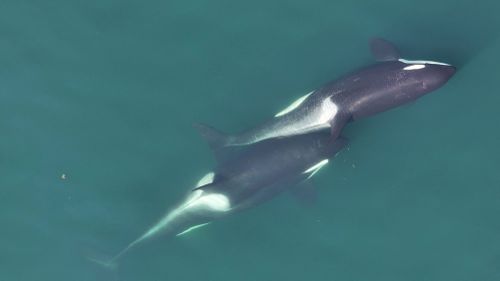

A small length of kelp is visible between the two whales that are "allokelping."
Share this @internewscast.com
Behavioral ecologist Michael Weiss was reviewing new drone footage of the orca pods he researches in the Salish Sea when he noticed one of the killer whales with something green in its mouth. He also observed unusual behavior: Some orcas were rubbing against each other continuously for up to 15 minutes.

Initially, Weiss didn’t think it was significant “because whales do weird things,” he remarked. However, further drone footage showed similar behaviors.

“I zoom in, and sure enough, there’s clear as day this piece of kelp that they’re using to rub on each other.”

A small length of kelp is visible between the two whales that are "allokelping."
A small length of kelp is visible between the two whales that are “allokelping.” (Centre for Whale Research)

Over the course of just two weeks in 2024, Weiss and his team documented 30 examples of these curious interactions.

It turned out that the southern resident orcas — a unique group of killer whales — were pulling strands of bull kelp from the seafloor to roll between their bodies, a behavior scientists termed “allokelping.”

Allokelping could be a form of grooming for skin hygiene, as well as a way to socially bond with other members of the pod, the researchers reported in a new paper published Monday in the journal Current Biology.

This discovery is the first recorded instance of cetaceans — marine mammals like whales, dolphins, and porpoises — using an object as a tool for grooming purposes.

Across the animal kingdom, using tools is rare, according to behavioural ecologists. But when it does happen, it’s often for finding food or attracting mates.

“This is a quite different way of using an object,” said Weiss, the study’s lead author and research director of the Centre for Whale Research in Washington state.

There are two possible reasons behind the allokelping behaviour, Weiss and his team hypothesise.
Hygiene, such as treating or removing dead skin, could be one explanation. Cetaceans often shed dead skin, which helps keep their bodies smooth and aerodynamic. Skin lesions, particularly gray patches, are becoming more prevalent in southern resident orcas, Weiss added, so allokelping might be a way to treat those lesions.
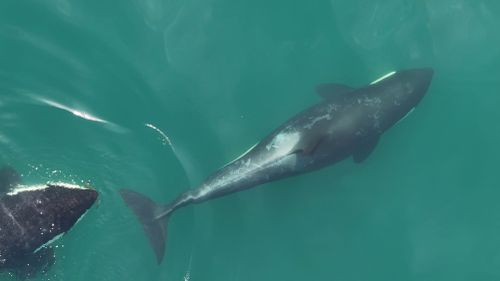
The orca on the left carries kelp in its mouth, allowing the whales to "allokelp," or roll the plant between their two bodies.
The orca on the left carries kelp in its mouth, allowing the whales to “allokelp,” or roll the plant between their two bodies. (Centre for Whale Research)

The other hypothesis, Weiss explained, is that allokelping is a way to strengthen social bonds, as the whale pairs seen exhibiting this behaviour were usually close relatives or similar in age.

“These guys are incredibly socially bonded,” said Deborah Giles, an orca scientist at the SeaDoc Society who was not involved with the research. This behaviour is fascinating but not entirely surprising, she added.

Orcas are curious and tactile, with brains that are large compared with their body size, Giles explained, adding that some parts of the killer whale brain are more developed than what’s seen in humans. Each orca population even has its own dialect.

Cetaceans also have sensitive skin, explained Janet Mann, a behavioural ecologist at Georgetown University who has studied marine mammals for 37 years. Orcas are known to rub on other objects such as smooth-pebble beaches in Canada, or on algal mats. But it’s unusual to see two individual killer whales using a tool to seemingly exfoliate each other, she said.

“What (the study) shows is that we know very little about cetacean behaviour in the wild,” Mann said.

Allokelping likely wouldn’t have been discovered without advances in drone and camera technology, which have opened up “a whole new world” for scientists to better understand cetaceans’ complex lifestyles, Mann said.

Historically, whales are observed from shore or from boats, offering a limited perspective of what’s happening in the water. But drones offer a bird’s-eye view of what marine animals are doing just below the surface. It’s likely this population has been allokelping for a while, she said — only now we can see it.

Orca scientists with drone footage are probably going to be on the lookout for this sort of behaviour now, Giles said.

Killer whales aren’t the only cetaceans known to use tools, though. Some bottlenose dolphins have been observed carefully removing and using sponges to scare up prey on the seabed, a sophisticated behaviour that only a small fraction of the population exhibits, said Mann, who has studied the dolphins in Australia’s Shark Bay.
Some other bottlenose dolphins use their tails to slap the ground in a circle, creating mud-ring plumes that trap fish. And humpback whales have long used bubble nets to catch prey.

Whether these examples constitute “using tools” is a topic of debate in the scientific community, but regardless, they are all behaviours related to foraging for food. What makes allokelping unique is its potential benefits for skin health and relationships — in other words, it appears to be a cultural practice.

“This idea of allogrooming (with tools) is largely limited to primates, which is what makes it remarkable,” said Philippa Brakes, a behavioural ecologist with the nonprofit Whale and Dolphin Conservation who was not involved with the research.

“This kind of feels like a moment in time for cetaceans, because it does prove that you don’t necessarily need a thumb to be able to manipulate a tool.”

Brakes, who studies social learning and culture in cetaceans, added that this new research “tells us quite a lot about how important culture is for these species.”

Each population — in this case, southern resident orcas — has a distinct dialect for communication, specific foraging strategies and now a unique type of tool use.

In a rapidly changing environment, Brakes said, “culture provides a phenomenal way for animals to be able to adapt,” as it has for humans.

“It’s more reason to ensure that we protect their habitat as well as their behavior,” she noted.

A ‘completely novel’ find

Indeed, southern resident killer whales are critically endangered and federally protected both in the United States and Canada, with a total population of just 74 whales.

And as bull kelp is in decline due to human activities that disrupt the seabed and more frequent heat waves caused by climate change, the overall ecosystem is degrading.

Kelp forests are also critical nursery habitat for juvenile chinook salmon — a key part of killer whales’ diet, Giles said. Southern residents have been spending less and less time in the Salish Sea over the years, possibly because of dwindling prey, said Monika Wieland Shields, cofounder and director of the nonprofit Orca Behavior Institute.

“This study makes me wonder if one of the reasons the Southern Residents continue to visit the Salish Sea periodically even during times of low salmon abundance is to engage in allokelping,” Shields wrote in an email to CNN.

The research is now leading to new areas of study.

“This cetacean data point is a really important one because it’s completely novel,” said Dora Biro, an animal cognition researcher at the University of Rochester who was not involved with the study.

Biro, who has mostly studied tool use in wild chimpanzees, added that examples of terrestrial tool use are much more widespread than in aquatic environments. She is now working on a grant proposal with Weiss’ team to better understand the purpose of the behavior.

But for Brakes, there doesn’t necessarily need to be a purpose: “The objective may just be social bonding, and that would still make it a tool.”

Share this @internewscast.com
You May Also Like

Finding Solace: Effective Strategies for Healing After the Bondi Beach Massacre

The emotional toll of the country’s worst mass shooting in nearly 30…
Vision shows hundreds of young beachgoers storming the Woolworths store.

Second Day Chaos: Teen Brawl Erupts on Beach Following Local Supermarket Vandalism

Scenes of chaos unfolded at Mordialloc Beach last night as numerous young…
England coach Brendon McCullum maintains belief his side can get back into this Ashes series, despite staring down the barrel of another defeat Down Under

Brendon McCullum Stands Firm on England’s Ashes Strategy as Crucial Decision Day Nears

D-Day has arrived sooner than England anticipated. With a mere 15 days…

Revealed: Epstein Files Include Clinton, Mick Jagger, and Michael Jackson, But No Mention of Trump

The United States Department of Justice (DOJ) has released more than 300,000…
Oprah Winfrey, 71, shared a picture on Instagram that displayed her amazingly fit physique on a boardwalk overlooking the city of Auckland, New Zealand

Oprah Winfrey Stuns with 50lb Weight Loss Transformation: See Her Fitness Secret in Action!

Oprah Winfrey is currently journeying through Australia and New Zealand on a…
US military launches strikes in Syria after American deaths

Breaking: US Military Retaliates with Strikes in Syria Following American Casualties

The Trump administration launched military strikes on Friday in Syria to “eliminate”…
Jactina Allan has warned there will be consequences for people who attend the rally in Melbourne's CBD.

Victorian Government Faces Intensifying Calls to Address Anti-Zionist Rally Concerns

Jewish leaders are calling on the Victorian government to prevent an anti-Zionism…
Chris Minns announced the new legislation will be rolled out on Monday.

NSW Premier Introduces Stricter Hate Laws Following Bondi Terror Incident

NSW Premier Chris Minns has announced the state government will be cracking…
An independent report released by Optus shines a light on a serious issue with our modern mobile-reliant communications systems.

Critical Alert for Australians: Changes to Triple Zero Emergency Call Protocols You Must Know

The Optus network outage on September 18, which led to the failure…

Victorian Premier Condemns Teen Mob After Massive Store Raid and Brawl Involving 200

Victorian Premier Jacinta Allan has called out the “appalling behaviour” of teenagers…
Ancient whale fossil

Ancient Whale Fossil Unearthed: A 20-Million-Year-Old Discovery Shocks Scientists

A 20-million-year-old whale fossil has been unearthed by a family exploring at…
Donald Trump and Jeffrey Epstein together.

Epstein Files Reveal Clinton’s Presence, Trump Absent

Recently released materials have unveiled a collection of photographs, call logs, grand…