
Share this @internewscast.com
The history of Hibernian Football Club comes to life not just through words, but through the vivid retelling of experiences.
Marking Hibernian’s 150th anniversary, a remarkable exhibition has been set up near Easter Road. This special event takes place at the visitor center and will run into next year, ensuring that more fans have the chance to experience it. It’s an opportunity not to be missed.
As a visitor, I was deeply engaged by the rich history of this esteemed club, which was the first British team to compete in the European Cup, among other achievements. However, the exhibition’s appeal extended beyond the historical placards that chart the club’s journey since Canon Edward Hannan founded it in 1875.
The exhibition features fascinating stories, including one about Hibs being an unexpected part of a dowry, the club’s efforts to strengthen ties with its community, an account of Joe Baker’s peculiar antics that warranted police involvement, and a fan’s charming belief that his connection to Hibs began before birth.
Adding to the tapestry, the presence of two priests is highlighted: one, a social reformer who established the club, and the other, a former player who later chose a spiritual path.

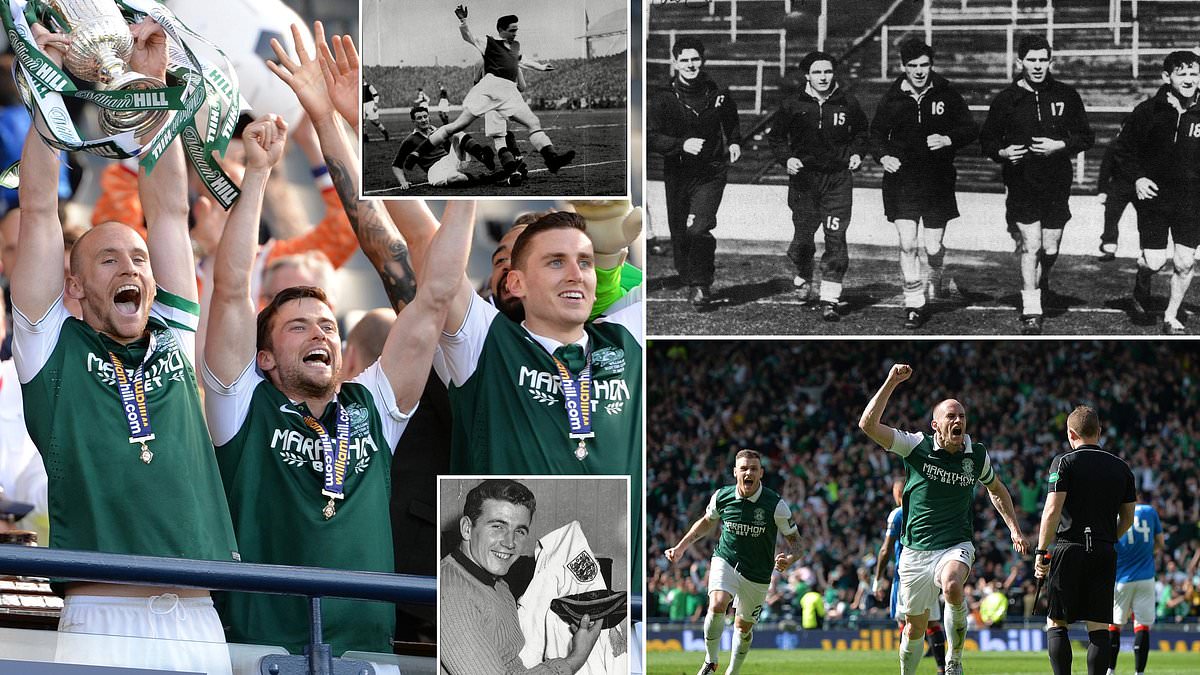
David Gray holds the Scottish Cup aloft after Hibs won trophy in 2016 for first time in 114 years

Hibs celebrate their 2016 triumph with fans on one of the most famous days in the club’s 150-year history

Canon Edward Joseph Hannan was the Irish-born priest who founded Hibernian FC in 1875
The stories unfolded gently like a welcoming wave. A mother, accompanied by her two sons, shared how marrying a devoted Hibs supporter sparked her own passion for the club and the sport. Her enthusiasm was infectious, as she confessed to attending matches more frequently than her husband.
Alastair Greig, a member of Hibernian Historical Trust, was the guide for the day. The trust has asked volunteers to help visitors and Greig, at 74 a fan for more than 60 years, was an informative presence.
His favourite Hibs story concerns Joe Baker, the striker who was born in England and raised in Armadale. Baker was first called up by England in 1959. He flew down and hailed a taxi to Hendon Hall Hotel, in northwest London. ‘That’s where the England team are staying,’ said the taxi driver. Baker replied in a distinctive West Lothian accent: ‘I ken, ah’m playing for them.’
The taxi driver made a discreet, unscheduled stop to contact police as he thought his passenger was somewhat deluded. Police stopped the car and checked the credentials of the striker who subsequently made the 40-man squad for the 1966 World Cup. England won without Baker, however, who was cut when the squad was reduced to 22.
Sean McPartlin, a teacher by profession and latterly a welfare and educational officer at the club before his retirement in the summer, can justifiably claim to have been imbued with the sensations of being a Hibs supporter even before he was born.
His family lived within shouting distance of Easter Road. His mother, who had endured miscarriages, was ordered to rest in bed in the months leading up to the birth of another child. Her husband, leaving for the match, would tell her to count the roars and she would know the score.
Sean was born healthy more than 70 years ago. Those roars have echoed down the decades as he is a passionate and knowledgeable follower of the club. This bond is further strengthened when he pointed out a name of the hall of fame board. It read: James McPartlin.

HIbs striker Joe Baker with his England jersey and his Scottish schoolboy cap

James McPartlin, the former HIbernian player who went on to become a priest

The Hibernian Famous Five, from left, Gordon Smith, Bobby Johnstone, Lawrie Reilly, Eddie Turnbull and Willie Ormond
He was Sean’s uncle and his football career ended when he was ordained as a priest. James signed for Hibs in 1926. ‘Like many Hibernian families, our history with the club goes back to Ireland,’ he said. His grandfather was born in County Leitrim and came to Scotland in the late 19th century, James McPartlin and Sean’s dad kicked a ball in the Meadows.
James was conspicuously good at football but his life exposed him to the reality of poverty and sickness. This may have been a strong factor in him giving up football to become a Franciscan priest.
Sean pointed out: ‘He studied in a seminary in Buckingham and turned out for Buckingham Town. He was a very good player for them, known as the College Boy.’
A forward, comfortable playing in a variety of positions, he scored a glut of goals for the side before replacing boots with a cassock when ordained.
He eventually became part of the priory in Dundee and is buried in the city. But his influence on his nephew is profound. ‘He had a trick of flicking an orange over his head and balancing it on his neck.’ More mundanely, he took Sean to his first game in 1956, when his nephew was not quite four.
The nephew has followed a family tradition of working constructively with people and following the fortunes of the team in green and white.
The greatest moment as a fan can be divined immediately for Sean. ‘The cup final,’ he said simply, referring to Hibs beating Rangers 3-2 at Hampden in 2016 to win the first Scottish Cup since 1902.
‘I remember the celebration so vividly, particularly as the bus came along Leith Walk and I saw a woman tolling a hand bell at an open window. It was like a scene from the past and quite wonderful.’
The past also involves another priest. Another Hibernian supporter has conjured up a wonderful tale of the life and times of Canon Edward Joseph Hannan, the priest who led the formation of the club after he was approached by members of the Catholic Young Men’s Society in the area. The date was August 8, 1875, and the location was the Catholic Institute, also known as St Mary’s Street Hall.
Mike Hennessy, an indefatigable historian, has shed new light on the creation of the club and the society it emerged from in Edinburgh’s First Hibernian (published by Thirsty Books). Its scope is capacious but its focus assured.
Described as a ‘labour of love’, it was conceived on a trip to Ballingarry, County Limerick, birthplace of Hannan, with a group of fellow Hibs fans. ‘It began as an essay, then it grew to where it could be part of a PhD and then it became a book,’ he said.
It is a fine achievement. ‘I wanted to debunk some of the legends and myths and I have done so,’ he said. The book is sprinkled with footnotes that show the provenance of Hennessy’s work.

Bobby Johnstone, one of the Famous Five, in action for Hibernian in his heyday

One of the great moments celebrated at the Hibs exhibition as Gray heads the winner against Rangers in 2016 Scottish Cup final

Jubilant David Gray celebrates his late winner in the historic 3-2 victory for Hibernian
One of its important messages is to link the formation of the club to the community. ‘It was another way Hannan saw of providing exercise for his people who were coming out of slums.
‘They needed something to rally round. It was to do with pride, self-esteem, raising hopes of people who had nothing. It was a vehicle for self-respect.’
Hennessy, who helped write the information placards at the visitor centre exhibition, believes the American owners are backing this drive to bring the club closer to its community in the 21st century.
His book is scholarly, fascinating and informative. Hennessy discovered that his great great grandfather was buried near Hannan in Grange cemetery in Edinburgh.
The book is dedicated to Hennessy’s grandad who first took him to games in the 1950s. ‘Without his patience…this book would not exist,’ writes the author.
It is the eternal spirit of football captured in a dedication. Football and family become one in a captivating tapestry that never unravels.