
Share this @internewscast.com
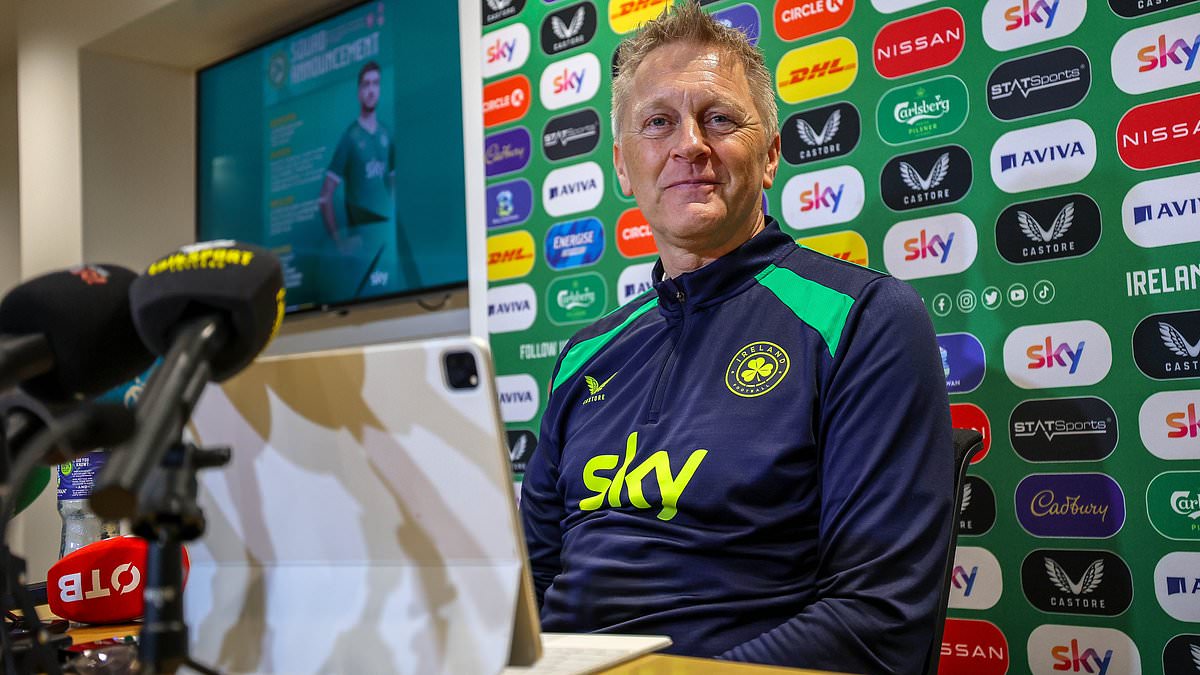
Heimir Hallgrímsson, true to his unique style, made a significant announcement as the press conference concluded yesterday. The occasion was the unveiling of his squad for the upcoming playoff in Prague.
During the session, the Ireland manager addressed various topics, including the inclusion of Troy Parrott, the addition of newcomer Harvey Vale, the noticeable absence of Josh Cullen in midfield, and concerns over Bosun Lawal’s fitness. However, the real surprise came when Hallgrímsson casually disclosed that he had finalized a new contract with his FAI employers that very morning.
This contract ensures that the Icelander will lead the team through to the end of Euro 2028, an event that Ireland will co-host. This decision appears to be a shrewd move, given Hallgrímsson’s seemingly laid-back attitude towards his contract. He has often remarked that he wouldn’t remain where he felt unwanted.
“I’m happy to be here; I like the project,” Hallgrímsson stated. “I wanted to make the decision after the qualification or tournament, but there was significant pressure from the association to sign before these playoff matches.”
“I didn’t want to stay where I’m not wanted, but I genuinely felt wanted, so we agreed to extend the contract until after the Euros,” the manager added.
While social media inevitably had its share of dissenting voices, this contract extension seems to be the right move. Regardless of the outcomes in Prague next Thursday or at the Aviva Stadium five days later, the Ireland football team seems to benefit from this sense of stability. Hallgrímsson appears to be the ideal fit for guiding the team forward.

Ireland’s performance in Armenia was confused and incoherent
And that has been quite the turnaround from just six months ago. After the debacle of a confused and incoherent performance in Armenia where only Caoimhín Kelleher’s excellence saved Ireland from a humiliation, Hallgrímsson seemed to concede himself that he wasn’t going to be in the job for much longer, asking journalists that night in Yerevan to go easy on the players, as they will be there long after he is gone.
Up until that point, progress had been made. They came from behind to win in both legs of the Nations League play-off against Bulgaria. They played out an impressive draw with Senegal, the best team in Africa even if CAF might disagree considering what they did this week.
There was a sense that momentum had been building. But all of that was shattered in just the second game of the World Cup qualification campaign. The outside noise and hysteria – always just one bad performance away in Irish football – was growing. But Hallgrímsson paid no attention.
And maybe his maturity and experience are also why he feels the right fit for this job. He has seen all of this before. It is not his first rodeo and he can let the mood swings and hysteria that can attach itself to this side wash over him.
Séamus Coleman’s omission from the first window is the rock on which the World Cup dream almost perished but Hallgrímsson was big enough to admit to that mistake, recalling the Killybegs man for the next window, along with another dressing-room leader in John Egan. The presence of those two around the squad was referenced by a number of players, including captain Nathan Collins, as they went about the business of repairing the damage of Yerevan.
Coleman was immense in the rearguard action in Lisbon that was only undone by Pedro Neto’s late winner. It was a far stodgier performance at home to Armenia, but the thing was that the team found a way to win. As they had done against Bulgaria.
And the manager understood what he had at his disposal. Such is Ireland’s defensive depth, that they can build from a solid base. The intelligence and assuredness of Josh Cullen being able to sit as a screen in front of the back five was integral to that system – and the Burnley captain had his best game for his country in the 2-0 win over Portugal, which was the best performance by the team under Hallgrímsson even before Cristiano Ronaldo’s fake tears.
Budapest will forever be associated with Parrott’s brilliance, but it was another illustration of how resilient the team had become under the manager. They fell behind twice, they lost Chiedozie Ogbene – their chief out-ball – to an injury early in the second half, and Hallgrímsson adapted to each setback.

Parrott’s wonderfully instinctive finish, using his studs to guide the ball past Dénes Dibusz
He had the courage to throw Johnny Kenny on for his first cap in the final 30 minutes and was almost rewarded with a late goal. He brought Finn Azaz deeper in the field, which allowed the Southampton playmaker to create Parrott’s second goal.
Of course, we all know what happened in the 96th minute, even New York mayor Zohran Mamdani. Kelleher’s long punt, the head of Liam Scales glancing the ball on and Parrott’s wonderfully instinctive finish, using his studs to guide the ball past Dénes Dibusz. But again, the team found a way to win.
It means that they are travelling to Prague on the back of having won their last three competitive games – something that Ireland last achieved under Martin O’Neill a decade ago. The Derry man never managed to win four competitive matches on the trot while we have to go all the way back to the qualification campaign for the 1990 World Cup to find the last time Ireland won five games on the spin.
For all this, and more, that’s why Hallgrímsson’s contract extension felt right. Come next Friday morning, if Tomas Soucek has snuck in at the far post to bundle home a late winner in a scrappy 1-0 win at Fortuna Arena, it might not feel like that.
But the feeling is that this manager will have planned for that. Aside from what happened in Armenia, there has been steady progress with this team. And he said yesterday that he wants to retain his coaching staff, such as John O’Shea and Paddy McCarthy. He’s earned that right.
There are problems to solve ahead of Prague, not least the absence of Cullen and the lack of minutes for Coleman and Ogbene. But the trust has grown that the manager will have a plan.
The contract extension was the right thing to do. Besides, it spares us having to ensure another farcical FAI managerial search.