
Share this @internewscast.com
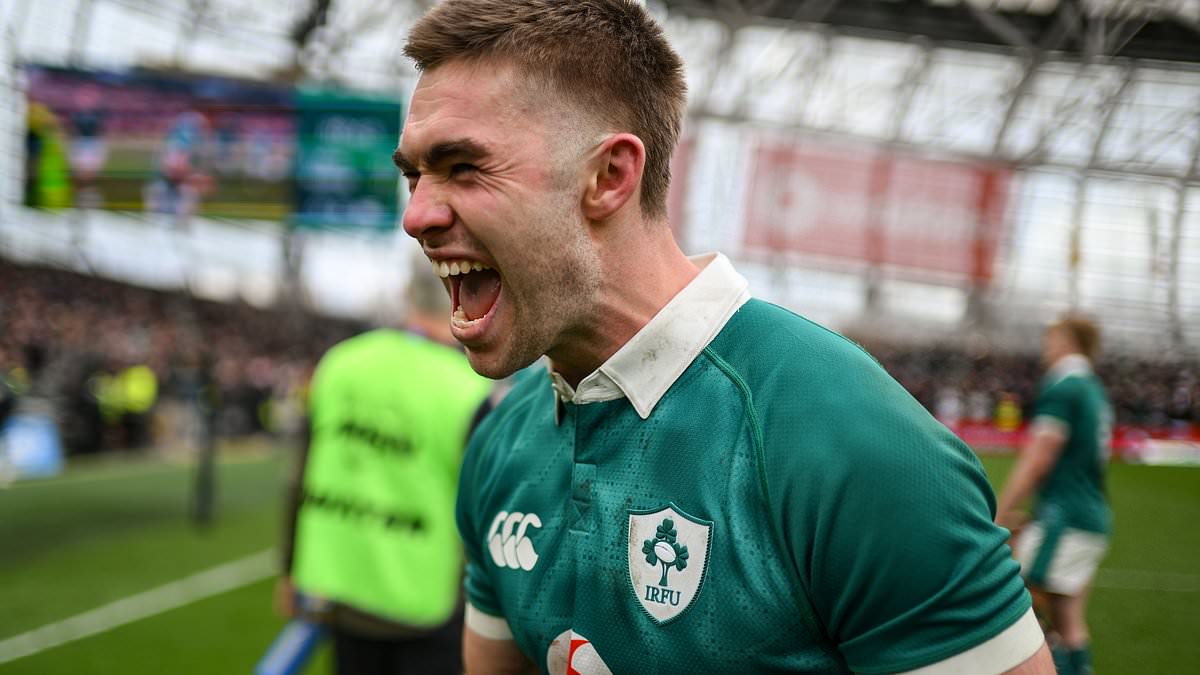
Soaring into the sky, Jack Crowley captured the ball, only to be tackled mid-air by a determined Scottish defender.
Yet, for Crowley, this collision was a triumph.
Moments earlier, Crowley had successfully converted Ireland’s fifth try, extending their lead to 12 points and leaving Scotland’s spirited attempts to catch up dwindling.

High stakes: Ireland’s Jack Crowley collides in the air with Scotland winger Kyle Steyn
Shortly after, he nailed another penalty, further boosting Ireland’s lead to 15 points.
This performance sent a clear message: it marked Ireland’s resurgence and continued dominance over a fierce rival, especially crucial as they look ahead to their World Cup encounter next year. It also firmly established Crowley as a key player.
This display was arguably the most persuasive in the ongoing debate over who deserves the coveted No.10 jersey for Ireland this season.
It’s a debate that will never be definitively settled, but Crowley made a compelling case with this display.
He was good in attack but two other strengths really distinguished his performance: his excellence in defence, and his vast improvement on last week from the kicking tee.
He was successful with six of his seven shots on goal, completing the job with a sumptuous strike from the left touchline in overtime.
This was an out-half attending to the routine but critically important part of the job.
For him, this couldn’t about a championship or permutations, this was about a gifted out-half in competition for his place against a richly talented rival, a legion of doubters, and a team’s history of dominant out-halves.

Back in the groove: Jack Crowley successfully converts Tommy O’Brien’s try for Ireland
Succeeding Johnny Sexton is like being asked to fill in for a national monument.
Sexton was one of the handful of Irish public figures known by his first name, and he became the personification of the standards espoused by the all-conquering teams of Joe Schmidt and then Andy Farrell.
Crowley and Prendergast are in competition not just with each other but also the ghosts of old victories, the vapour-shapes in memory left by the command performances of Sexton and before him Ronan O’Gara.
There was a reminder of that during the week with O’Gara’s trenchant criticism of the performances put in by the two pretenders in this campaign.
‘What we have at ten right now is simply not good enough for a nation ranked third in the world,’ he declared.
He decried the toxicity around the out-half debate here, and he believed it has manifested in the performances of the two competing No10s.
But his core point was correct. Crowley and Sam Prendergast had not played up to the level needed, let alone the standard set by Finn Russell at times in the Six Nations.
Convention flipped on a Dublin day that made you believe springtime is coming.
Bigger, better and brighter days are ahead.
As the country emerges from a sodden winter, Crowley took his cue and produced a vibrant performance, overshadowing a vaunted opposite number in a match worthy of this extraordinary Six Nations.
Where Russell grew rushed and looked stalked by familiar old phantoms long before half time, Crowley was assured.

Confidence: Crowley puts pressure on the lauded Scottish midfield of Russell and Tuipulotu
Intent was a word that Andy Farrell deployed like an accusation after the opening night collapse in Paris. His players hadn’t shown any, he complained.
Crowley showed enough of it here to power a whole team.
It helped that he had early opportunities to get his prints on the performance.
He played the final pass for Jamie Osborne’s dizzying opener, and hit a sweet spiral strike in the fifteenth minute to get Ireland up the pitch.
In between, he barely made touch with penalty in the tenth minute. It went close to flag, but it was in, and it was a good example of an out-half wringing every vital inch out of a kick in those circumstances.
If his head wasn’t slowly frazzling, it was also a kick that Russell might have appreciated.
An hour before the match kicked off, Russell had stooped to the ground near the half-way line. Earbuds in, he picked his phone up off the grass, stood and gave a thumbs-up to a man in a Scottish tracksuit near the corner-flag to his right.
For the previous 10 minutes, Russell had kicked ball after ball from his hands, trying to get it as close to the corner as possible.
He was rehearsing his penalty routine, but with seven points and not three points in mind.
It was an extended signal of Scotland’s intent on the day, but it gave two other insights as well.
This is how Gregor Townsend’s Scotland, for all their history of flattering to deceive, have consistently tried to play the game, eschewing the safe option for the more daring one.

Defender of the realm: Crowley helps bring down Tuipulotu with a committed tackle
And the second thing it revealed was the hard work that goes into making the game look as easy as Russell does.
Andy Farrell had smiled at his team announcement earlier in the week when talking about the man he made the playmaker on his Lions Test teams.
‘People think he’s laid back but he knows what he’s after,’ said Farrell.
But he’s not the only one.
There isn’t a player who gets near a stadium like this on days like this without sharing that unblinking commitment to perfection.
That they’ll never get there is immaterial; it’s the standard by which they must abide.
Russell was in his 30s before becoming the complete player he can be on his good days.
This wasn’t one of them. That was partly because every time he looked up he had the unwelcoming sight of Stuart McCloskey in front of him.
It was also because Scotland started chasing early. They were obliged to, because Ireland out-played them and reduced them to the dread role of pursuers.
Crowley was one of the keys to Ireland building their advantage, and if there were times when they must have felt hot Scottish breath on their necks, they always had a counter.
Scotland eventually blew themselves out. The team that ran the legs off France a week earlier couldn’t live with these hosts.
After curling over his final, delicious kick to convert Tommy O’Brien’s second, crowning try, Crowley turned and embraced Aled Walters.
Walters is the head of athletic performance, the man charged with the physical wellbeing of the team. But on match-days, he is the man who ferries on the kicking tee to the out-halves.

Happy days: Crowley celebrates victory with McCloskey (left) and Baloucoune (right)
He has seen the travails of Crowley and Prendergast up close.
This time, he was there to acknowledge the final say in a terrific performance.
Jack Crowley has arrived. He won’t budge easily.