
Share this @internewscast.com
This season has been marked by turmoil at the nation’s two largest football clubs, with fans in open revolt. However, at Aberdeen, the atmosphere surrounding manager Jimmy Thelin has been markedly different.
Unlike the uproar seen elsewhere, there were no mass protests at Pittodrie Stadium. Thelin was not subjected to harsh criticism or public outcry. There were no angry demonstrations or calls for his dismissal.
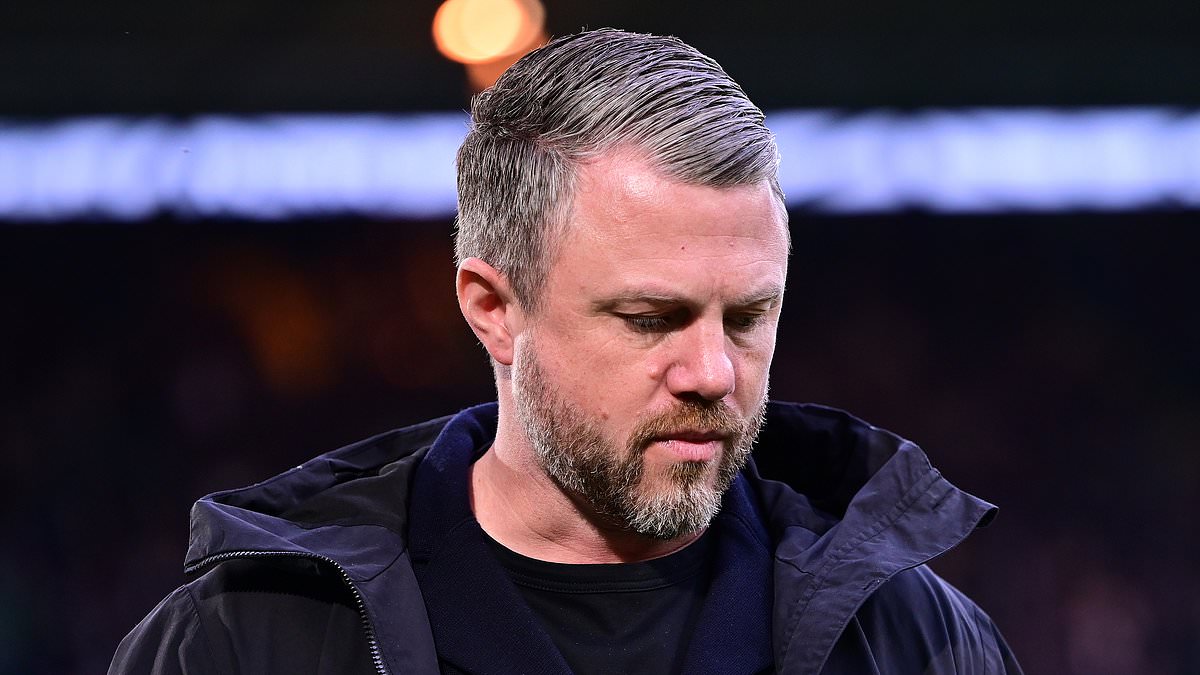
Ultimately, what lingered was a sense of apathy and a void left by the departure of a well-liked manager. Thelin, who had the distinction of winning the Scottish Cup, faced a growing acceptance of his departure after a 1-0 defeat to Falkirk on Saturday sealed his fate.
This loss marked Aberdeen’s fourth defeat in five games across various competitions, leaving the club in eighth place in the Premiership standings. For the 47-year-old Swedish manager, it was the end of the road.
As the team prepares for consecutive matches against Rangers, Peter Leven steps in as interim manager. He will lead the team at Ibrox tomorrow night and again when they face Rangers at Pittodrie on Sunday.

Jimmy Thelin has paid the price for a poor run of form amid a thoroughly uninspiring season

Thelin seemed unable to lift the club out of a rut, with his Dons enduring a few winless runs

The weekend defeat at the hands of Falkirk proved the final straw for chairman Dave Cormack
The search for a new manager will be spearheaded by the recently appointed sporting director, Lutz Pfannenstiel, who will be at the forefront of the recruitment process.
Thelin had been in charge for 18 months and he arrived to much fanfare when he pitched up at Pittodrie in the summer of 2024.
He had built a good reputation at Elfsborg in his homeland and had taken them very close to winning the league title in Sweden, finishing as runners-up on two occasions.
It was viewed as an exciting, progressive appointment, one which could help transform the club’s identity and playing style.
Thelin made a flying start to his time at Pittodrie, winning 15 of his first 16 matches last season to fuel belief that the Dons could mount a title challenge.
They were scoring a lot of late goals during that run, grinding out results and showing an ability to compete with a Celtic team who, at that point, were going well under Brendan Rodgers.
But, shortly after a 6-0 thrashing against Celtic in the League Cup semi-finals, a dreadful run of 14 matches without a win saw them slide back down the table and eventually finish fifth.

Thelin’s greatest hour arrived at Hampden with a Scottish Cup final triumph over Celtic
Aberdeen salvaged their season by beating Celtic on penalties to win the Scottish Cup at Hampden, the first time the club had lifted the trophy in 35 years.
It was the ultimate high. A brilliant platform upon which to build. But that Scottish Cup triumph can now be viewed for what it was: an anomaly. A glorious anomaly. But an anomaly all the same.
Aberdeen’s form has been poor for a long time. Since the Scottish Cup final and the euphoric denouement to last season, they have won only eight of 30 games in all competitions this term.
Immediately before the final, they had won only once in seven matches, a run which scuppered the belief that Thelin had managed to steady the ship around February and March time.
Despite being backed with the biggest budget of any manager in the club’s history, there were no signs of progress. No evidence that this would get better any time soon.
Aberdeen backed Thelin with significant investment, something they referenced in the club statement confirming his departure on Sunday night.
The club banked £6.8million with the sale of Bojan Miovski to Girona in 2024, much of which was then reinvested under the new manager.

Ex-Celtic boss Wilfried Nancy managed only two wins… and one of those came against Thelin
Topi Keskinen was signed for £850,000. There was £500,000 for Kenan Bilalovic, £400,000 for Nicolas Milanovic, £750,000 for Kristers Tobers and £500,000 for Alexander Jensen.
Another £300,000 was forked out to sign Kevin Nisbet, with a chunky wage packet also required to sign Swedish international winger Jesper Karlsson on loan from Bologna.
But, in terms of results on the pitch, the investment amounted to nothing. Truth be told, Thelin should probably have been sacked back in late September.
At that stage, Aberdeen sat bottom of the league and had taken only one point from their opening six matches, a run which had seen them fail to even score a goal.
There was a flicker of life with a run of only one defeat in 10 games across October and November, but it wouldn’t last.
Thelin’s departure now turns the spotlight firmly on Dave Cormack and the club’s wider structure.
Aberdeen are now looking for their fifth permanent manager since Derek McInnes left the club back in 2021.
Stephen Glass, Jim Goodwin, Barry Robson have all tried and failed to bring success and long-term prosperity.

Thelin was backed by his board, with Swedish winger Jesper Karlsson arriving on loan at cost
When you throw the bizarre interim appointment of Neil Warnock into the mix as well, you have to ask the question: do Cormack and Aberdeen have the faintest clue what they are actually looking for?
The whole Warnock episode was an embarrassment. He spoke with the arrogance of a man who clearly felt he was doing the club — and Scottish football — a favour by being here.
Glass was plucked from obscurity in the MLS whilst coaching Atlanta United’s reserves. Goodwin was intended to be the safe pair of hands with solid SPFL experience.
Thelin was supposed to be the bright, progressive young coach who would deliver exciting attacking football.
Plainly, none of it has worked. Whilst no one can question Cormack’s commitment and investment, he and Aberdeen continue to stumble from one managerial failure to another.
There is a profound sadness in seeing a club like Aberdeen reduced to this serial ritual of severance as they continually burn through managers.
This is a club who once strode the corridors of European football with power and purpose. They are — or should be — a giant of the Scottish game.
Perhaps that is what will be most galling for supporters. With both Old Firm clubs so vulnerable this season, the Dons should be up there challenging with Hearts at the top of the league.

Dons chairman Cormack must now make another appointment after a series of dugout failures
Even beyond the glories of Gothenburg or the fact they remain the last non-Old Firm team to win the title, there was always a certain structure and resolve to Aberdeen.
When he left in 2021, McInnes had established Aberdeen as a model of consistency. Did they play scintillating football? No, but he gave them structure, purpose, and got results.
They reached four cup finals under McInnes, winning the League Cup in 2014, and regularly qualified for Europe.
Whilst it is true that his time at the club had probably run its course, those foundations have slowly eroded over the past few years.
Layer by layer, they have wasted away until what remains is a club bereft of soul and identity. A blank slate upon which a succession of managers have scrawled incompatible visions before being quickly erased.
Cormack has pumped a lot of his own money into the club. He has helped build a fantastic new training facility, as well as investing in other areas.
But investment alone does not constitute good leadership when the central task — appointing and sustaining a manager capable of imprinting a lasting philosophy — has been botched with such relentless consistency.
Cormack must look in the mirror. His off-field contributions are undeniable — Cormack Park stands as a monument to progress — but on the pitch, his record invites harsh scrutiny.
This is now the biggest appointment of his time in charge of the club. It is one they have to get right, otherwise the club will continue to flounder around in mid-table mediocrity.