
Share this @internewscast.com
Hillary Clinton has launched a scathing critique against a leading Republican amid a controversy regarding how her and her husband’s testimonies about their connection to Jeffrey Epstein will be documented by Congress.
Both Bill and Hillary Clinton are slated to provide testimony later this month before the House Oversight Committee concerning their interactions with the convicted sex offender.
On Thursday, Hillary Clinton accused James Comer, the Republican Chair of the Oversight Committee, of “moving the goalposts.” She claims that despite an initial agreement for their depositions to be conducted privately, Comer is now insisting that the sessions be recorded on video as well as transcribed.
The former Secretary of State took to X, formerly known as Twitter, to issue her challenge: “Let’s stop the games. If you want this fight, @RepJamesComer, let’s have it—in public.”
She emphasized the importance of transparency, stating, “There’s nothing more transparent than a public hearing, cameras on. We will be there.”
Earlier in the week, Comer announced that Hillary Clinton had agreed to appear for a deposition on February 26, followed by former President Bill Clinton on February 27.
The agreement came after months of wrangling, with the Clintons demanding that they be allowed to provide the committee with a closed-door deposition in New York and written testimony.
The couple finally agreed to Comer’s demands after the chair threatened to hold them in contempt of Congress.

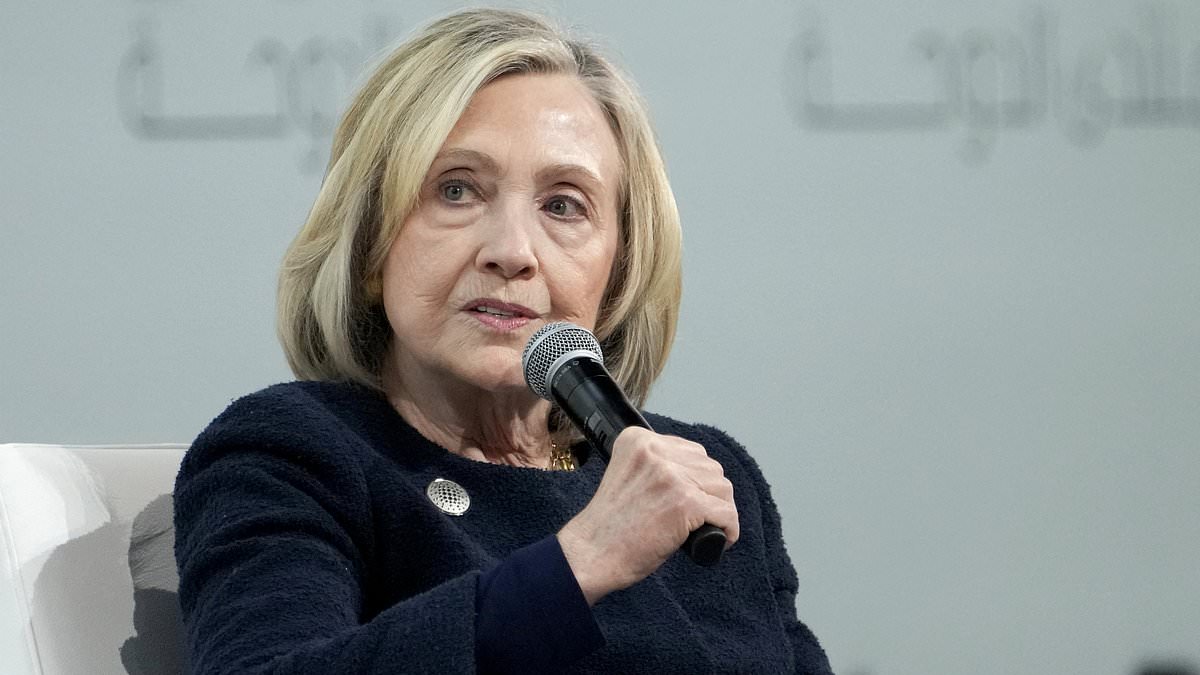
Former US Secretary of State Hillary Clinton speaks during the Doha Forum in Qatar on December 7, 2025

Infamous sex offender Jeffrey Epstein and associate Ghislaine Maxwell at the Clinton White House. The image, from the William J. Clinton Presidential Library, shows Epstein and Maxwell speaking with then-President Bill Clinton at an event that took place in 1993 for donors to the White House Historical Association
In a follow-up post on Thursday, Hillary noted that for six months, she and her husband ‘engaged Republicans on the Oversight Committee in good faith’ and ‘told them what we know, under oath.’
Bill Clinton’s testimony will mark the first time a former president testifies before Congress after being served a subpoena.
Donald Trump said in an interview on Wednesday that he likes Clinton, and was ‘bothered’ that Congress was going after him.
The President told reporters the previous day in the Oval Office: ‘I think it’s a shame, to be honest. I always liked him. Her, she’s a very capable woman. She was better at debating than some of the other people, I will tell you that. She was smarter. Smart woman.’
Clinton, like a number of other elites including Trump, had a well-documented relationship with Epstein in the late 1990s and early 2000s.
Neither Trump nor Clinton has been credibly accused of wrongdoing in their interactions with the late financier.
Both Clintons have said they had no knowledge that Epstein was sexually abusing underage girls before prosecutors brought charges against him.
The Clintons had initially argued the subpoenas for their testimony were invalid and offered to submit sworn declarations on their limited knowledge of Epstein’s crimes.

Bill Clinton, 42nd US President and his wife Hillary Rodham Clinton, 67th US Secretary of State, arrive at the Booksellers Room of the White House on the occasion of the State Dinner with the Kenyan president at the White House in Washington, DC, on May 23, 2024

Bill Clinton with Ghislaine Maxwell and Jeffrey Epstein in a signed photograph that belonged to the pedophile
But as Comer threatened to proceed with contempt of Congress charges, they began looking for an off-ramp.
Both Clintons have remained highly critical of how Comer has handled the Epstein investigation and argue that he is more focused on bringing them in for testimony rather than holding the Trump administration accountable for how it has handled the release of its files on Epstein.
However, as Comer advanced the contempt charges out of the House Oversight Committee last month, he found a number of Democrats willing to help.
A younger generation of more progressive Democrats showed they had few connections with the Clintons, who led the Democratic Party for decades, and were more eager to show voters that they would stand for transparency in the Epstein investigation.
Nine Democrats out of 21 on the Oversight panel voted to advance charges against Bill Clinton, and three Democrats joined with Republicans to support the charges against Hillary.
As the vote loomed this week, House Democratic leaders also made it clear they would not expend much political capital to rally votes against the contempt resolutions.
That left the Clintons with little choice but to agree to testify or face one of the most severe punishments Congress can give.

Republican Congressman from Kentucky and Chairman of the House Oversight Committee James Comer after speaking to reporters at the US Capitol in Washington, DC, USA, 14 January

Donald Trump and his then-girlfriend Melania Knauss, Jeffrey Epstein, and Ghislaine Maxwell at the Mar-a-Lago club, Palm Beach, Florida, February 12, 2000
Congress has historically shown deference to former presidents. The Clintons’ concession, however, prompted some Democrats to suggest that it set a precedent for former presidents to comply with congressional subpoenas.
‘We look forward to using this same precedent when we take back the majority in November,’ Rep. Daniel Goldman, a New York Democrat, said on social media.
Trump’s attorneys successfully resisted a congressional subpoena in 2022, between his first and second terms, issued by a House committee investigating the deadly January 6, 2021, riot by a mob of his supporters at the US Capitol.
Trump’s lawyers cited decades of legal precedent they said shielded an ex-president from being ordered to appear before Congress, and the committee ultimately withdrew its subpoena.