
Share this @internewscast.com
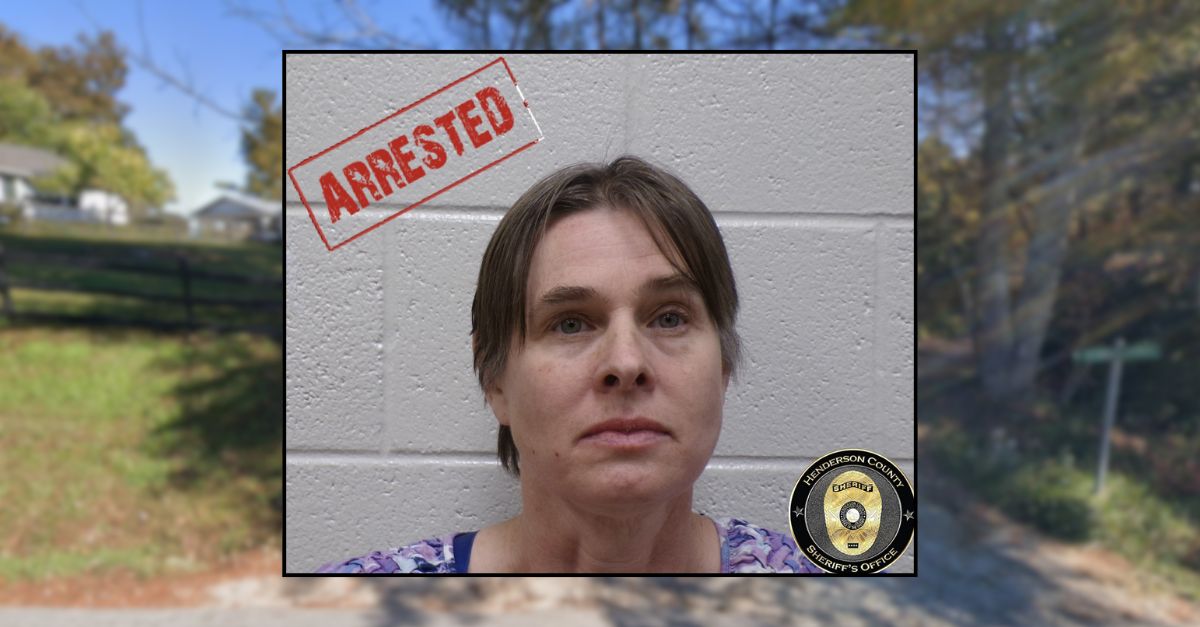
Inset: Gudrun Casper-Leinenkugel (North Carolina State Bureau of Investigation). Background: The rural road where Gudrun Casper-Leinenkugel lives in Hendersonville, N.C. (Google Maps).
Disturbing revelations have surfaced in a North Carolina homicide case, where a mother allegedly poisoned her daughters during a Thanksgiving gathering last year.
Gudrun Casper-Leinenkugel, aged 53, faces a charge of first-degree murder in connection with the death of her 32-year-old daughter, Leela Livis, as reported by the North Carolina State Bureau of Investigation.
In addition to this charge, Casper-Leinenkugel has been indicted on two counts of attempted murder and three counts related to the illegal distribution of certain consumable products, according to a statement released by the agency in January.
The victim, who perished, was found to have died from poisoning after consuming wine that had been tampered with, based on warrants recently made public and reviewed by Law&Crime.
Authorities revealed that Leela Livis succumbed to poisoning from acetonitrile, a harmful substance that metabolizes into cyanide within hours of ingestion.
During the Thanksgiving meal, both daughters of the accused, along with one daughter’s boyfriend, reportedly consumed wine contaminated with acetonitrile. Consequently, all three individuals experienced symptoms similar to the flu later that evening, according to police statements.
One of Casper-Leinenkugel’s daughters died the next day.
The other daughter, however, said she only had a few sips of the poisoned wine and her complications were relatively mild, police said. The surviving daughter’s boyfriend, on the other hand, had to be admitted to a nearby hospital for six days due to having a cyanide level more than five times the lethal limit, according to the warrants.
“[T]he defendant unlawfully, willfully, and feloniously did knowingly distributed or otherwise caused to be placed in a position of human accessibility or ingestion a beverage which contained a poisonous chemical, acetonitrile, which might cause death or serious physical injury,” an arrest warrant reviewed by Law&Crime said. Acetonitrile is a chemical solvent used for a variety of purposes, including pharmaceuticals, pesticides and batteries.
According to the Centers for Disease Control, acetonitrile “forms cyanide in the body” and can result in “delayed toxicity.”
The defendant told investigators someone else living in her house purchased the poison, according to the affidavit. Investigators found a bottle of acetonitrile inside the residence.
Casper-Leinenkugel tried to pin the blame on an open bottle and said the wine was stored in a closet near other chemicals like rat poison, according to search warrant applications obtained by Law&Crime.
“[T]he bottle of wine was open when it was presented at the party,” one of the warrant applications reads. “[T]he open bottle was stored in a closet next to chemicals used in the barn.”
After the poisonings, Casper-Leinenkugel allegedly told the attending physician at the hospital where her daughter’s boyfriend was being treated: “The kids play back there as well and may have ‘got to it.’”
Another warrant application supports the idea the bottle of wine had been opened prior to the holiday party. The defendant’s surviving daughter told investigators “that when the bottle was presented to everyone, it was already open and appeared to have a small amount missing, possibly the amount of a tasting rather than a full glass.”
As investigators intensified their probe into the poisonings, authorities quickly linked Casper-Leinenkugel to a years-old cold case.
The defendant also stands accused of the October 2007 murder of Michael Schmidt, a man who lived in a camper on her property.
“This death was discovered by Gudrun, and she was also the last person to see the decedent alive when they had a few alcoholic drinks together,” a detective wrote in a warrant application.
Police believe acetonitrile was also the substance used to fatally poison the 42-year-old man who lived on the Schmidt Terrace property – the same property he transferred ownership of to Casper-Leinenkugel in 2006, according to Henderson County records.
At the time of Schmidt’s death, Casper-Leinenkugel told detectives she had last seen him “approximately two days prior and that she believed him to be a drug user and alcoholic and that he was coughing for a few days prior to his death,” according to a warrant application.
In 2008, Schmidt’s death was listed as due to “acute acetonitrile toxicity (probably huffing)” and categorized as accidental.
Only later, when a large number of emergency calls were placed regarding the defendant’s residence, law enforcement reinvestigated the death of the prior property owner.
Now, the local district attorney says Casper-Leinenkugel is tied to additional deaths that are currently under investigation.
In 2016, the defendant was the subject of a story on local news website Mountain Xpress about the opening of her restaurant, Patton Public House, in nearby Asheville. According to that story, Casper-Leinenkugel had opened “six restaurants and bars across the country.”
She is next slated to appear in court on April 30.