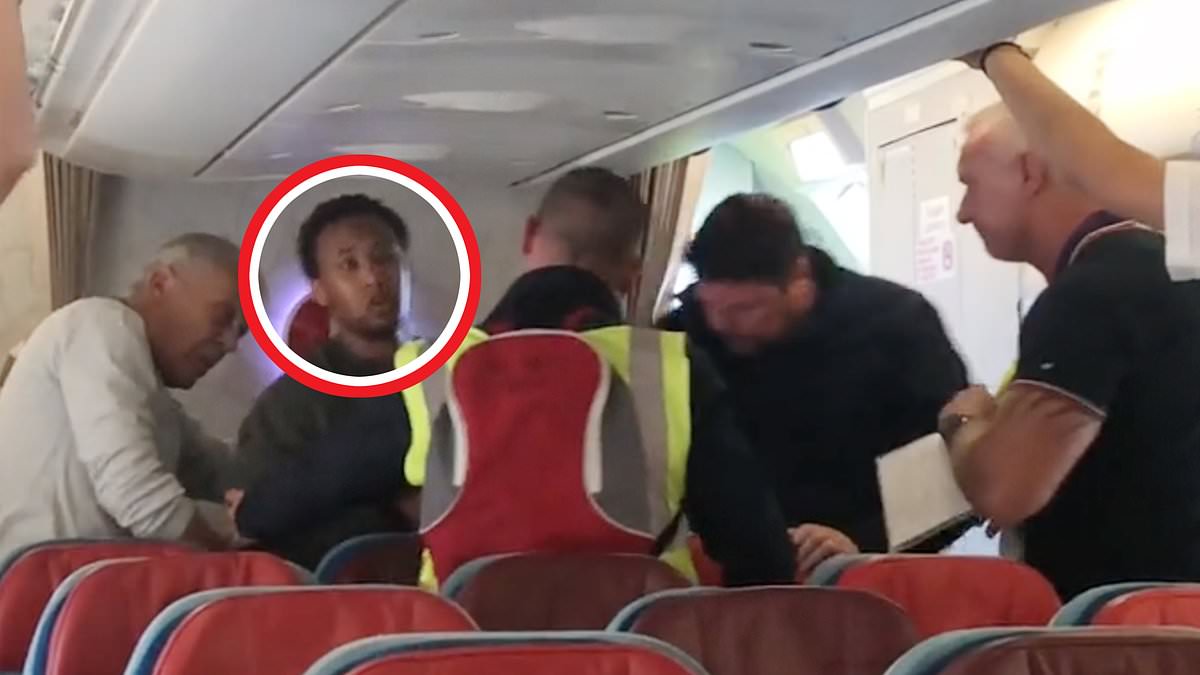

He’s the notorious gang rapist whose deportation was notoriously halted by an impromptu protest from fellow airline passengers.
Now, The Mail on Sunday discloses that it took an additional five years to finally send Yaqub Ahmed back to Somalia, with officials having to resort to an extraordinary set of concessions to break his persistent cycle of questionable human rights appeals.
To facilitate his removal, Ahmed was accommodated for 14 weeks in one of Somalia’s most upscale hotels, complete with all meals, armed security, and a customized therapy program to address his mental health claims—all funded by taxpayers. Meanwhile, the woman he assaulted at 16 has struggled to access similar support for the psychological trauma he caused.
Ahmed extended his deportation battle across at least 24 tribunal or court appearances, involving more than 20 judges, by making a series of misleading claims. However, this publication can confirm that the 34-year-old was finally deported in August, with the entire process costing taxpayers up to £1 million, including the lavish ‘welcome package’ upon his arrival in Somalia.
Last night, Ahmed’s victim expressed her dismay, saying it was ‘utterly appalling’ that officials had to go to such lengths to overcome his repeated human rights objections.
‘Our legal system is a farce,’ she remarked. ‘We used to pride ourselves on fairness, but this has been anything but fair.’
SO NEAR: Rapist Yaqub Ahmed, circled, is led off the flight due to deport him as passengers thwart efforts by the Home Office – triggering five years of human rights challenges through the courts
Ahmed was jailed in 2008 after he and three other men lured their teenage victim to a flat in London before brutally attacking her
LAP OF LUXURY: Somalia’s Peace Hotel where Ahmed was offered full-board accommodation for 14 weeks
The petal-scattered beds offered to guests at the Peace Hotel in Somalia
Details of Ahmed’s extraordinary case exposes the ease with which foreign criminals run rings around officials and comes just days after the Supreme Court torpedoed Rishi Sunak’s flagship scheme to deport Channel migrants to Rwanda.
Former Home Secretary Suella Braverman told The Mail on Sunday the case was an example of how criminals exploit human rights laws to make ‘spurious, repetitive and ultimately obstructive’ legal claims to thwart deportation.
Our exclusive investigation also reveals that:
- Ahmed has cost taxpayers almost £85,000 in legal aid;
- A chartered flight used to finally deport him cost around £200,000 – and it is unclear whether any other deportees were on board;
- In an audacious plot, Ahmed fabricated a claim that he would be targeted by Islamic State terrorists if he returned to Somalia, arranging for a fake death threat video to be posted online;
- Ahmed exploited modern slavery laws by falsely claiming to have been under the control of a UK drugs gang;
- A senior BBC editor was paid to give evidence for Ahmed – but her testimony was heavily criticised by judges and her objectivity questioned;
- A draconian legal order gagged this newspaper from revealing Ahmed’s duplicity until now, as he was granted anonymity for 15 weeks after he was deported.
Ahmed was granted refugee status in 2003 after arriving in Britain from Somalia aged 14.
But he was jailed in 2008 after he and three other men lured their teenage victim to a flat in London before brutally attacking her. A judge lambasted him for having ‘no respect for other human beings’.
In April 2015, Theresa May, then Home Secretary, stripped him of his refugee status and slapped a deportation order on him. This was, however, simply the opening salvo of a tortuous legal battle.
The string of hearings went as high as the Court of Appeal and Government lawyers have fought off three claims by the rapist and his lawyers for judicial review.
Six successive Home Secretaries have attempted to remove him from the UK. In October 2018, his deportation dramatically collapsed when woke holidaymakers, unaware of his appalling crime, mutinied and demanded he be hauled off the Turkish Airlines jet that was about to fly him out of the UK as it sat on the tarmac at Heathrow.
A typical security detail provided by the Peace Hotel in Somalia
THWARTED: The Home Office team escorting Ahmed on the Turkish Airlines flight that should have deported him in 2018
TENSE SITUATION: A Home Office official talks to mutinous passengers on the plane
How the Mail on Sunday broke the story about rapist Ahmed’s deportation being halted in October 2018
April 2019: How could bleeding heart plane passengers stop my rapist being deported?
October 2018: How plane mutiny rapist has cost you £300,000 (And he STILL hasn’t been kicked out of UK)
In an audacious plot, Ahmed fabricated a claim that he would be targeted by Islamic State terrorists if he returned to Somalia, arranging for a fake death threat video to be posted online
An astonishing three-minute video showed passengers erupting into applause as the four-strong Home Office team frogmarched him off the plane, with one holidaymaker shouting: ‘You’re free, man!’
Ahmed was hours from being escorted on to another deportation flight on at least two more occasions, only for his removal to be halted by last-ditch legal challenges.
Court papers obtained by the MoS reveal how – in a bid to persuade the courts that deportation would not breach his human rights – Home Office officials took the extraordinary step of agreeing to use public funds to support Ahmed for three-and-a-half months after his arrival in Somalia’s capital, Mogadishu.
‘This included the provision of mental health medication and psychological services through a clinic in Mogadishu,’ the papers stated. The package also included the supply of a month’s worth of antidepressants, full-board accommodation in the Peace Hotel for 14 weeks, transportation from the airport to the hotel in an armour-plated vehicle and transportation between the hotel and a clinic for medical appointments.
Ultimately, however, even that was not enough to head off yet another human rights appeal. On November 2, 2020, just two days before his planned deportation, Ahmed claimed he was at risk of being killed if returned to Somalia.
The court papers show how this final appeal was aided by BBC Africa Editor Mary Harper, who appeared as an expert witness.
She warned in a written report and during a hearing before three judges that if Ahmed was sent back to Somalia his life would be in danger. She said he would struggle to get a job and even claimed he could be accused of being a British spy.
‘Why are his human rights being prioritised above mine and people like me?’ Ahmed’s victim Hannah, not her real name

Former Home Secretary Suella Braverman (pictured) told The Mail on Sunday the case was an example of how criminals exploit human rights laws to make ‘spurious, repetitive and ultimately obstructive’ legal claims to thwart deportation
Last night, Ms Harper, 58, did not respond when asked how much she was paid, but experts estimated a typical fee could be around £3,000.
It later emerged that Ahmed’s last-ditch appeal was based on fake evidence. Days before he was due to be deported, a video mysteriously appeared online which purportedly showed Islamic State gunmen threatening to kill Ahmed. But in a bombshell judgment last year, three judges ruled the video was actually a ‘fabrication’ that had been recorded on Ahmed’s orders.
His victim, Hannah – not her real name – last night lambasted the justice system. ‘He negated his human rights after he did what he did,’ she said. ‘It wasn’t a human thing to do. Why are his human rights being prioritised above mine and people like me?’
For years, the MoS has been prevented from fully reporting on Ahmed’s case by a series of draconian court orders. The most recent order, granted last December, provided Ahmed with anonymity until ‘the first day of the 15th week’ after his removal from the UK.
Dawn Alford, executive director of the Society of Editors, said the order was ‘hugely concerning’.
This newspaper also successfully fought an ‘unprecedented’ application for three of Ahmed’s barristers to be granted anonymity.
The Home Office has removed 14,700 foreign criminals between January 2019 and March 2023. A spokesperson said: ‘Returning a foreign national offender to their country of origin can involve enormous challenges. Occasionally support packages are required to secure agreement from the court to proceed with deportation.’