
Share this @internewscast.com
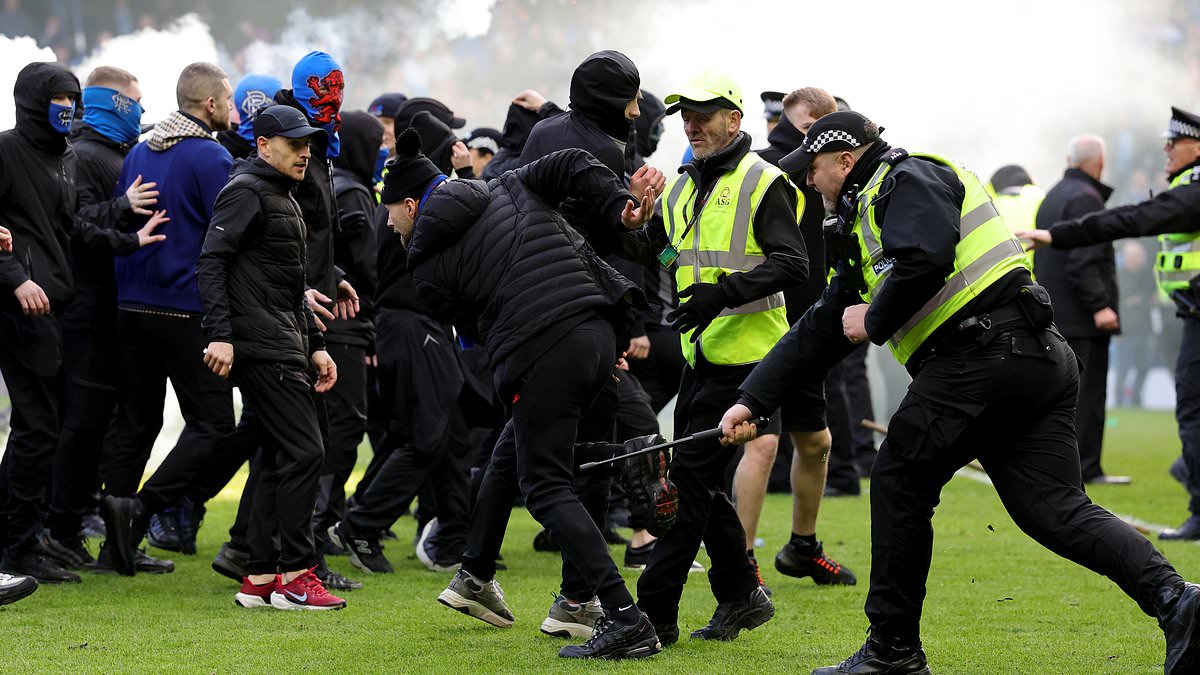
The Scottish Football Association has announced an investigation into the troubling events that unfolded as hundreds of Old Firm supporters stormed the pitch following the Scottish Cup quarter-final at Ibrox.
After a tense, scoreless 120 minutes, Celtic emerged victorious, defeating their long-time rivals 4-2 in a dramatic penalty shootout.
The deciding penalty, scored by Tomas Cvancara, led to an eruption of excitement among visiting fans, who surged onto the track and eventually onto the pitch.
The situation quickly escalated as opposing fans began hurling bottles, flares, and flagpoles at each other, resulting in at least one reported injury.
Celtic’s full-back, Julian Araujo, celebrated the win by leaping into the crowd of his own supporters but soon found himself in a confrontation with a Rangers fan who had invaded the pitch. The chaos persisted for approximately 10 minutes.

Police have described the chaos at the Old Firm derby as ‘shameful’ as the aftermath of the game turned violent

Both Celtic and Rangers fans invaded the field of play after the former won the game

Police said that there were injuries suffered and full investigations will now be carried out
A representative from the Scottish FA stated, “The Scottish FA strongly condemns the actions of the supporters who entered the field of play following today’s Scottish Gas Scottish Cup quarter-final at Ibrox Stadium.”
‘An investigation will be carried out immediately in line with the judicial panel protocol.’
Chief Superintendent Kate Stephen, meanwhile, said: ‘The behaviour of a number of supporters at the Scottish Cup quarter final between Rangers and Celtic at Ibrox today was shameful. It must be condemned by everyone involved in football and wider society.
‘A number of arrests have already been made, and Police Scotland will now work with both clubs and the Scottish Football Association to carry out a robust investigation following the scenes on the pitch at the conclusion of the match.
‘Officers and stewards were faced with extreme hostility and violence over a sustained period, with many individuals having armed themselves with items clearly intended to cause harm. Officers and members of the public have been injured in this despicable display and I want to express my thanks to all officers and staff deployed.
‘The investigation will also include the actions of some supporters who entered the Broomloan Road stand without tickets before the match started, forcing delays in the security operation and the turnstiles to be closed for a period of time.
‘I would also urge anyone with information about who was involved in disorder before, during or after the match to get in touch with Police Scotland on 101.’
The match was the first since 2018 to have the Broomloan Road end filled exclusively with 7,500 Celtic fans.

One fan appeared to get kicked in the head after a rival supporter broke through the wall of stewards and police

A security guard was also thrown to the floor as they joined in trying to control the situation

Celtic fans entered the field of play to celebrate the Scottish Cup victory over Rangers
The scenes are likely to end any hope of visiting clubs receiving that traditional allocation for future league matches.
Asked if the flashpoint was set to overshadow the outcome of the match, Celtic boss Martin O’Neill said: ‘I think that would be a worry. For me, from a distance, I’ve been saying that the fixture itself is still a phenomenal fixture. There’s no question about that.
‘It had lost a bit of its lustre because the away fans, the full complement of away fans, weren’t allowed in.
‘I have no idea what might happen. So, from that viewpoint, yes, (I’d be concerned) because I think today with the crowd, with our crowd there, I thought it was a proper Old Firm game in that sense. But we’ll see what develops.’
Pressed on whether he feared that the incident would see the number of visiting fans restricted, he added: ‘No, that’s not for me to make a judgment… certainly not 20 minutes after the game is over.’
O’Neill confirmed that none of his players or staff had been injured in what followed.
‘I think as we were making our way back, there was some sort of fracas,’ he recalled. ‘I don’t know. All I saw was there was a bit of a scrum.
‘Maybe it does taint proceedings, but I think there’s an element of self-protection in that one. I’m making judgments here on things that I only half saw.’

Objects were thrown between each sides, including a flare, with events lasting for 10 minutes

Celtic fans continued to chant about their side from the stands as Rangers supporters confronted them on the pitch
O’Neill was asked if there had been any discussion with security staff about removing the players from the field quickly after the game ended.
‘Well, no, I don’t think there was any,’ he said. ‘The security men, in fairness to them, were wanting to get people off. But there is a natural euphoria about winning a game and about fans joining in. If this has gone too far, that would be disappointing.’
After 21 years away, O’Neill feels the Old Firm game still carries the same level of animosity.
‘I don’t know whether it’s grown. It hasn’t lessened,’ he stated. ‘Anyway, let me put it this way. And if any of us ever come down to this earth in 500 years, it will be exactly the same. Exactly the same.’
Asked if it was frightening to witness at close hand, O’Neill said: ‘Well, I didn’t think so, because if I’m on and I’m waving to our crowd and we have actually won, there’s a fairly decent chance I’m going to get off lightly in that one. If we had lost, I don’t think I would have been there.
‘I think I might have been the first one down in the tunnel. I’m not trying to play lightly or whatever. There is an excessive celebration if that’s the case, and I would need to see the whole thing again.’
Rangers boss Danny Rohl expressed regret at what unfolded despite not getting a clear view of what happened.
‘I’m honest, I was not on the pitch in this moment. I didn’t see it until now,’ he said.
‘I heard just that there was something on the pitch. I think we all know the emotional situation after a game. Nobody likes to see this. I think it was a great atmosphere, 120 minutes. I think it should be like this. All the other things should not be in the stadium or around football.’
Told that the SFA had issued a statement which threatened disciplinary action against the respective clubs, Rohl added: ‘The good thing is I take a lot of responsibility for a lot of topics, but this is not my topic. I think there are a lot of good people around me that will speak about this and then we will see.’
Last night, there were further reports of disorder among Celtic fans before the game. It’s believed that an entry door at the Broomloan End was forced by ultras with a number of ticketless fans then making their way into the stadium.