Share this @internewscast.com
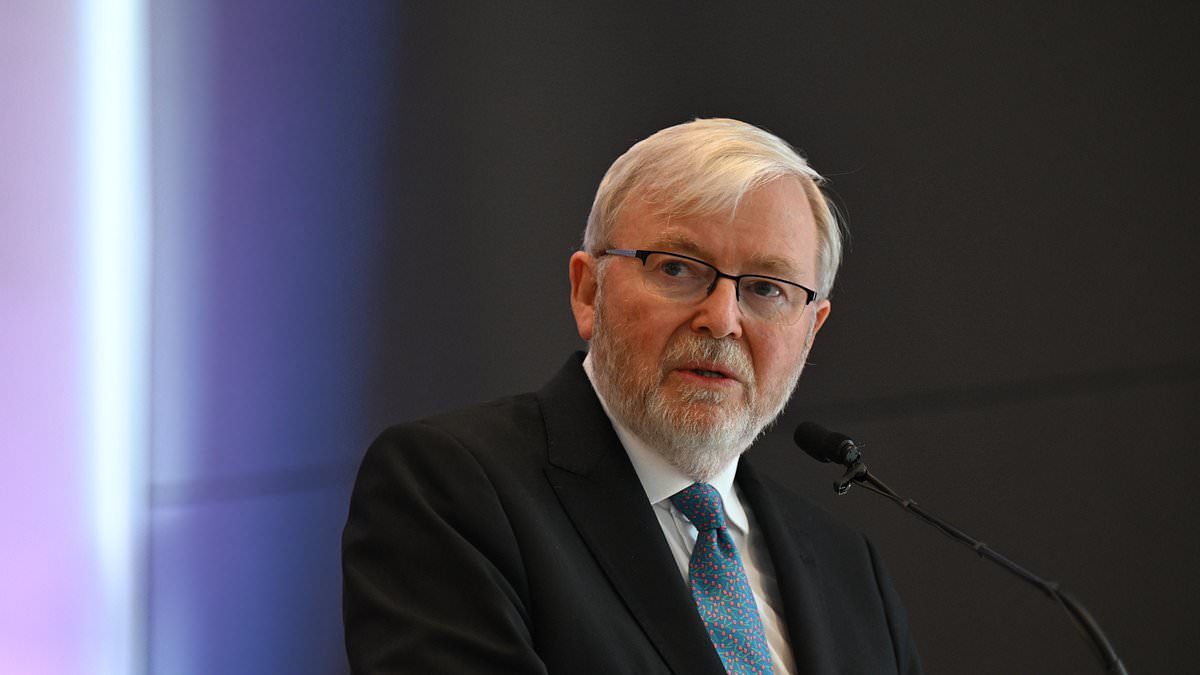
Former Australian Prime Minister Kevin Rudd is reportedly eyeing the position of United Nations Secretary-General, just weeks after announcing his resignation as Australia’s Ambassador to the United States.
The potential candidacy was disclosed by Sky News Chief Anchor Kieran Gilbert, who indicated that Rudd is contemplating a bid for the UN’s top job, following discussions with various government officials.
The current Secretary-General, Antonio Guterres, will be stepping down upon the completion of his second five-year term on December 31, 2026, leaving the position open for new leadership.
Phil Coorey, the Political Editor for the Australian Financial Review, shared with Sky News that he anticipates Rudd will receive bipartisan support in his pursuit of the role.
“There’s a lot of diplomacy involved, and Kevin is quite adept at it. Perhaps they’ll offer him the position just to stop him from persisting,” Coorey commented.
Thus far, four candidates from Chile, Argentina, Costa Rica, and Bolivia have been nominated for the prestigious position leading the international organization.
Rudd attempted to run for the job in 2016 but was denied by then-prime minister Malcolm Turnbull on the basis he wasn’t suitable for the role.
In an opinion piece published in The Guardian in 2016, Rudd offered 10 principles to ‘reform the United Nations before it’s too late.’

Former Prime Minister Kevin Rudd is set to throw his hat in the ring for the UN’s top job

UN Secretary-General Antonio Guterres concludes his second five-year term on December 31
‘Those of us who are proud to be lifelong friends of the UN today will defend the institution to the hilt. But the uncomfortable truth is that while the UN today is not broken, it is in trouble,’ Rudd wrote.
‘This need not be the case. The UN is capable of re-inventing itself.’
Among Rudd’s reflections included his advice to the incumbent Secretary-General and UN member states to anticipate, plan and prevent for future crises, ‘rather than a culture of simple reaction, “band aid” solutions, and fingers crossed.’
He also claimed the United Nations should focus on its ‘performance in the field’, rather than on writing reports, for which Rudd said there is ‘too many.’
The news of Rudd’s renewed run at the top job comes just weeks after he announced he would be stepping down as Australia’s ambassador to the United States on March 31 – a year earlier than planned.
He was appointed to the role in March 2023.
His previous comments, in which he labelled Donald Trump ‘the most destructive president in history’, resurfaced after Trump returned to office in 2024, putting renewed strain on relations despite Rudd’s efforts to mend ties.
That tension came to a head during an Oval Office exchange in 2025, when Trump told Rudd, ‘I don’t like you … and I probably never will’.

Rudd tried to run for the job in 2016 but was denied by then-prime minister Malcolm Turnbull

Rudd’s exit followed an awkward exchange with Trump during Albanese’s October trip to Washington, when Trump told him directly: ‘I don’t like you either, and I probably never will’

In March 2024, Trump publicly described Rudd as ‘a little bit nasty’ and warned bluntly that if the ambassador was hostile, ‘he will not be there long’
Rudd’s successor, senior public servant Greg Moriarty, is expected to take over the role from March 31.
Moriarty has previously served as ambassador to Iran and Indonesia, held senior postings in Papua New Guinea, and in 2015 became Australia’s first counter‑terrorism coordinator.
It had been previously reported that Rudd was resigning from his post to return as head of the Asia Society think tank.
‘We thank Kevin for his service to Australia and for advancing Australia’s interests with our closest security ally,’ Albanese said at the time.
‘He’s moving on to a role that he believes is pivotal.
‘Kevin Rudd will tell you privately what he has said publicly and what drove him to write his book is that the relationship between the United States and China, the two big superpowers, is he thinks that is the most important one that will define the mid-part of this century.’
More to come.