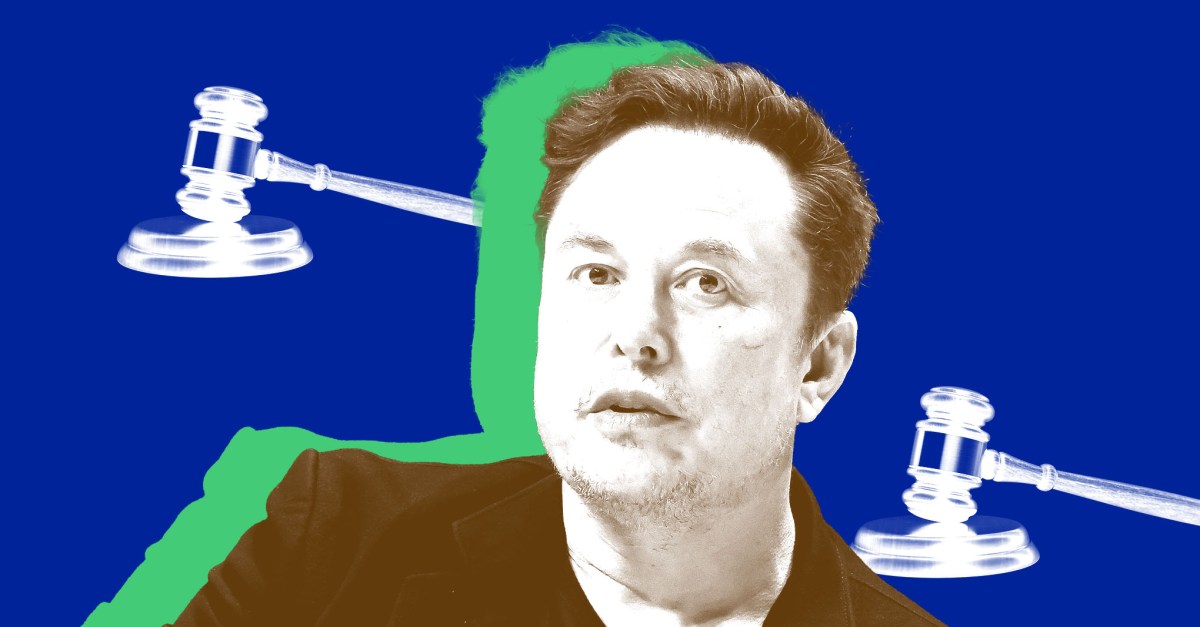
About five hours into Elon Musk’s testimony, I found myself typing an unexpected note: “I have never felt more sympathetic towards Sam Altman.”
Musk’s performance during his direct testimony showed some improvement from the previous day, although his lawyer’s frequent leading questions seemed to guide his responses. However, this somewhat positive impression quickly faded during a grueling cross-examination. Musk persistently avoided providing straightforward yes or no answers, occasionally “forgetting” details he had mentioned earlier, and even rebuked defense attorney William Savitt. I noticed jury members exchanging glances, and at one tense moment, a woman in the jury was rubbing her temples. I could relate.
Even the judge, who occasionally prompted Musk to respond with a simple “yes” or “no,” appeared frustrated. After the jury exited, Yvonne Gonzalez Rogers commented on Musk’s demeanor, saying, “He was at times difficult.” At one point, she interrupted his argumentative answer, which drew the day’s biggest laugh. “Part of my job is just to get through testimony,” she remarked.
“I don’t yell at people,” Musk insisted.
During the previous day’s testimony, Musk had portrayed himself as a stoic figure, claiming, “I don’t lose my temper,” and “I don’t yell at people.” He admitted he might have called someone a “jackass,” but only in a context similar to saying, “don’t be a jackass.”
However, shortly after, Savitt provoked Musk into displaying a petty and irritable demeanor. Everyone witnessed Musk’s temper flare as he engaged in prolonged disputes over simple questions. Savitt repeatedly referenced Musk’s prior deposition where his responses differed slightly, casting doubt on his consistency. Whether or not the jurors believed he was lying, his testimony appeared, at the very least, inconsistent.
Savitt’s cross-examination left the distinct impression that Musk quit his quarterly payments to OpenAI because he wasn’t going to get full control of the company, then tried to kneecap it and fold it into Tesla. Initially, Musk wanted four board seats and 51 percent of the shares. The other co-founders would get three seats, together, to be voted on by shareholders (including other employees). Though Musk said that the eventual plan was to expand to 12 seats, it was obvious that Musk had full control on the initial board of seven.
When Musk didn’t get what he wanted, he pulled the plug on his funding commitment and hired Andrej Karpathy, OpenAI’s second-best engineer, to Tesla in 2017. Despite his fiduciary duty to OpenAI as a board member, he did not try to get Karpathy to stay at OpenAI when he said he heard Karpathy wanted to leave. (“I think people should have a right to work where they want to work,” Musk said on the stand.)
“In my and Andrej’s opinion, Tesla is the only path that could even hope to hold a candle to Google.”
By 2018, Musk was saying that OpenAI had no path forward with its current structure, declaring it was on “a path of certain failure” in emails to Ilya Sutskever and Greg Brockman. His proposed solution was to merge Tesla and OpenAI. “In my and Andrej’s opinion, Tesla is the only path that could even hope to hold a candle to Google,” Musk said. The plan never came to fruition, and Musk resigned from OpenAI’s board that year.
As early as 2016, Musk had own concerns about OpenAI as a non-profit. In an email to a colleague at Neuralink, he wrote “Deepmind is moving very fast. I am concerned that OpenAI is not on a path to catch up. Setting it up as non-profit might, in hindsight, have been the wrong move. Sense of urgency is not as high.”
Asked about this, Musk said he was just speculating. Savitt said, “Those are your words, yes or no?”
“You mostly do unfair questions.”
Musk replied, “This is a hypothetical.”
Savitt said, “So you thought it might have been a wrong move? That’s what you said?”
Getting Musk to put any of that on the record was intensely difficult. He refused repeatedly to answer questions like whether he knew cutting off OpenAI donations would create financial pressure, or whether he’d asked Karpathy to stay at OpenAI. He accused Savitt of asking questions that were “designed to trick me,” and we got multiple versions of this:
Musk: You mostly do unfair questions
Savitt: I am trying to put the questions as fairly as I can. I am doing my best.
Musk: That’s not true.
Musk was trying to make this as painful as possible for Savitt, but he also made it as painful as possible for everyone else, including the jury. Watching him simply refuse to answer questions during cross he’d easily answered during direct was annoying. Watching him refuse to admit he understood the nature of linear time — and therefore the fact that he was still a director of OpenAI’s board before he resigned in 2018 — was infuriating. It made him look dishonest.
“I’d lost trust in Altman and I was concerned they were really trying to steal the charity.”
Musk’s basic, oft-repeated story during this week’s testimony has been that OpenAI is “stealing a charity” and “looting a non-profit.” He maintains that he was all right with some limited for-profit activity, but not anything that would overshadow OpenAI’s nonprofit work and constitute “the tail wagging the dog” — another phrase he reached for, over and over, like a security blanket. In direct testimony, he painted himself as a trusting “fool” who had believed the wily promises of Sam Altman and his cohort: “I gave them $38 million of essentially free funding, which they used to create an $800 billion for-profit company,” he lamented. His own lawyer’s questioning wrapped up with Musk being purportedly blindsided by a multibillion-dollar deal with Microsoft.
“I’d lost trust in Altman and I was concerned they were really trying to steal the charity,” Musk said. “It turned out to be true.”
“I said I didn’t look closely! I read the headline!”
On cross examination, Musk would barely even explain how much he bothered to learn about OpenAI’s operations before suing over them a few years later. When OpenAI proposed a for-profit arm around 2018, he got an email outlining the proposed corporate structure. On the stand, he said he’d only read the very first section of it,, which said that contributors should consider the investments as donations that may have no return. “I read the highlighted box with ‘important warning,’” Musk said.
Savitt asked Musk if he’d raised any objection to the structure then, when he’d received the documents. Musk said that he didn’t read beyond that first box.
Musk: I didn’t read the fine print.. We’re going into the fine print of this document.
Savitt: It’s a four-page document.
Musk then said he hadn’t read beyond taking this in the “spirit of a donation.” And then we got the deposition, where Musk said, “I don’t think I read this term sheet… I’m not sure I actually read this term sheet… I did not closely look at this term sheet.” Savitt pointed out that nowhere in the deposition did Musk say he’d read the first paragraph and Musk, raising his voice and effectively undermining his claims from the morning that he doesn’t lose his temper (lol) or yell at people (lmao), said, “I said I didn’t look closely! I read the headline!”
Imagine having to deal with this man as your cofounder. I think I would sooner open a vein.