
Two summers ago, I attended a charming outdoor wedding in August, where the sweltering heat and humidity drove guests into their cars for a quick blast of air conditioning. Had Dyson’s latest $99.99 handheld fan been available, it would have been a welcome source of relief, though powering it up during the ceremony might have been a bit conspicuous. The HushJet Mini Cool, as Dyson calls it, is as slim and stylish as their recent vacuum and hair dryer models, but its noise level falls short of justifying the “Hush” moniker.
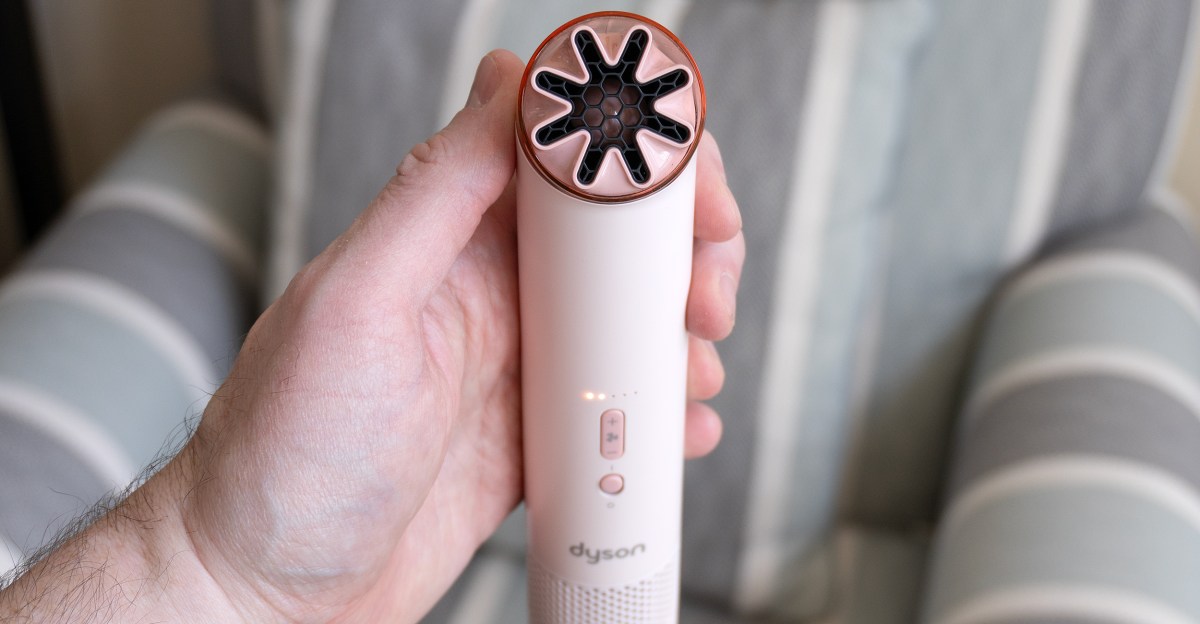
Despite this, the HushJet Mini Cool showcases Dyson’s knack for redesigning products to be both aesthetically pleasing and efficient. Unlike many handheld fans that use flexible or folding blades, which are often exposed and not kid-friendly, Dyson’s fan encloses all its components—including the motor, a 5,000mAh rechargeable battery, and the blades—within a sleek, cylindrical body measuring just 38mm in diameter. This design ensures it easily fits into a pocket, unlike other models that have a bulky top section.


Weighing in at 208 grams, the HushJet Mini Cool is comparable to an iPhone 17 Pro, making it a lightweight companion for those hot days. The fan is user-friendly: a toggle switch turns it on and off, while a rocker button allows you to cycle through five fan speeds, indicated by a row of five small white LEDs. There’s also a more powerful Boost Mode, activated only when you press and hold the “plus” side of the rocker button.

The main adjustment involves remembering to grip the fan above the vent at its base to avoid obstructing airflow. Some added texture to guide hand placement would be a nice touch to improve usability.

Dyson claims the fan can run for up to six hours on its lowest setting, but during my use, it powered down after 62 minutes at its highest speed—still, an impressive feat for full power operation. The battery life is indicated by the fan’s five white LEDs, visible only when the device is off. Having a way to monitor battery drain while in use could help predict how much cooling time remains.

Additionally, the HushJet Mini Cool is designed to stand on its own, thanks to its bottom-heavy design. Dyson provides an accessory to widen the base for added stability, though it’s easy to misplace. When connected to a power source via USB-C, the fan can run indefinitely, but it’s restricted to its lowest speed, limiting its effective range to about 5 feet.

Dyson’s marketing for the fan, including the HushJet branding, emphasizes how it’s engineered to be quiet. “Dyson’s obsession with acoustics means tonal comfort: with the HushJet nozzle, we’ve lowered frequencies, eliminated high-pitched whirring, and silenced the sound of whining motors,” the company said in a press release. But it was definitely not as quiet as I expected it to be.
It doesn’t get anywhere near as loud as Dyson’s cordless vacuums or hair dryers, but the HushJet Mini Cool isn’t whisper-quiet, even at its lowest setting. The handheld fan also has a similar high-pitched whine as those other Dyson devices, despite its tiny electric motor spinning at less than half the speed of theirs.

For the past year my family has been using Nitecore’s izzCool 10 Pro fan to beat the heat whenever AC isn’t available. Its design makes it harder to slip into a pocket, and at full power its blast is nowhere near as strong as Dyson’s — even at half power. While both fans were similarly loud at their lowest settings (measured using the NIOSH Sound Level Meter app on my iPhone), Dyson’s was well over 10 decibels louder at full power. That’s not surprising given Dyson’s fan far outperforms Nitecore’s, but the sound of the HushJet Mini Cool was generally far more noticeable, since it produced noise at higher frequencies.
At a noisy outdoor music festival, crowded carnival, or bustling state fair I can see myself comfortably pushing the fan’s speed to its third or fourth speed setting without worrying about getting too many annoyed looks. But in quieter settings, like that stifling-hot outdoor wedding I attended, I would be hesitant to fire up the HushJet Mini Cool. At least until the wedding DJ took over.

Compact electric air dusters like the Wolfbox MF100 are stronger and cheaper than the HushJet Mini Cool, but they’re typically much louder because they’re designed to be pointed at keyboards covered in Doritos crumbs, while fans are designed to be pointed at your head. Dyson’s HushJet Mini Cool is better at balancing size, performance, and battery life. If used nonstop it can last half a day at an amusement park. You can definitely find a quieter alternative, but I doubt you’ll find a more powerful one this size.
Photography by Andrew Liszewski / The Verge