
Share this @internewscast.com
In recent years, Capcom has excelled in strengthening its portfolio of well-established franchises. Titles such as Monster Hunter, Resident Evil, and Street Fighter have consistently delivered robust performances, a remarkable feat given the current climate of uncertainty within the gaming industry. Building on this momentum, Capcom is now venturing into new territory with an ambitious project called Pragmata.
Pragmata cleverly combines the deliberate action pace reminiscent of Resident Evil with a sci-fi narrative that delves into themes like lunar colonization and artificial intelligence. The game introduces several innovative concepts, such as a distinct combat system and mind-bending levels that resemble three-dimensional AI chaos. However, these novel ideas are somewhat overshadowed by a conventional structure and a storyline heavily reliant on familiar sci-fi themes. Although Pragmata shows potential for greatness, its inaugural release treads cautiously, preventing it from truly standing out.
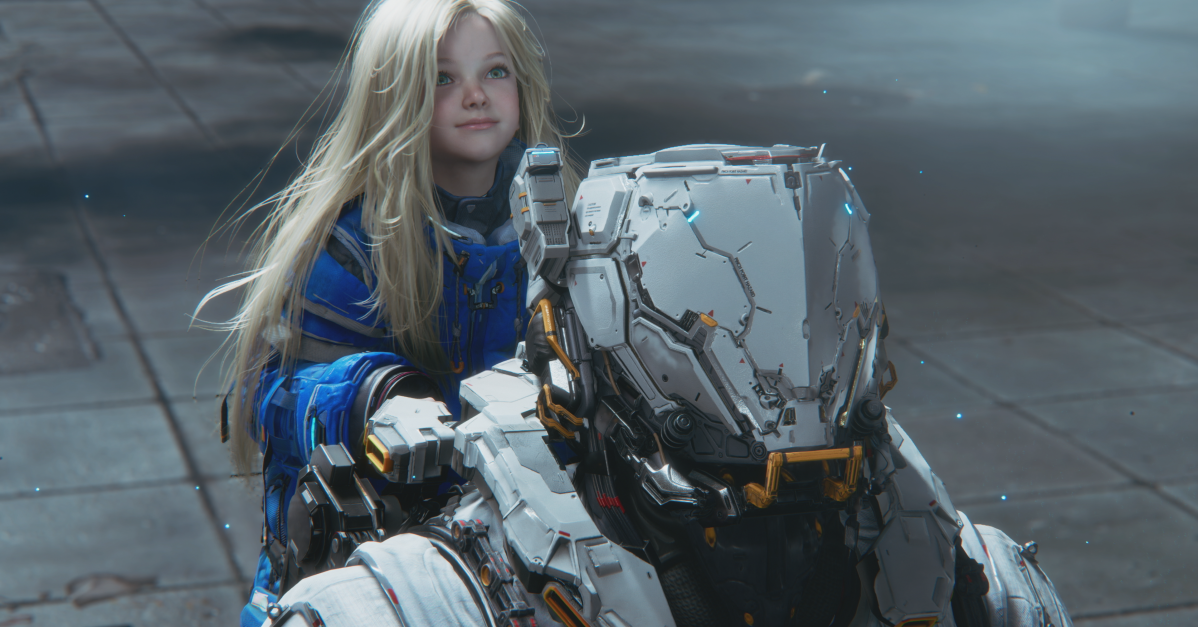
As is typical in such tales, Pragmata kicks off with a team dispatched to investigate an anomaly at a lunar outpost. Upon arrival, they find the outpost eerily deserted. Soon, one of the investigators, a man named Hugh, finds himself isolated from his team. He encounters what seems to be a young girl, who is actually an experimental android named Diana. Together, they embark on a mission to uncover the truth and return to Earth, all while contending with a rogue AI that has taken control of the colony, turning every bot into a lethal adversary.

Image: Capcom
Although it shares DNA with Resident Evil, Pragmata is not a pure horror game, though it does deliver some chilling moments. Instead, it leans more towards a conventional third-person action adventure. Hugh is equipped with a range of futuristic weapons, including classics like a shotgun and missile launcher, while also offering players extensive customization options for combat. By collecting materials, players can upgrade Hugh’s suit and arsenal to fit their preferred playstyle. One particularly enjoyable tactic involves deploying a holographic decoy to distract enemies, allowing for stealthy close-range takedowns.
The unique gameplay twist lies in the dynamic between Hugh and Diana. The android companion rides on Hugh’s back, and during combat, players control both characters simultaneously. Diana can hack into enemies, weakening them as Hugh engages in combat. Initially, this feels unusual, as hacking involves navigating a cursor through a grid to target an enemy’s weak point. This happens in real time, requiring players to dodge attacks and fire weapons simultaneously. It’s akin to the challenge of patting your head while rubbing your stomach, but with the added complexity of solving a maze amid a robotic onslaught.
The combat is easily the best part of Pragmata. Not only is it completely unlike anything I’ve ever played, but every aspect is well tuned: The weapons feel great, the enemies are varied and often terrifying, and the customization options are plentiful. I also appreciate that Pragmata has very generous checkpoints; there are multiple spots in each area where you can head back to your shelter, a very Death Stranding-inspired space that lets you catch your breath, chat with Diana, and upgrade your gear.

Image: Capcom
But aside from that there isn’t much interesting going on. Mostly you’re just exploring the colony to turn on power stations and unlock doors (which lead to more power stations) in order to make your way back to Earth. The story doesn’t help much. There’s a lot about Pragmata’s setup that could speak to our current moment, given that it’s set on the Moon and features a deadly AI villain. It even explores the impact of a new element that makes it possible to 3D print basically anything. At least initially, it seems like Pragmata is using these concepts to go to some interesting places. One of the early areas you explore is a 3D-printed version of New York, but designed by an AI in ways that don’t actually make much sense. There are yellow cabs melted into the ground and shop windows that appear upside-down and inaccessible. It’s like AI slop made physical, a hallucination that you can explore.
But that scene is an outlier. Outside of a few key moments, the story relies entirely on well-worn sci-fi tropes, which means it’s constantly reminding you of other, more original tales. The company that runs the colony, for instance, is basically Alien’s Weyland-Yutani, a group that uses the lawless nature of space to run morally dubious experiments. The relationship between Hugh and Diana echoes just about every story about an artificial being that wants to be human, from Pinocchio to The Terminator. Hell, there’s even an enemy that’s basically a robotic Dune sandworm.
Worse still is that most of the actually interesting narrative bits — like the sheer callousness of the tech corporation, or the way so many employees shift their responsibilities to AI — only appear if you choose to read the many optional notes lying around or listen to talking holograms. If you want to get anything out of Pragmata’s story, you have to dig for it.
This is especially frustrating because there’s a core of a really unique game in Pragmata. It’s well crafted and has a handful of fresh ideas. But at the same time, it feels too derivative. This isn’t an uncommon thing in games; there are plenty of brand-new franchises that struggle to form an identity at first before cutting loose in a sequel, like the progression from Watch Dogs to Watch Dogs 2. Hopefully something similar happens with Pragmata. Capcom has shown a real knack for developing its franchises, and Pragmata feels achingly close to joining that list.
Pragmata launches on the Switch 2, PS5, Xbox, and PC on April 17th.