
Share this @internewscast.com
The most unsettling element in the ongoing debate over the autonomy of the US Federal Reserve, now echoed by other central banks within the G7, is the surprisingly muted response from the markets.
The dollar, already on shaky ground, slipped further, while US bond yields saw a minor uptick. Stock markets have remained relatively calm, unlike the significant declines witnessed during the ‘liberation day’ Trump tariffs in April 2025.
One straightforward reason for this complacency could be the so-called Taco trade (Trump Always Chickens Out). However, concerns linger that a more serious underlying issue may be developing.
Back in 1996, Alan Greenspan, then the Fed chairman, famously cautioned against the ‘irrational exuberance’ fueling Wall Street and global share markets.
His warning went unheeded, and the collective momentum pushed prices higher, peaking with the £135 billion acquisition of media giant Time Warner by AOL in 2000.
This merger was heralded as a perfect union, with the emerging internet and dot-com economy poised to dominate the landscape by absorbing one of the leading producers of news, film, and entertainment content.

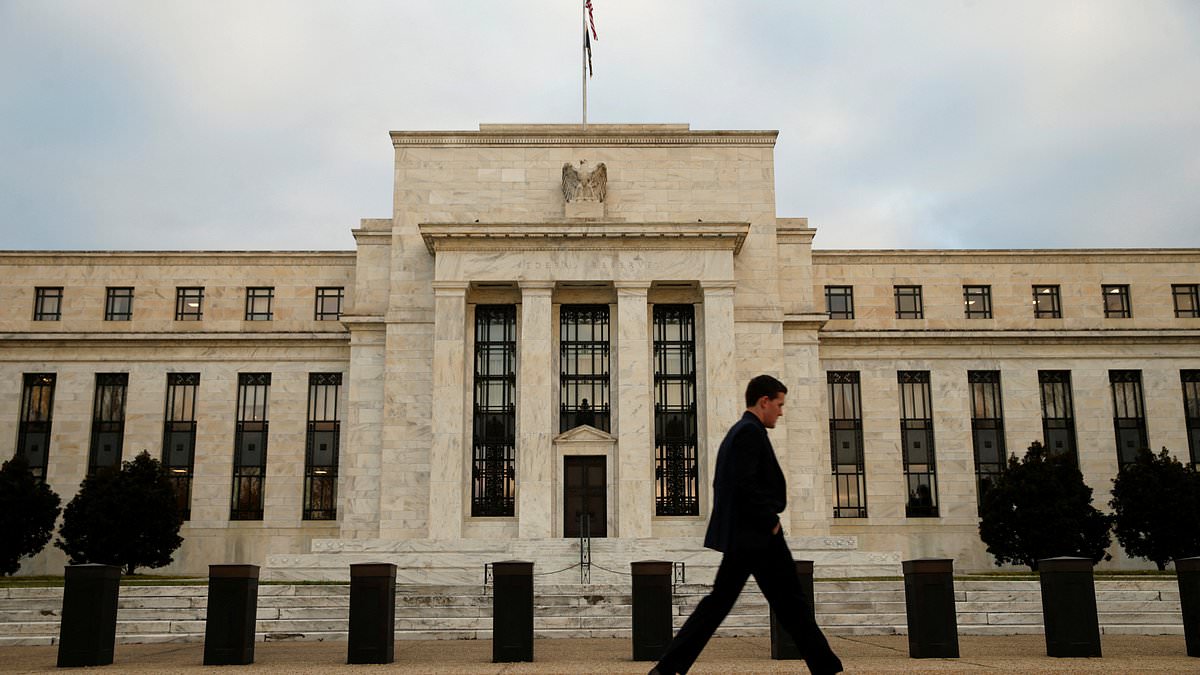
Debt fears: US President Donald Trump is attempting to bully the US Federal Reserve (pictured) into lowering interest rates
The deal failed spectacularly. Part of the dot.com crash, billions of dollars of debt and goodwill were written off, the architects of the merger were forced out, and Time Warner spun off. AOL barely exists.
Anyone looking for parallels might see the debt-fuelled bid by Paramount Skydance for Warner Bros Discovery, in competition with Netflix, as similarly ill-fated.
When equity markets are in their current mood – even the fusty FTSE 100 is trading at record levels – it is almost impossible to divert the optimism.
A point is reached when private investors, fearful of missing out on easy money, pile into the markets as more cautious players build war chests.
As I have written elsewhere in the paper this week, my anxiety is that artificial intelligence (AI) has been over-hyped.
There can be no doubt that AI is transforming the economic landscape. It has enhanced the capabilities of UK firms, such as medical, legal and cyber innovator RELX, which has zoomed up the FTSE.
The London Stock Exchange Group (LSEG), which has huge financial data capabilities, is carving out deals with Microsoft and OpenAI, which are potentially transforming.
AI is the new great hope for the NHS, although one fears that even advanced technology will fail to turn that tanker around.
Despite the uses for AI, there is huge dissonance in parts of the financial community. The bears see incestuous deals among the biggest players as a cause for extreme anxiety.
The debt build-up among AI players, data centres, and the power sources to support them is seen as overdone.
The Silicon Valley giants are piling in for fear of missing out. Medical research funder, the Wellcome foundation, has built up a £3.7billion war chest to protect its work from interruption by a market slump.
The most likely source of such a meltdown is some kind of macro-economic event. The stand-off between the US executive branch and the central bank the Federal Reserve is a case in point.
The Fed is the guardian of the world’s reserve currency, the dollar. If the Fed is browbeaten into keeping rates lower than they should be, effectively monetising America’s deficit, it will be a clear and present danger to global stability.
One cannot imagine that Donald Trump will be shaking in his boots after central bankers – including Bank of England governor Andrew Bailey and European Central Bank president Christine Lagarde – affirmed their solidarity with under fire Fed chairman Jay Powell.
The US President already has a poor view of Europe and will regard it as an unholy interference in America’s domestic affairs.
Financial markets should remember that throughout modern financial history, central banks on both sides of the Atlantic only show such unity at times of acute stress such as the Great Financial Crisis of 2008 and the Covid-19 business shutdowns six years ago.
It would be a fatal mistake if financial markets were to ignore the breakdown of trust at the core of the US and global economy.
Blind faith may be preventing equities and bonds from crashing.
The past tells us that, ultimately, events in the economy of surging debt, rocketing credit and monetary instability will impoverish us all.
DIY INVESTING PLATFORMS
AJ Bell
AJ Bell
Easy investing and ready-made portfolios
Hargreaves Lansdown
Hargreaves Lansdown
Free fund dealing and investment ideas
interactive investor

interactive investor
Flat-fee investing from £4.99 per month
Freetrade

Freetrade
Investing Isa now free on basic plan
Trading 212

Trading 212
Free share dealing and no account fee
Affiliate links: If you take out a product This is Money may earn a commission. These deals are chosen by our editorial team, as we think they are worth highlighting. This does not affect our editorial independence.
Compare the best investing account for you