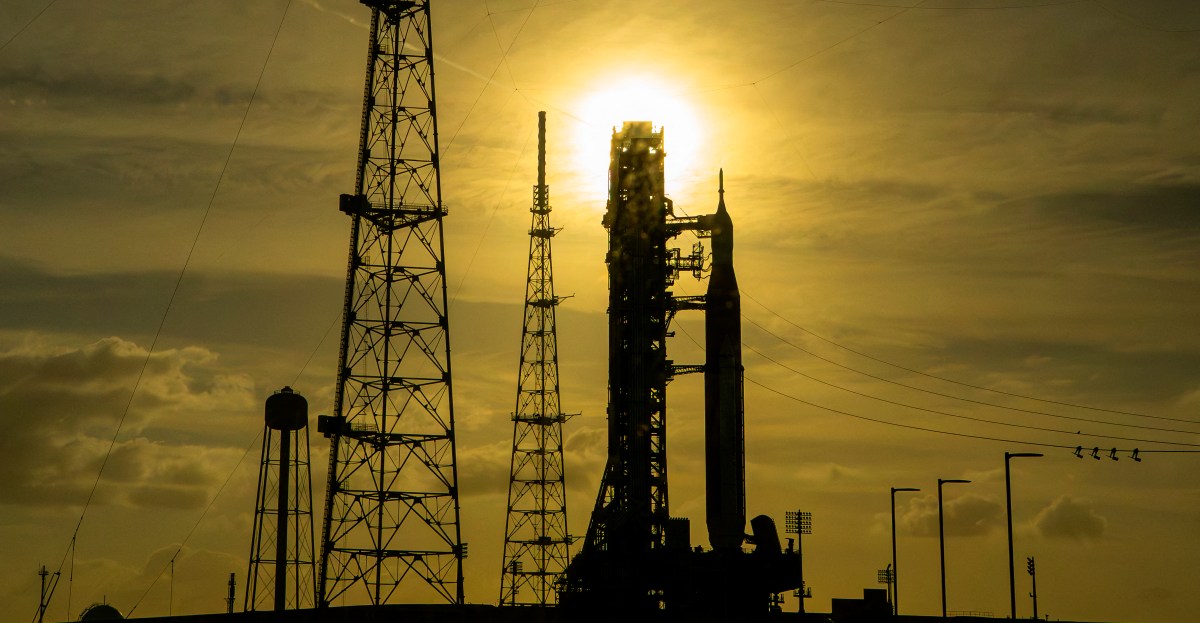

The countdown to humanity’s return to the Moon is on, as NASA gears up to launch four astronauts on the Artemis II mission this Wednesday. This ambitious journey will have the crew orbit the Moon aboard the Orion capsule, completing a round trip in 10 days. The mission serves as a critical test of the hardware and systems that aim to put Americans back on the lunar surface for the first time in over half a century, with the Artemis IV mission slated for 2028. While the current mission won’t involve a lunar landing, NASA’s sights are firmly set on establishing a sustained human presence on the Moon within the next five years.
Unlike the fleeting visits of the Apollo era, Artemis aims for something far more enduring—a long-term human habitation on the Moon. Though the specifics are still being worked out, the vision includes creating a lunar base where astronauts can live for weeks or even months at a time.
This ambitious goal brings complex logistical challenges, as astronauts will not be able to carry all necessary supplies from Earth. Instead, they will need to rely on a strategy known as in-situ resource utilization. This means using the Moon’s own resources, like melting lunar ice for water, to support their stay. On paper, it sounds straightforward, but the execution is far from simple.
The core rationale behind Artemis is clear: to sustain a Moon base, we must first build one to explore and harness its resources.
This endeavor is not just about resources, however. It intersects with science and law, presenting myriad challenges.
The Moon’s environment is far from welcoming. Astronauts will face harsh conditions, including hazardous space radiation, abrasive lunar dust known as regolith, and the challenges of lower gravity. While not as speculative as Elon Musk’s Mars colonization dreams, NASA’s timeline to establish a Moon base by 2030 remains highly ambitious. The agency has underscored the importance of utilizing lunar resources, such as water for fuel, helium-3 for energy, and rare earth elements like scandium, crucial for electronics. Although the extent of these resources is still being assessed, their potential value could be significant for sustaining life on the Moon. This resource-driven exploration is at the heart of the Artemis mission: we need resources to support a Moon base, and a Moon base is needed to uncover these resources.
The agency has even described these efforts as a “lunar gold rush.” But this points to a problem with Artemis that isn’t solvable by developing new technologies: Some experts say that extracting resources from the Moon is a violation of international law.
There isn’t a huge amount of international law that applies to space exploration, but what there is is very clear in one regard: No one owns the Moon. The Outer Space Treaty (which was signed nearly 60 years ago but is still the main basis for international law in space today, if you can believe it) is very explicit regarding the principle of non-appropriation, meaning that nations can’t claim sovereignty over any body in space. But what about extracting resources? There, we get into sticky territory.
“The US considers that resource extraction is not appropriation … That is an incorrect interpretation of the Outer Space Treaty.”
“The US considers that resource extraction is not appropriation,” says Cassandra Steer, space law expert and founder of the Australasian Centre for Space Governance. Many international space lawyers, including Steer, have argued that this is unlawful. “That is an incorrect interpretation of the Outer Space Treaty. You’re trying to carve out a loophole.” After all, if a nation started digging up resources from a territory it didn’t have claim to on Earth these days, that would cause a few legal problems.
The US has been tactical in its approach to this issue, through the use of an agreement called the Artemis Accords. This is not an international treaty, but rather an agreement signed by over 60 nations about adopting high-level principles regarding space exploration and the Moon in particular. Many of these principles are sound, reasonable approaches to space exploration, covering topics like the sharing of scientific data, consideration of safety and emergency procedures, and adherence to the peaceful use of space.
But the document also includes sections specifically allowing the extraction and use of space resources, saying that this doesn’t conflict with the principle of non-appropriation, and allowing specific nations to establish “safety zones” around areas of their lunar activity where other nations cannot interfere.
That’s not exactly saying that whoever gets to the Moon first and claims a chunk of it now owns it, but it is implicitly saying that whoever starts activities like research or mining in a certain lunar region now gets to extract resources from that region and other countries can’t stop them. It’s not owning a piece of the Moon, but it is getting priority access to it by drilling, scraping, and occupying a strategic location for its potential value.
It’s hard not to draw a parallel between this approach and the history of land grabs across the American West in the 19th century, especially regarding access to key resources such as water. “I think the Artemis Accords might open the door for these sorts of access claims on the Moon,” says Rebecca Boyle, journalist and author of a book on the topic, Our Moon. “The accords do say that safety zones should be relevant to the activities at hand, but again, I think a creative attorney or a nifty legal argument could lead to a situation where someone who gets to a spot first uses the safety zone rule to lay claim to whatever is there.”
The smart move on the part of the US was integrating the accords into the Artemis program, so countries that wanted to be involved in Artemis had to sign the document. With a handful of key players like Canada, Japan, Australia, the UAE, and the UK signed on, many other countries, including France, Israel, Saudi Arabia, India, and Germany, followed suit.
“And so, it was a bit of a strong-arming of the US to say, if you want in on our program, you have to agree with our international law interpretation. It is forcing what we call opinio juris in international law,” Steer explains. The power of this consensus from so many countries is that, if resource extraction is tolerated in practice, the original intention of the treaty can be in effect overruled by a broadly accepted interpretation.
Steer summed up NASA’s approach bluntly: “You’re just trying to rewrite the treaty, and somehow you’ve convinced 60 countries to do it with you.”
“Why go to the Moon? And it is, to my mind, purely geopolitical.”
The real elephant in the room of this legal wrangling is China, which did not sign the Artemis Accords and is on course to set its own astronauts on the Moon perhaps even before the US can. China and the US have practically zero relationship when it comes to space activities, but China has been building its own international cooperations for its lunar program, including signing an agreement with Russia and carrying payloads from various European countries and Saudi Arabia on its lunar rovers. China has plans to build its own Moon base with Russia called the International Lunar Research Station, and the US is aggressively pushing its Moon program to try to beat its rivals to the punch.
“The multi-trillion- dollar question is, why go to the Moon? And it is, to my mind, purely geopolitical,” Steer says. That’s certainly what drove the US during the last space race, when the Cold War was in full swing and racing the Soviet Union to the Moon was not just a matter of political power but also an attempt to demonstrate who had the superior political ideology. Now, in the age of America First Trumpism, the US is attempting to prove its power and capability once again, but the nationalist rhetoric fails to capture the reality of space exploration, which is that it’s now dependent on international partnerships and cross-border cooperation.
Today, it’s not only prestige that is at stake but also access to space resources, from controlling cislunar orbits and lunar locations to controlling the materials required for the Moon’s further exploration, such as ice or helium-3. NASA, after all, has been notably circular in its justifications for Artemis: We need to send astronauts to the Moon to secure access to ice, because we need access to water to support human exploration. There are potential scientific justifications for a Moon mission, from learning about the formation of the Solar System to using the Moon as a base for building a powerful telescope, but these haven’t been well articulated or widely promoted by NASA.
“The real justification, the hidden one, is who gets to have political dominance,” Steer says. “Space is just another domain where geopolitics are playing out. It’s no different from the AI race, it’s no different from competition around other resources, around oil, around water … It’s another domain where the US is grasping at straws to remain the single dominant power, and discovering that actually it can’t.”