
Share this @internewscast.com
Canada has devised a strategic response to President Donald Trump’s tariffs by extending a warm welcome to Chinese car manufacturers.
With U.S. auto companies reducing their presence in Canada, the Canadian government is opening its doors to affordable Chinese electric vehicles, which are still largely restricted in the United States.
As part of a new trade agreement, Canada has replaced its previous 100 percent tariff on Chinese-made cars with a more lenient import cap of 49,000 vehicles and a modest 6.1 percent duty.
The former tariff structure discouraged brands like BYD, which recently surpassed Tesla as the leading global producer of EVs, along with Chery and Great Wall, from entering the Canadian market. Under the revised system, Chinese vehicles are expected to make up about 3 percent of Canada’s annual car sales.
This development positions the U.S. as the only major auto market where Chinese cars face significant entry barriers. Furthermore, with these economical electric vehicles now available just north of the border, Ford CEO Jim Farley has expressed concern, labeling them an “existential threat.”
This trade decision follows the retreat of U.S. automakers from Canada after the Trump administration’s imposition of tariffs on aluminum, cars, and automotive parts last year.
General Motors canceled plans to build its BrightDrop electric vans there, and Stellantis shifted Jeep Compass production from Ontario to Illinois after the tariffs took effect.
Canadian Prime Minister Mark Carney has framed the China deal as a way to push back against US influence.

A new Canada-China trade deal replaces the 100 percent tax on Chinese cars with an import limit, making it easier for brands like BYD, Chery, and Great Wall to sell in Canada. Pictured here is a BYD Seal in the UK, where they are also sold

Canadian Prime Minister Mark Carney (pictured) says the China deal is a way to push back against US influence
‘American hegemony, in particular, helped provide public goods, open sea lanes, a stable financial system, collective security and support for frameworks for resolving disputes,’ Carney said at the World Economic Forum in Davos.
‘This bargain no longer works.’
Carney later stressed that Canada has ‘no plans’ to pursue a full free-trade agreement with China – after Trump warned he would slap a 100 percent tariff on Canadian exports if Ottawa struck a broader deal with Beijing.
Still, US automakers are alarmed.
GM chief executive Mary Barra said on Tuesday that Canada’s deal to allow tens of thousands of inexpensive Chinese electric vehicles into the country is a risk to North American auto manufacturing.
‘I can’t explain why the decision was made in Canada,’ Barra said on Tuesday. ‘It becomes a very slippery slope.’
The government hopes this move will attract Chinese companies to invest and partner in Canada.
By the end of the decade, at least half of those imported EVs would have to cost about $26,000 or less, and all vehicles would still need to meet Canada’s safety standards.

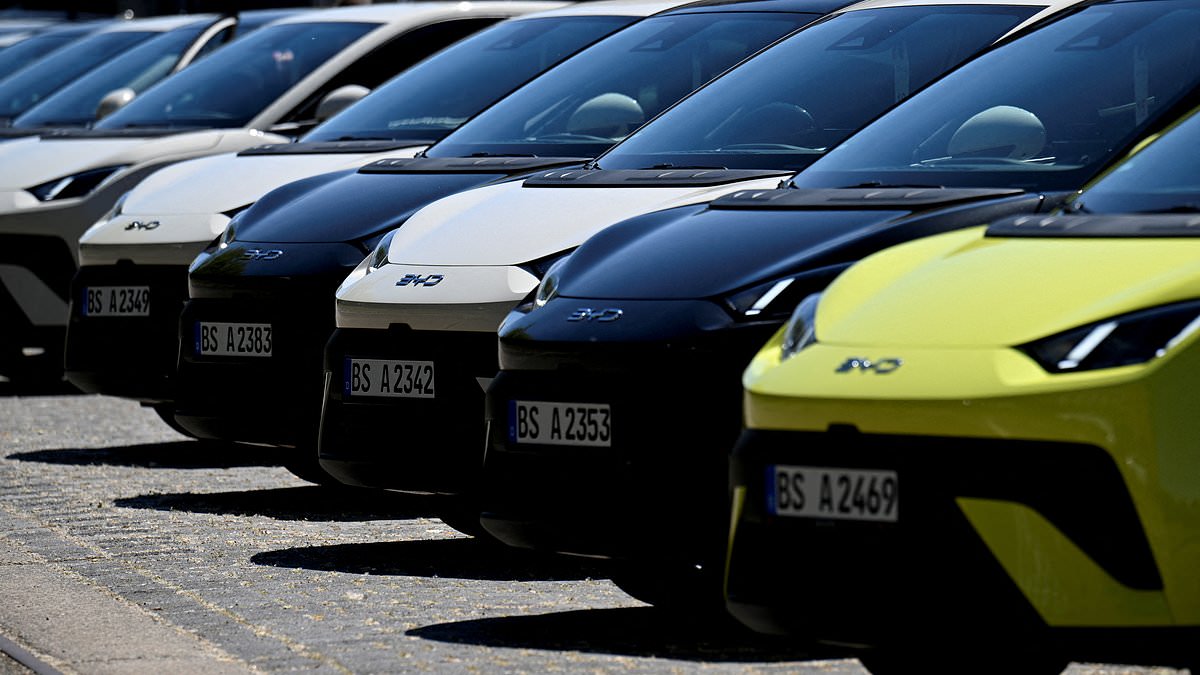
BYD Dolphin Surf electric cars are parked in Berlin, Germany – where they are not banned as they are in the US – in May 2025. This week Canada has opened its market to Chinese-made EVs under a new import cap

Canada says it will allow up to 49,000 Chinese electric vehicles into the country this year at a low 6.1 percent tariff. Photo shows workers cleaning vehicles at BYD factory in Camacari, Brazil in October 2025.

The US and Canada share a tightly connected auto industry, with parts and cars crossing the border easily under long-standing trade deals (pictured: vehicles moving along the Chevrolet Bolt EV and EUV assembly line in Michigan)

General Motors chief executive Mary Barra (pictured) said on Tuesday that Canada’s deal to allow tens of thousands of inexpensive Chinese electric vehicles into the country is a risk to North American auto manufacturing
The US and Canada share a tightly connected auto industry, with parts and cars crossing the border easily under long-standing trade deals.
Canada is also a big market for Detroit automakers. In 2025, Ford, GM and Stellantis sold more than 700,000 vehicles there.
Because Canada’s safety and emissions rules closely match US standards, cars approved in Canada can be brought into the US with little trouble.
That system has been strained over the past year as US tariffs hit Canadian-made vehicles and parts, leading automakers to cut back.
GM stopped producing its electric vans at a plant in Ontario and is reducing shifts at a pickup factory there. Stellantis also scrapped plans to build the electric Jeep Compass in Ontario, moving production to Illinois.
Meanwhile, Chinese automakers have gained ground worldwide but are largely shut out of the US market because of very high federal tariffs on Chinese-made cars.