
Share this @internewscast.com
In the aftermath of widespread panic and confusion caused by the FAA’s closure of airspace over El Paso, Texas on Tuesday night, Border Patrol officials are challenging claims about the use of a military laser to shoot down balloons. The incident has sparked a flurry of unverified reports, with some suggesting that a high-powered laser, borrowed from the military, was employed to target what was initially thought to be a drone operated by Mexican cartels.
However, these assertions are being met with skepticism from those within the Border Patrol. An official, speaking to the Daily Mail under the condition of anonymity, dismissed the rumors, stating, “That’s ridiculous. No one would confuse balloons for a cartel drone.” This statement aims to clarify the situation amidst a backdrop of speculation and media coverage.
Various media outlets, including CNN and the New York Times, have been circulating these unconfirmed reports, adding to the uncertainty surrounding the event. According to these reports, the Border Patrol allegedly deployed the laser to bring down what it mistakenly identified as a cartel drone, which was later discovered to be harmless party balloons.
This incident underscores the complexities and potential pitfalls of utilizing advanced technology, like drones and lasers, in sensitive operations. The technology, while promising, remains relatively new and has yet to receive clearance for use in proximity to aircraft, highlighting the challenges faced by agencies tasked with maintaining security along the border.
According to the reporting, the Border Patrol used the laser to down what it first believed to be a Mexican drone that later turned out to be party balloons.
The drone is still relatively new technology and has not been cleared for use around planes.
The incident forced the Federal Aviation Administration (FAA) to initially shut down El Paso airspace, which reached into neighboring New Mexico, for ten days.
On Tuesday night, the FAA Administrator decided to close the airspace without alerting the White House, the Pentagon, or Homeland Security officials, or local officials.
Hours later, the agency lifted the ban, adding that the military had refused to give it information on when the anti-drone laser would be used.

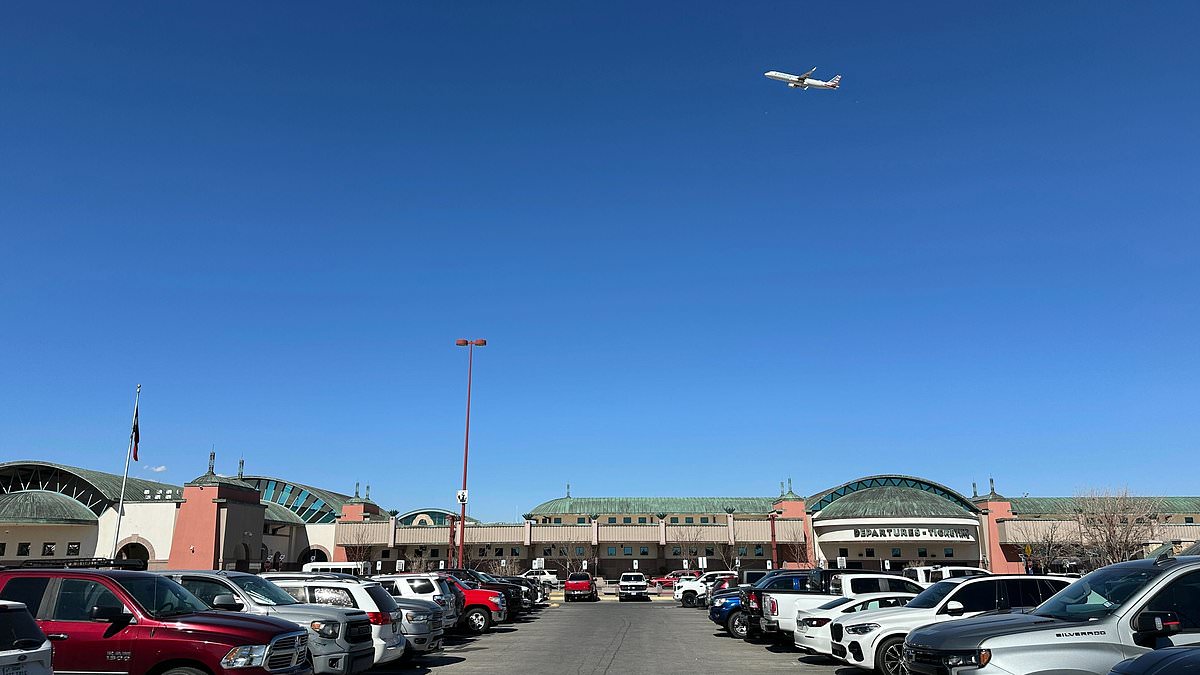
A plane flies over El Paso International Airport after the airspace over the city was reopened
Officially, the US Border Patrol has not said whether its employees were behind the deployment of the laser– meant to obliterate drones using extreme heat.
When asked by Daily Mail whether its agents had used the laser, an agency spokesman told us to direct our questions to the White House.
The department also refused to say where exactly the laser was used and what had been shot at.
Border Patrol agents who spoke with Daily Mail did not know who had deployed the laser, however, they believe the unverified narrative about the balloons is dead wrong.
They explained that drones sent by Mexican cartels often breach US airspace in and around El Paso- calling it a ‘regular occurrence.’
Although there is cartel drone activity along the entire border, much of the activity near El Paso is concentrated to the west of the city near Santa Teresa, New Mexico.
That area is a no-man’s land and known as a smuggling corridor.
On the US side, the area is sparsely populated and is mostly vast, wide open desert.
Several agents assigned to the area tell Daily Mail that they commonly see drones flying above them as they were chasing illegal immigrants who are trying to sneak into the country.


Mount Cristo Rey, seen from New Mexico, is a no-mans land take over by the smugglers to sneak illegal immigrants into the US near El Paso, Texas

An US Army soldier stands next to an armored tank next to the US-Mexico border at Santa Teresa, New Mexico, US, as seen from Ciudad Juarez, Chihuahua state, Mexico on January 14, 2026

An US Air and Marine Operations (AMO) helicopter patrols the US-Mexico border at Santa Teresa, New Mexico, US, as seen from Ciudad Juarez, Chihuahua state, Mexico on January 14, 2026

An US Army soldier stands next to an armored tank next to the US-Mexico border at Santa Teresa, New Mexico, US, as seen from Ciudad Juarez, Chihuahua state, Mexico on January 14, 2026

A smuggler, who covered his face when he spotted a camera, was seen preached on a mountain top in Santa Teresa – using the high ground as an advantage to keep an eye on US immigration authorities in the Santa Teresa, New Mexico area
The drones cross into US airspace to track agents’ movements so the criminal organizations south of the border can direct drugs or immigrants to smugglers on the US waiting to sneak the drugs and migrants further into the US.
They’re also used by the cartels instead of human guides who used to accompany groups of migrants who had paid for passage into the US.
If the group of migrants are caught, the smugglers are often caught and arrested with them.
Now cartels are using drones so they don’t risk losing an employee, especially since Border Patrol agents aren’t allowed to shoot at the drones.
But these drones, the agents say, are not usually the small kind anyone can buy online.
‘They’re usually military grade, very sophisticated,’ one agent explained. ‘The kind you buy off Amazon can’t fly very far before you lose control of them. These (military drones) can fly miles into the US but the person controlling them in in Mexico.’
Agents say those drones, usually with a 100-foot wingspan, can be seen with the naked eye.
‘They’re pretty big. This idea you would mistake it for shiny balloons doesn’t sound right.’
An elected official in El Paso who did not want to share his name also expressed skepticism about the balloon story.

People stand in line at check-in counters at El Paso International Airport, Wednesday, Feb. 11, 2026, in El Paso, Texas

Rosie Leal sits at El Paso International Airport, Wednesday, Feb. 11, 2026, in El Paso, Texas after flights were canceled due to the sudden closure of the airspace over the city

A cancelled Latam Lines flight to El Paso, Texas, is seen on a departures screen at Hartsfield-Jackson Atlanta International Airport in Atlanta, Georgia, USA, 11 February 2026. The Federal Aviation Administration issued a closure of airspace over El Paso, Texas
‘I don’t believe anything they’re telling us. We’re being kept in the dark,’ the official said.
‘El Paso is always the red-headed stepchild, and because we’re on the border, they think they can do this to us. They would never have closed the airspace over Dallas or even Fort Worth,’ he said of the larger Texas cities.
He explained even the hours-long closure of the airspace cost the local economy money and could have cost lives as even medical flights were grounded.
If the flight ban had gone on for ten days, he says it would have devastated El Paso’s economy.
While an official account of what happened has yet to be revealed, Lone Star State officials have called for Congressional hearings to get answers.
Local Congresswoman Veronica Escobar as among several politicians calling for the decision makers to have to explain themselves.
‘Events like this are inexcusable and cause lasting degradation of trust among communities with their local and national leaders,’ the letter sent by the Congressional delegation Thursday said.