
Share this @internewscast.com
The Royal Navy of the United Kingdom has closely monitored a Russian vessel after it spent 14 hours near critical undersea data cables in the Bristol Channel. The presence of the ship has sparked concerns over potential security risks.
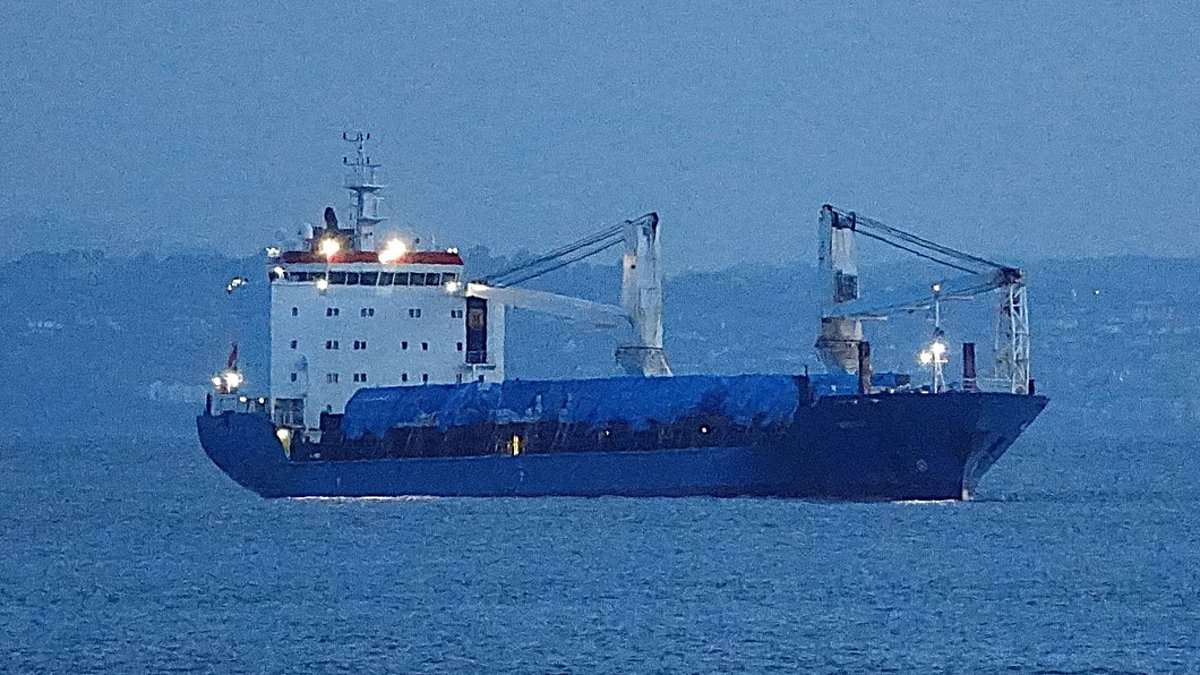
On Tuesday evening, the Sinegorsk, a Russian cargo ship, was spotted navigating the waters of the Bristol Channel, situated in the southwest of England, approximately two miles from Minehead.
The undersea cables in question serve as vital communication links connecting the UK with the United States, Canada, Spain, and Portugal.
This incident has heightened worries about security threats, especially in light of Russia’s international activities following its invasion of Ukraine in 2022.
Alicia Kearns, the Conservative shadow security minister, expressed alarm, stating: “The movements of this Russian ship are deeply suspicious, positioned right over our transatlantic deep-sea data cables.”
“This serves as yet another reminder of the persistent and insidious threats that our nation faces from Putin and his allies,” she added.
The most recent port call from Sinegorsk came three weeks ago at Russian trading port Arkhangelsk.
Information shared by the website MarineTraffic shows Sinegorsk travelled along the Bristol Channel on Tuesday night before stopping two nautical miles off Minehead at about 11pm.

Russian cargo ship Sinegorsk left this month port of Arkhangelsk in north-western Russia
A Department for Transport spokesperson said: ‘We issued a clear warning as a first step to the SINEGORSK vessel to leave UK waters after it entered to undertake essential safety repairs.
‘This directive has been complied with, and the vessel has left UK waters.
‘We continue to take strong action against Russian-flagged ships, as well as to deter, disrupt and degrade the shadow fleet by stepping up our response through tough sanctions.’
Reports have suggested that within a quarter of a mile of Sinegorsk’s location were five undersea data cables.
These include two from the TGN Atlantic cable system, linking the UK to New York, while another – EXA Express – connects Britain to Canada’s Nova Scotia.
Weather forecast organisation, the Met Office, has warned of Force 6 winds ahead.
It was previously revealed in November 2025 that a Russian spy ship was lurking in British waters and tried to jam the Royal Navy frigate’s GPS.
Defence Secretary John Healey said the research vessel Yantar was spotted lurking north of Scotland and attempted to blind RAF pilots using military-grade lasers.

Defence Secretary John Healey told in November 2025 how a Russian spy ship had been spotted on the edge of UK waters
The lasers were directed at the pilots of RAF P-8 Poseidons, long-range reconnaissance aircraft that were sent with HMS Somerset to track the Yantar.
Healey said it constituted a ‘deeply dangerous’ provocation and the first time a Russian crew had used lasers against UK forces.
It has since been revealed they also attempted to disrupt the GPS on HMS Somerset.
The Russian spy ship used jamming technology to interfere with the global position systems of the Royal Navy vessel, a defence source told the Telegraph.
Warships run using a mixture of civilian and military-grade GPS systems, which help with accurate navigation as well as the deployment of precision-guided weapons.
It is understood only civilian-grade systems were impacted, as the military systems are encrypted and almost impossible to jam.
The source said it was ‘more low-level disruption, causing a nuisance’.
Commercial vessels near the Yantar, including fishermen, were also believed to have had their systems disrupted.

A Royal Navy Fleet Air Arm Agusta Westland Wildcat helicopter is pictured here approaching to land at RAF Waddington in Lincolnshire in July 2014

An infrared photograph of Russian spy ship Yantar taken following its recent arrival to the edge of British waters. It is thought to be capable of mapping underwater cables

The Yantar (pictured, front of image, followed by a Royal Navy vessel) is a Russian spy ship operated by the elusive GUGI unit
The boat, operated by Russia’s elusive deep-sea research unit GUGI, has been situated on the edge of the UK’s waters for ‘the last few weeks’, Mr Healey said.
It is suspected by the West to map vital undersea infrastructure such as internet cables.
A Royal Navy frigate and RAF P-8 reconnaissance planes were deployed to monitor and track the Yantar’s moves, and to capture infrared photographs.
The Russians responded by directing lasers at pilots – an unprecedented escalation that the Defence Secretary was taking ‘extremely seriously’.
‘That Russian action is deeply dangerous, and this is the second time this year that this ship, the Yantar has deployed to UK waters,’ Mr Healey said.
He changed the Navy’s rules of engagement to allow them to track the Yantar more closely.
‘We have military options ready should the Yantar change course,’ he added, though he would not go into detail, citing security reasons.
He also confirmed that a Royal Navy submarine surfaced close to the ship the last time it was seen in British waters.
Mr Healey added: ‘My message to Russia and to Putin is this: We see you, we know what you’re doing, and if the Yantar travels south this week, we are ready.
‘Make no mistake: we will not tolerate a threat to the British people’s essential connections underwater.’
It was warned this month that Russia could cripple Britain by cutting just 60 undersea cables that carry 99 per cent of our data.
Vessels in Vladimir Putin’s ‘shadow fleet’ – ships operating secretly to avoid sanctions – have been blamed for sabotaging telecommunications cables, oil and gas pipelines and electricity cables keeping countries connected.
And Britain is particularly vulnerable, experts say, with disruption to undersea cables ‘akin to a major military attack’ – throwing our economy and everyday lives into chaos.
The UK has 45 cables which connect with countries overseas, with roughly £1.15trillion in financial deals flowing through every day, linking Wall Street with the City of London, and European financial capitals to North American partners.
Prof James Bergeron and Charlotte Kleberg, for the Council on Geostrategy think tank, said: ‘Accidental damage from weather or (innocent) anchor dragging is unlikely to threaten Britain’s network significantly.
‘A more concerted effort to cut several key data cables simultaneously would be required.

‘Difficult to monitor and protect, undersea information cables are vulnerable to deliberate disruption, with Russia presenting a particular challenge. In conflict with Ukraine, it seeks to dissuade NATO and EU states from supporting Kyiv.
‘With its land forces drained, maritime activity presents an attractive means of sub-threshold action. Furthermore, the Kremlin has made it clear that it does not see a sharp distinction between peace and war, but rather a continuity.’
They added: ‘Without the internet and the cloud, air and maritime transport would be disrupted, critical aspects of the National Health Service (NHS) could not function, pay would not arrive in current accounts, and supermarket shelves would be empty.
‘Any widespread disruption could threaten national security.’
And the report also doubted if Labour would respond to Moscow unless there was a critical incident.
The study also said that while Russia’s current efforts were ‘aimed at structural damage’, they fall ‘below the threshold of the UK’s willingness to escalate’.
‘The essence of this strategy is implausible deniability,’ the report reads.
‘While some incidents arise from accidents and negligence, others are suspicious but undetermined.
‘This difficulty of attribution, combined with the challenges of monitoring and protection, makes the undersea domain well-suited to sub-threshold tactics.’

Russian vessels were returning from a deployment in the Mediterranean and were closely watched throughout their voyage by NATO warships in the English Channel this month

HMS Mersey and P282 HMS Severn are pictured shadowing RFN Boikiy in January 2026
Meanwhile, earlier this month, the Navy intercepted Russian ships in the English Channel – as the UK warned Mr Putin it knows ‘exactly what his navy is doing.’
British warships and aircraft were activated to shadow Russian vessels during a two-day operation in coordination with NATO allies.
Portsmouth-based patrol ships HMS Mersey and HMS Severn were dispatched alongside a Wildcat helicopter from 815 Naval Air Squadron to intercept Russian corvette Boikiy and accompanying oil tanker MT General Skobelev as they sailed towards the North Sea.
Mersey first intercepted the Russian vessels on entry to the Channel, taking over shadowing duties from NATO allies after they had monitored them through the Bay of Biscay.
Near the Isle of Wight, Severn and Mersey combined with the Wildcat to monitor the group in close coordination, utilising powerful sensors to gather valuable information and report on their movements.
Severn continued to keep watch on the Russians as they sailed into the North Sea before handing over responsibility for the group to a NATO ally as they continued their journey north.
Armed forces minister Al Carns said: ‘With this operation, our sailors have once again sent a message to Putin – we know exactly what his navy is doing.
‘Every time a Russian ship comes near the UK, the Navy is ready to track, deter, and defend.’
MI6 head Blaise Metreweli has accused Russia of ‘testing’ the UK through sabotage, cyber attacks, and drone harassment, while the head of the Armed Forces warned Moscow wants to ‘challenge, limit, divide, and ultimately destroy NATO’.
Ministers have already been warned that Britain may not be able to stop attacks on its undersea cables, or repair them quickly if they are damaged, despite the creation of a new oversight board.
Some defence experts have gone further, arguing that Atlantic Bastion should be reinforced with long-range strike weapons to deter sudden Russian submarine ‘surges’ from Arctic bases.
Mr Healey previously said: ‘We are living in a new era of threat which is less predictable and more dangerous.’
‘We see the threat that Russia poses to our nation,’ he said. ‘They are mapping our undersea cables, our networks and our pipelines — and those of our allies.’
Atlantic Bastion, he added, would ‘detect, deter and defeat those who threaten us’.