
Share this @internewscast.com
Seaweed, often seen clinging to rocks and scattered across beaches in the UK, is more than just slippery and slimy. This marine plant is rich in protein, calcium, essential vitamins, and iodine, which is known to support thyroid health.
Officially termed marine macroalgae, seaweed is a nutrient-dense food source filled with vital minerals. While it may not be the most glamorous addition to your meals, it is certainly a functional one with numerous health benefits.
As its name implies, seaweed is an edible form of algae found in marine environments, growing along coastlines and on submerged rocks. With thousands of varieties available, the most commonly consumed types fall into three categories: brown (including kelp and wakame), red (such as nori and dulse), and green (like sea lettuce).
The consumption of seaweed has a long history.
Archaeological discoveries indicate that coastal communities were harvesting and eating seaweed over 10,000 years ago. Long before the advent of modern supplements, smoothies, or wellness trends, people relied on the natural bounty of their surroundings.
For those living near the sea, seaweed was an accessible source of minerals, iodine, fiber, and trace nutrients, many of which are difficult to find in other foods.
East Asian cuisines are probably best known for their seaweed delicacies. In Japan, kombu – a variety of kelp – forms the backbone of dashi stock, nori wraps sushi, and wakame turns up in soups and salads.
Korea leans on miyeok-guk (seaweed soup), traditionally eaten after childbirth, and in China, sea vegetables have been part of both food and medicine for centuries.

Seaweed is a familiar sight at beaches across the UK – and the rest of the world
But seaweed has deep roots across Europe, too. In Ireland and Scotland, dulse has long been eaten dried or fried. Iceland uses carrageen moss in desserts.
Elsewhere, laverbread (made from laver seaweed) has been part of Welsh cuisine since at least the 17th century, traditionally served with oats and bacon. It’s earthy, savoury and, for some, an underrated source of healthy goodness.
Today, seaweed is being rediscovered and championed by chefs, nutritionists and sustainability advocates alike. But none of this is new. It’s ancient food, repackaged for a new health-conscious generation. The kind of ingredient our ancestors relied on because it was convenient and it worked.
But despite its impressive health benefits and versatility in the kitchen, there’s still a lot of myths and mystery surrounding seaweed – so we asked two experts to dive beneath the surface and tell us more about these very special plants.
Is seaweed high in fibre?
Yes, seaweeds are very rich in both soluble and insoluble fibre, the type that helps keep your regular.
Amanda Swiminer is a marine biologist and kelp harvester based in Victoria B.C. in Canada. She has a BSc in Marine Biology and is owner and operator at Dakini Tidal Wilds, a sustainable seaweed growing and harvesting business based in the Juan de Fuca Strait off the west coast of Vancouver Island.
She told the Daily Mail: ‘Fibre is the largest component of seaweed’s biomass,’ says Ms Swiminer.

Nori contains high levels of protein and calcium
‘Some of these fibres, like fucoidan, have been shown to have disease preventing properties in peer-reviewed in-vitro and in-vivo studies.’
Fucoidan has been shown to boost your immune system, lower inflammation and reduce blood pressure. A 2020 study also linked the natural substance to fat loss.
What is the nutritional profile of seaweed?
Seaweeds are very low in fat. Most edible seaweeds range in fat content from about 0.1 to 3 per cent. Similarly, seaweed is very low in calories (the exact amount varies depending on species).
‘There are an estimated 12,000 species of macroalgae, most of which are marine species,’ Ms Swiminer explains.
Different kinds of seaweeds contain different nutrients, though all seaweeds are incredibly nutrient-rich
Nori is the highest seaweed in protein (approximately 45 per cent of dry weight) and contains a significant amount of a soluble fibre called porphyran, which studies have shown to have anti-tumour properties.
Kelps (includes wakame, kombu and winged kelp) are the richest in iodine, sea lettuce is the highest in iron and winged kelp and wakame are exceptionally high in calcium.
‘Your best bet is to eat seaweed from all three groups if you can: greens, reds and browns. Think of seaweeds like your different coloured vegetables: different colours will have different nutritional properties,’ Ms Swiminer explains.
What vitamins and minerals are in seaweed?
Seaweeds are the most concentrated food source of minerals on the planet. Most edible seaweeds contain vitamins A, B-complex, C, D, E and K, and they are all rich in calcium.
They are an excellent source of essential fatty acids, including rare omega three fatty acids that have been shown to have positive health benefits and which are typically associated with cold-water fish.
The original source of essential fatty acids in fish is algae. Edible seaweeds often have close to a 1:1 ratio of omega 3 fatty acids to omega 6 fatty acids, which is considered optimal for human health.
Seaweeds are also a significant source of prebiotics, substances that nourish our gut microbiome, the trillions-strong community of friendly bacteria and fungi which helps us digest and absorb food.
‘Seaweeds store minerals in chelated and colloidal forms, which makes them easy for humans to absorb,’ says Ms Swiminer.
‘They are a rich source of both macro-essential minerals and rare trace minerals.
‘They often contain minerals in ratios beneficial to humans. For example, the sodium/potassium ratio in kelp is similar to human blood.’
Furthermore, seaweeds are also a good source of protein, although the exact amount varies by species.
Nori is the highest in protein, containing about 45 per cent of dry weight, with bull kelp and winged kelp containing about 25 per cent protein.
‘The rich iodine content of seaweed is what makes it truly stand out,’ adds Lily Soutter, registered nutritionist BSc MSc.

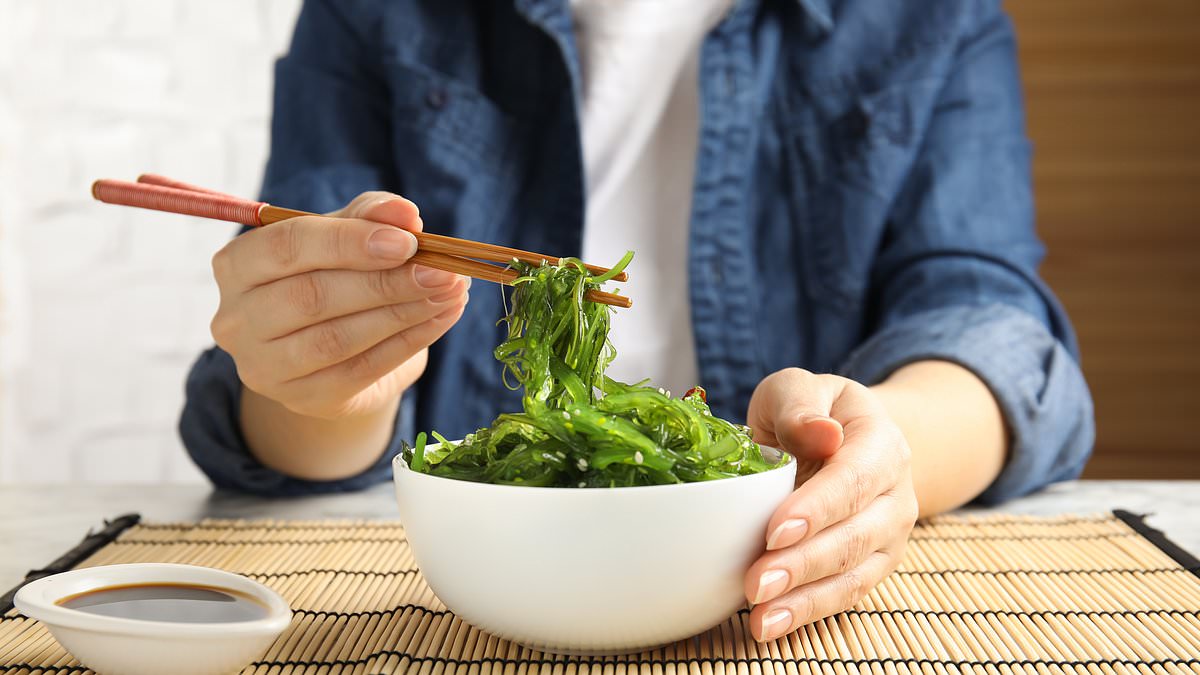
Seaweed salad is a Japanese staple
Research by the British Thyroid Association, found that 70 per cent of young women in the UK are iodine deficient, which can cause thyroid dysfunction, leading to weight gain, dry skin, hair loss, tiredness and depression, as well as an intolerance to cold temperatures.
Iodine is a mineral that plays a key role in thyroid health and is required for the production of thyroid hormones.
Ms Soutter adds: ‘These hormones are fundamental for keeping cells healthy and help regulate our metabolic rate, which determines how quickly chemical processes occur in the body, such as converting the food we eat into energy.
‘Having adequate iodine levels is especially important during pregnancy, as even mild deficiency can impair a baby’s brain development, cognition and future school performance.’
But, she warns, ‘Seaweed is generally safe to eat in moderation, but the British Dietetic Association recommends limiting brown seaweed, such as kelp, to no more than once a week, especially during pregnancy.
Who shouldn’t eat seaweed?
Due to the iodine content in most seaweeds, medical and dietary guidance should be taken if you’re taking medication.
‘Anyone with thyroid issues needs to tread carefully and see how their body responds when introducing seaweed into their diet, due to its rich iodine content,’ says Ms Soutter.
‘If you have hyperthyroidism, you need to be very careful that the iodine in seaweeds doesn’t exacerbate the condition.
‘For people who are taking a synthetic thyroid medication like Synthroid (levothyroxine sodium), seaweed, especially kelp, can affect the potency of their medication.’
Ms Soutter adds that people with an underactive thyroid (hypothyroidism) who are not currently medicated can benefit from adding iodine-rich seaweed or supplements to their diets, but should speak to their GP first.
‘I would suggest starting with a seaweed lower in iodine, such as nori or dulse, which has significantly less iodine than kelps and other brown seaweeds, and work with your physician to closely monitor your thyroid levels,’ she adds.
How much seaweed should I eat?
Portions can be very small, because seaweed is so nutrient dense and typically comes in dried form, which concentrates it further.
In fact, only about 3 to 5 grams per day can provide the nutritional and health benefits.
‘Obtaining the health benefits from seaweeds is about consistency,’ Ms Swiminer says.
‘Eating a little most days is more effective than eating a large amount once in a while.
Is it a good idea to supplement seaweed?
There’s a huge array of seaweed-based supplements on the market, but it’s imperative to exercise caution.
Some experts say mild iodine deficiency in adults may lead to sluggishness, depression and weight problems.
Iodine is found in the soil and the sea, which is why dairy products, fish and seaweed are the biggest dietary sources.
Iodine is essential for thyroid health, but excessive consumption – which the NHS classes as over 500-600 micrograms a day – can actually lead to thyroid problems.
Paradoxically, too much iodine causes some of the same symptoms as iodine deficiency, including the formation of a lump in the neck, known as a goitre.

Seaweed is a staple in cuisines all across the world
The NHS advises avoiding kelp-based supplements because a single serving can contain more than 2,000 micrograms of iodine, which significantly exceeds the safe upper limit of 150 micrograms.
What foods pair well with seaweed for maximum nutrition or absorption?
Taking note of cultures where seaweed is more of a staple gives us a much better idea about complementary foods. In Japan, for example, seaweed makes up about 30 per cent of their traditional diet.
‘Many Japanese dishes are wonderful for maximising the benefits of seaweed and minimising unwanted effects,’ Ms Swiminer says.
‘For example, dashi, a staple in Japanese cooking, is made by boiling a seaweed called kombu.
Kombu is the highest seaweed in iodine content, containing significantly higher amounts than other seaweeds. Boiling reduces the iodine content in kombu.
‘Miso soup is another great example. The probiotics in miso, a fermented product, aid in digestion, so you can absorb more of the abundance of nutrients seaweed contains.’
Do we need to be wary of microplastics from the ocean affecting edible seaweed?
Sadly, microplastics affect every part of the oceanic food chain, including seaweeds.
Although, Ms Swiminer says, there is not nearly as much scientific investigation into this as there is with regards to things like edible fish, there are some studies and fortunately some ways to minimise the risk.
‘Current studies show that microplastics cling to the outside of seaweed and that washing seaweed can be very effective in removing microplastics. Studies also indicate that proximity to contaminated areas affects the microplastic load of seaweeds.
‘They found that seaweeds growing close to contaminated areas had significantly increased microplastic loads compared to seaweeds growing far from contaminated areas (which sometimes had no microplastic contamination).
‘Studies also showed that seaweeds growing in wave exposed areas had significantly less microplastic contamination than seaweeds growing in more stagnant waters.’